Chhattisgarh CMO: First Iron-Ore Freight Train Leaves Raoghat
Synopsis
The Chhattisgarh CMO announced that the Dallirajhara-Raoghat-Jagdalpur Rail Project has reached a landmark moment as a freight train carried iron ore from Raoghat for the first time, promising stronger rail connectivity and accelerated economic development for the mineral-rich Bastar region.
Key Takeaways
The Chief Minister's Office of Chhattisgarh confirmed the first-ever departure of an iron-ore freight train from Raoghat on 22 June 2026 .
The milestone marks progress on the Dallirajhara-Raoghat-Jagdalpur Rail Project , sanctioned by the Ministry of Railways in the early 2010s.
The corridor is designed to supply iron ore from Bastar's mines to the Bhilai Steel Plant in Durg district , a major SAIL facility.
Improved rail connectivity is expected to lower logistics costs and boost economic development in the tribal-majority Bastar division.
The CMO attributed progress to the 'double-engine government' framework of aligned state and central administrations.
Full commissioning of the Dallirajhara-to-Jagdalpur corridor and possible passenger services remain future milestones to watch.
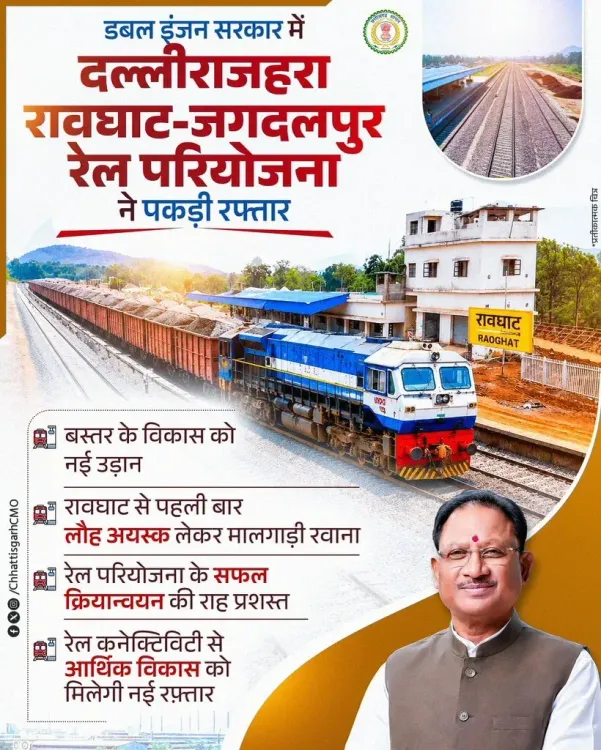
The Chief Minister's Office of Chhattisgarh announced on Monday, 22 June 2026 that the long-pending Dallirajhara-Raoghat-Jagdalpur Rail Project has gained significant momentum, with a freight train carrying iron ore departing from Raoghat for the first time — marking a milestone in the mineral evacuation corridor linking Bastar to the Bhilai Steel Plant.
The CMO posted in Hindi: 'रावघाट से पहली बार लौह अयस्क लेकर मालगाड़ी रवाना होने से रेल परियोजना के सफल क्रियान्वयन की राह प्रशस्त हुई है' — ('The departure of a freight train carrying iron ore from Raoghat for the first time has paved the way for the successful implementation of the rail project'). The post attributed the development to the 'double-engine government', a term used by the ruling alliance to describe aligned state and central administrations working in tandem.
Context
The Raoghat area in Narayanpur district, located in the mineral-rich Bastar division of southern Chhattisgarh, holds substantial iron-ore deposits that have long been difficult to evacuate due to the absence of reliable rail connectivity. The Dallirajhara-Raoghat-Jagdalpur Rail Project was conceived to bridge this gap, creating a dedicated freight corridor from the mines to steel-making facilities. The first departure of a loaded ore rake from Raoghat signals that at least the initial segment of this corridor has become operational.
Policy Backdrop
The Ministry of Railways sanctioned the Raoghat rail corridor in the early 2010s as part of a broader push to develop resource corridors in central India. The project was designed primarily to ensure a steady supply of iron ore to the Bhilai Steel Plant in Durg district, one of India's major steel-making facilities under Steel Authority of India Limited (SAIL). Progress on the project was historically slow, hampered by difficult terrain, forest clearances, and security concerns in a region that was previously marked by left-wing extremist activity.
Security improvements in former Naxal-affected zones across southern Chhattisgarh have in recent years enabled faster execution of infrastructure projects. State and central governments have increasingly prioritised such rail links to lower logistics costs and connect remote tribal districts with industrial centres — a pattern visible across the mineral belt of central India.
Stakeholders and Impact
The commissioning of freight services from Raoghat is expected to benefit multiple stakeholders. Iron-ore miners and operators in Bastar will gain a cost-effective and reliable mode of transport, reducing dependence on road haulage over difficult terrain. The Bhilai Steel Plant, which requires a steady ore supply, stands to gain improved input logistics. For the tribal-majority communities of Bastar, improved rail infrastructure carries the potential for broader economic integration — the CMO post explicitly stated that 'रेल कनेक्टिविटी मजबूत होने से बस्तर के आर्थिक विकास को नई रफ़्तार मिलेगी' ('strengthening of rail connectivity will give new momentum to the economic development of Bastar').
The project also aligns with the #ViksitChhattisgarh vision promoted by the state government, which frames infrastructure investment as a driver of inclusive development in historically underserved regions.
What's Next
The commencement of freight operations from Raoghat is a first step; the full corridor spanning Dallirajhara to Jagdalpur will require further construction and commissioning. Analysts will watch for the regularisation of freight rake schedules, any announcements regarding passenger train services on the route, and state budget allocations for last-mile road linkages to newly connected rail heads. The pace of forest and environmental clearances for the remaining sections will also determine how quickly the full project delivers on its economic promise for Bastar.
Point of View
The Chhattisgarh CMO is explicitly linking infrastructure delivery to electoral co-ordination between the state and the Centre, a narrative the ruling alliance has consistently deployed ahead of key political cycles. The Raoghat corridor also fits into a broader national pattern of using resource-sector rail investment to assert state presence in formerly Naxal-affected geographies, where development and security are treated as mutually reinforcing. Whether regular freight operations and eventual passenger services follow will determine if this milestone translates into durable economic change for Bastar's communities.
NationPress
22 Jun 2026
Frequently Asked Questions
What is the Dallirajhara-Raoghat-Jagdalpur Rail Project?
The Dallirajhara-Raoghat-Jagdalpur Rail Project is a dedicated railway corridor sanctioned by the Ministry of Railways in the early 2010s to transport iron ore from the Raoghat mining area in Narayanpur district, Bastar, to the Bhilai Steel Plant in Durg district, Chhattisgarh.
What happened at Raoghat on 22 June 2026?
A freight train carrying iron ore departed from Raoghat for the first time on 22 June 2026, marking a key operational milestone in the Dallirajhara-Raoghat-Jagdalpur Rail Project, as announced by the Chhattisgarh Chief Minister's Office.
How will the Raoghat rail project benefit Bastar?
The Raoghat rail project will lower logistics costs for iron-ore transport, reduce dependence on road haulage through difficult terrain, ensure a steady ore supply to the Bhilai Steel Plant, and is expected to accelerate broader economic development in the tribal-majority Bastar division.
What is the 'double-engine government' in the context of Chhattisgarh?
'Double-engine government' refers to the ruling alliance's description of aligned state and central governments working together to deliver infrastructure and development projects, a phrase used by the Chhattisgarh CMO in announcing the Raoghat milestone.
Will passenger trains run on the Raoghat rail corridor?
As of the 22 June 2026 announcement, only freight services have commenced from Raoghat. Introduction of passenger trains on the Dallirajhara-Raoghat-Jagdalpur corridor remains a future possibility to be watched as the project progresses toward full commissioning.