CM Office Chhattisgarh Issues Weather Alert for 7 Southern Districts
Synopsis
The Chief Minister's Office of Chhattisgarh warned residents of Bastar, Dantewada, Dhamtari, Gariaband, Kanker, Kondagaon, and Sukma of lightning, strong storms, and heavy rainfall expected within three hours on 10 June 2026, advising people to stay indoors and avoid travel.
Key Takeaways
The Chief Minister's Office of Chhattisgarh issued the alert at 3:12 PM IST on 10 June 2026 .
Seven districts were named: Bastar, Dantewada, Dhamtari, Gariaband, Kanker, Kondagaon, and Sukma .
The alert warned of lightning strikes, strong dust storms, and heavy rainfall within a three-hour window.
Citizens were advised to stay indoors, avoid unnecessary travel, and move to safe locations.
The advisory reflects Chhattisgarh's established practice of using official social-media handles for real-time disaster-risk communication .
Southern Chhattisgarh districts, including those in the Bastar division , are among the most weather-vulnerable zones in central India during the monsoon season.
The Chief Minister's Office of Chhattisgarh issued an urgent weather alert on Wednesday, 10 June 2026, warning residents of seven southern districts to brace for lightning strikes, strong dust storms, and heavy rainfall within the next three hours. The advisory named Bastar, Dantewada, Dhamtari, Gariaband, Kanker, Kondagaon, and Sukma as the areas at risk, urging citizens to stay indoors and avoid unnecessary travel.
Context
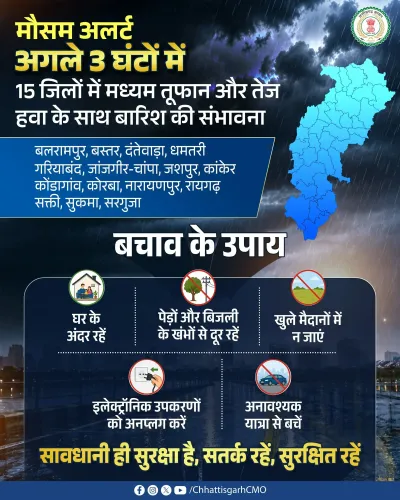
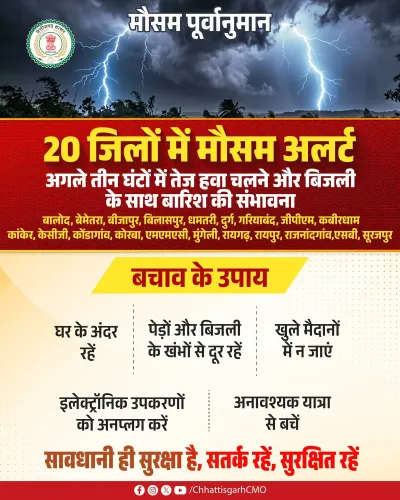
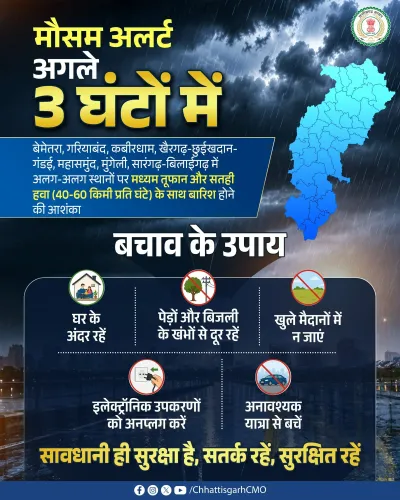
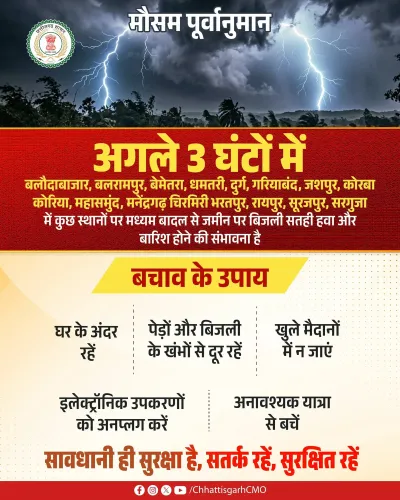
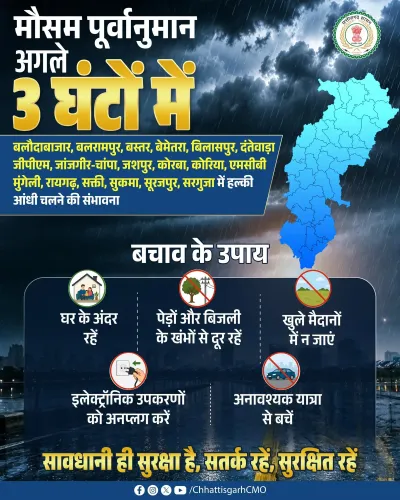
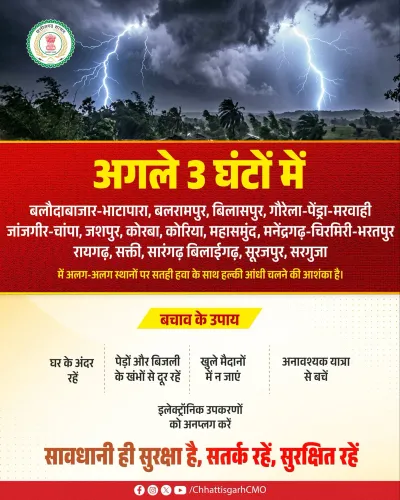
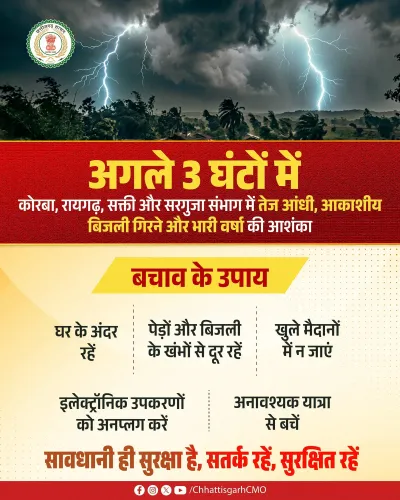
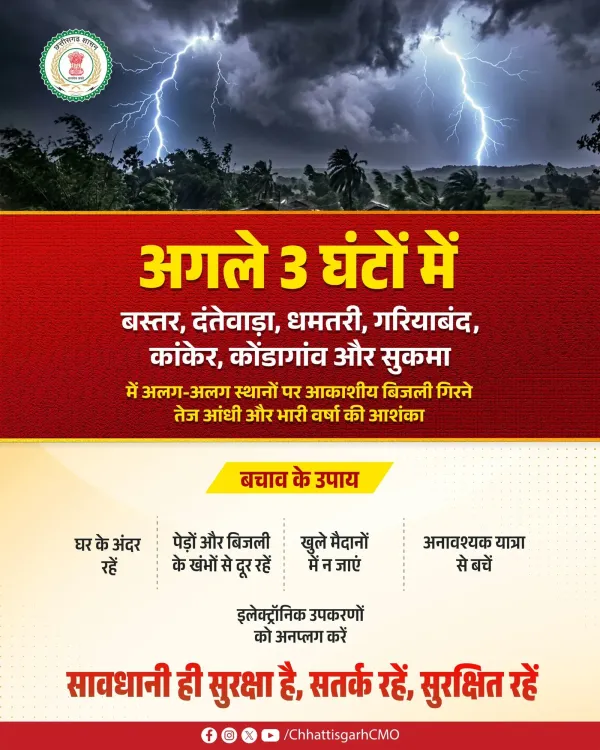
The post, written in Hindi, stated: 'Agle 3 ghanton mein Bastar, Dantewada, Dhamtari, Gariaband, Kanker, Kondagaon aur Sukma ke kuch ilakon mein aakashiya bijli girne, tez aandhi aur bhaari varsha ki aashanka hai' — ('In the next 3 hours, there is a likelihood of lightning, strong storms, and heavy rainfall in some areas of Bastar, Dantewada, Dhamtari, Gariaband, Kanker, Kondagaon, and Sukma.'). The alert closed with the advisory: 'Savdhani hi suraksha hai. Satark rahein, surakshit rahein' — ('Caution is safety. Stay alert, stay safe.').
The alert was accompanied by a weather-warning graphic and posted at 3:12 PM IST, giving residents daylight hours to act on the guidance before the predicted weather window.
Policy Backdrop
Chhattisgarh's southern districts, particularly those in the Bastar division, are among the most meteorologically vulnerable zones in central India. The region receives intense pre-monsoon and monsoon rainfall accompanied by lightning — a pattern documented annually by national meteorological agencies. The Disaster Management Act, 2005 formalised early-warning dissemination as a core state responsibility, and successive Chhattisgarh governments have used official digital channels to relay short-duration severe-weather alerts as part of routine disaster-risk-reduction communication.
Districts such as Dantewada and Sukma, which have historically faced compounded vulnerabilities including difficult terrain and dispersed tribal settlements, are particularly dependent on timely government advisories to reach populations that may not have access to broadcast media.
Stakeholders and Impact
The primary audience for this alert is the resident population — including significant tribal communities — spread across the seven named districts. Agricultural workers, daily-wage labourers, and those travelling on rural roads are among those most exposed to lightning and storm risks during this period. Gariaband and Dhamtari, which lie to the north-east of the Bastar cluster, are also included, suggesting the weather system is forecast to affect a broad geographical corridor.
District disaster-management control rooms in the affected areas are expected to remain on standby, coordinating with local administration to respond to any incidents arising from the predicted severe weather.
What's Next
Residents and local authorities will be watching for updated bulletins from the India Meteorological Department as the weather system develops. If conditions escalate, district administrations may activate emergency helplines or deploy response teams. The CMO's advisory is part of a broader pattern of real-time digital early-warning communication that Indian state governments have increasingly adopted to reduce weather-related casualties during the monsoon season.
Point of View
Where official handles now function as first-responder broadcast channels during severe weather. The inclusion of relatively smaller districts like Gariaband and Dhamtari alongside the better-known Bastar division suggests the administration is casting a wide net, prioritising over-communication over under-warning. For a state with large tribal and rural populations with limited media access, this kind of digital early-warning push is both a governance signal and a practical safety measure. The pattern also points to growing institutional reliance on platforms like X for time-sensitive public-safety messaging — a shift with implications for digital equity and information reach.
NationPress
24 Oct 2026
Frequently Asked Questions
Which districts are under weather alert in Chhattisgarh today?
The Chief Minister's Office of Chhattisgarh named Bastar, Dantewada, Dhamtari, Gariaband, Kanker, Kondagaon, and Sukma in its weather alert issued on 10 June 2026 .
What kind of weather is expected in Bastar division?
The alert warned of lightning strikes, strong dust storms, and heavy rainfall expected within three hours of the advisory being issued at 3:12 PM IST.
What should residents do during the Chhattisgarh weather alert?
The CMO advised residents to stay indoors, avoid unnecessary travel, and move to a safe location during the severe-weather window.
Why does southern Chhattisgarh frequently face severe weather alerts?
Southern Chhattisgarh, particularly the Bastar division , receives intense pre-monsoon and monsoon rainfall accompanied by lightning annually, making it one of the most weather-vulnerable regions in central India.
How does the Chhattisgarh government communicate weather warnings?
Successive Chhattisgarh governments have used official social-media handles , including the CMO's account on X, to issue short-duration severe-weather advisories as part of disaster-risk-reduction communication under the framework of the Disaster Management Act, 2005 .