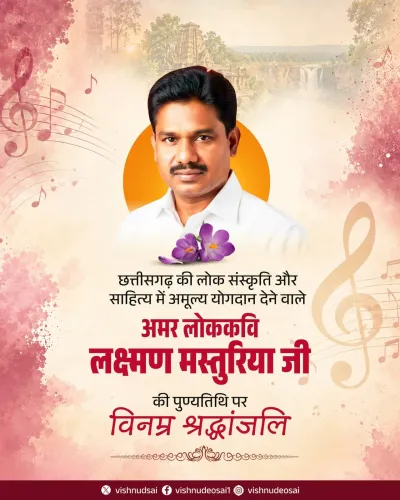
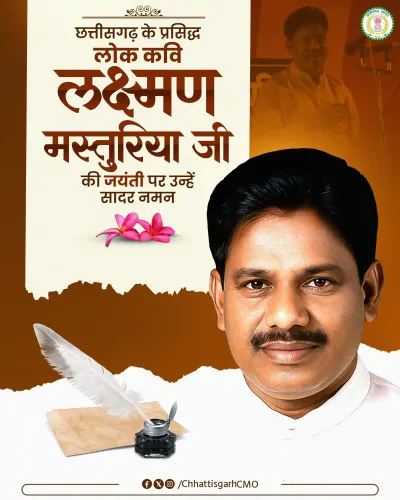
Chhattisgarh CMO pays tribute to folk poet Laxman Masturiya
Synopsis
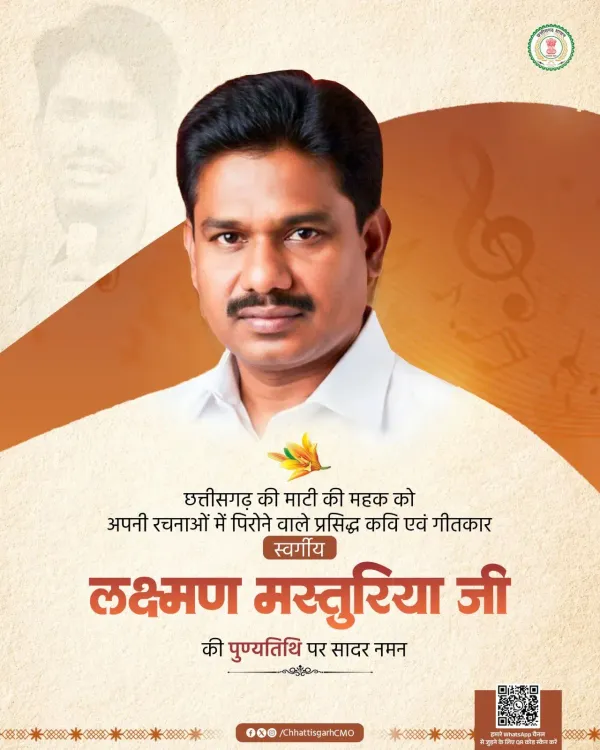
The Chief Minister's Office of Chhattisgarh honoured renowned folk poet and lyricist Laxman Masturiya on his death anniversary, paying tribute to a voice that celebrated Chhattisgarhi dialect, traditions, and regional identity through verse.
Key Takeaways
The Chief Minister's Office of Chhattisgarh posted a formal tribute to Laxman Masturiya on his death anniversary on November 3, 2026 .
Masturiya is recognised as a jankavi (people's poet) and lyricist who composed in the Chhattisgarhi dialect , celebrating local folk traditions.
The tribute was offered in Hindi with the phrase 'sadar naman' — a respectful salutation to the departed.
Chhattisgarh, formed in 2000 , actively invests in regional cultural identity through official recognition of folk artists and poets.
Such state-level tributes often precede institutional actions like literary festivals, awards, or archival projects linked to the honoured artist's name.
A voice that sang the soil of Chhattisgarh into the hearts of millions fell silent years ago — but on his death anniversary, the state's highest office paused to remember him. The Chief Minister's Office of Chhattisgarh on Tuesday, November 3, 2026, paid solemn tribute to Laxman Masturiya, the celebrated folk poet and lyricist widely regarded as one of the most resonant voices in the Chhattisgarhi literary tradition.
The post, shared in Hindi, offered a respectful bow — 'सादर नमन' (a respectful salutation) — to Masturiya on his punyatithi, the anniversary of his passing. The gesture, brief but deliberate, signals the state government's ongoing intent to keep regional cultural memory alive through official channels.
The poet who gave Chhattisgarh its song
Laxman Masturiya earned the title of jankavi — people's poet — through a body of work composed in the Chhattisgarhi dialect, a language that carries the rhythms of the region's forests, rivers, and tribal communities. His lyrics drew from everyday life in the Chhattisgarh heartland, weaving local traditions, seasonal cycles, and folk sensibility into verse that ordinary people could sing, not just scholars could study. In a state where oral tradition runs deep, that distinction matters enormously.
Why official tributes to folk artists carry policy weight
State governments across India have long used death anniversaries of regional cultural figures as soft-power moments — a low-cost, high-resonance way to signal commitment to sub-national identity and linguistic heritage. For Chhattisgarh, a state carved out of Madhya Pradesh only in 2000, the project of building a distinct cultural identity remains active and politically meaningful. Honouring figures like Masturiya feeds directly into that effort, positioning folk art not as nostalgia but as living heritage worth protecting.
The broader pattern aligns with Central and state-level schemes aimed at documenting intangible cultural heritage — folk music, oral literature, and regional dialects that fall outside mainstream archival systems. A Chhattisgarhi folk lyricist's body of work represents precisely the kind of material such efforts seek to preserve.
What the Chhattisgarhi literary community watches next
Tributes like this one often serve as preludes — a signal that literary festivals, state awards, or archival projects bearing a poet's name may follow. The folk artist and literary communities of Chhattisgarh will be watching whether today's social-media salutation translates into institutional action: a foundation, a chair, a festival, or a government-backed recording of Masturiya's work in a permanent archive.
A single post is a beginning. Whether it becomes a legacy programme is the real question the Chhattisgarh government must now answer.
Point of View
Anchoring its distinctiveness in celebrated regional voices like Masturiya is a low-cost, high-return investment in sub-national pride. Chief Ministers and their offices across India have increasingly used social media to perform cultural stewardship, but the test is always whether an online salutation leads to durable institutional support for folk arts. If Chhattisgarh is serious about preserving its oral literary heritage, a post is a starting gun, not a finish line.
NationPress
3 Nov 2026
Frequently Asked Questions
Who was Laxman Masturiya?
Laxman Masturiya was a celebrated Chhattisgarhi folk poet and lyricist, widely called a jankavi or people's poet, known for composing verse in the Chhattisgarhi dialect that captured the region's local traditions, folk sensibility, and everyday rural life.
Why did the Chhattisgarh CMO pay tribute to Laxman Masturiya?
November 3, 2026 marks Laxman Masturiya's death anniversary, and the Chief Minister's Office of Chhattisgarh posted a formal tribute on X to honour his legacy as a defining voice of Chhattisgarhi folk literature.
What language did Laxman Masturiya write in?
Laxman Masturiya primarily composed in the Chhattisgarhi dialect , a regional language spoken across Chhattisgarh that reflects the state's tribal and vernacular cultural heritage.
What does 'jankavi' mean?
'Jankavi' is a Hindi term meaning 'people's poet' — a title given to poets whose work resonates deeply with ordinary people rather than being confined to elite or academic literary circles. Laxman Masturiya is widely remembered by this title.
How does Chhattisgarh support its folk arts and regional literary tradition?
Chhattisgarh, formed in 2000 , actively promotes its sub-national cultural identity through official tributes to regional artists, literary festivals, and state-level awards. Such gestures align with broader Indian policy efforts to preserve intangible cultural heritage at the sub-national level.