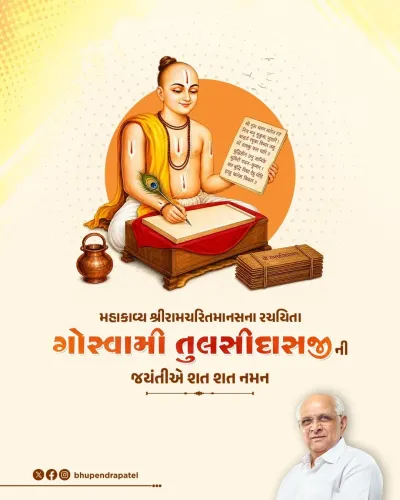
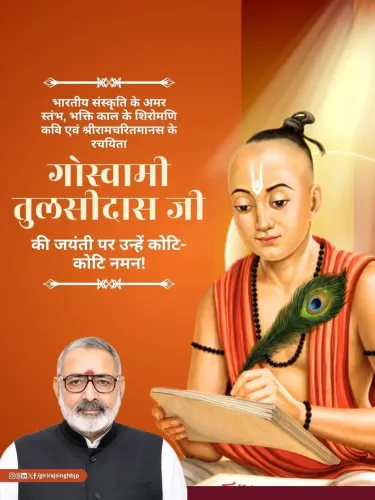
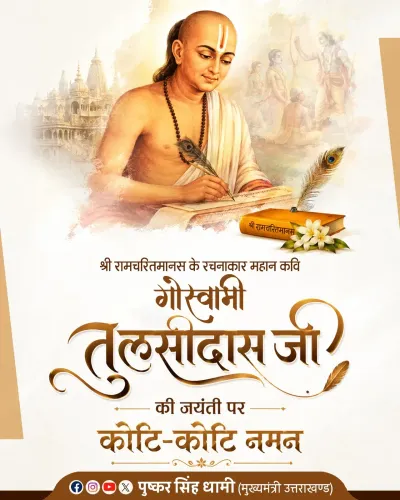
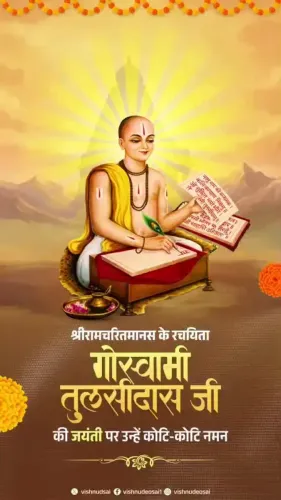
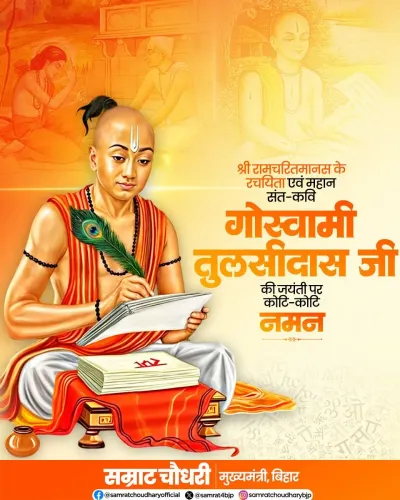
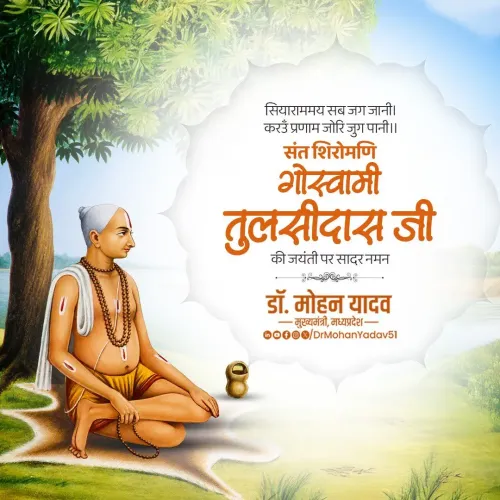
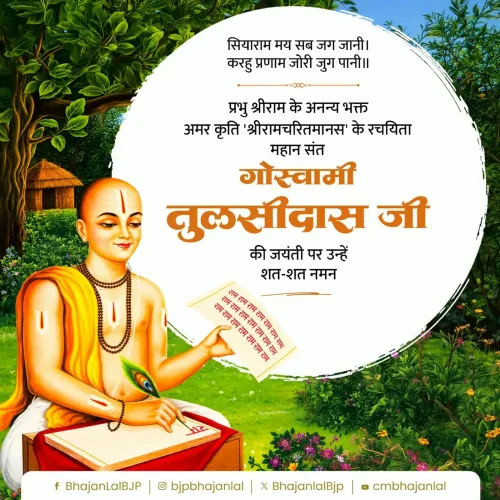
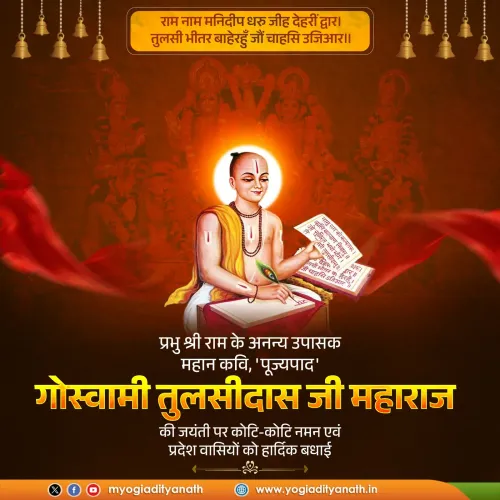
Chhattisgarh CMO pays tribute to Goswami Tulsidas on Jayanti
Synopsis
The Chief Minister's Office of Chhattisgarh paid respectful tribute to Goswami Tulsidas on his birth anniversary on 19 August 2026, honouring the 16th-century saint-poet who composed the Ramcharitmanas in Awadhi and reshaped North Indian devotional practice.
Key Takeaways
The Chief Minister's Office of Chhattisgarh posted a formal tribute to Goswami Tulsidas on his Jayanti on 19 August 2026 .
Goswami Tulsidas was a 16th-century saint-poet who composed the Ramcharitmanas , an Awadhi retelling of the Ramayana.
The Ramcharitmanas is composed in Awadhi , making the sacred Ramayana narrative accessible to common people beyond Sanskrit scholarship.
Indian state governments routinely issue official tributes to bhakti poets on their birth anniversaries to signal cultural continuity.
Chhattisgarh's tribute reflects the deep resonance of Tulsidas's Awadhi verse in Hindi-speaking communities across the region.
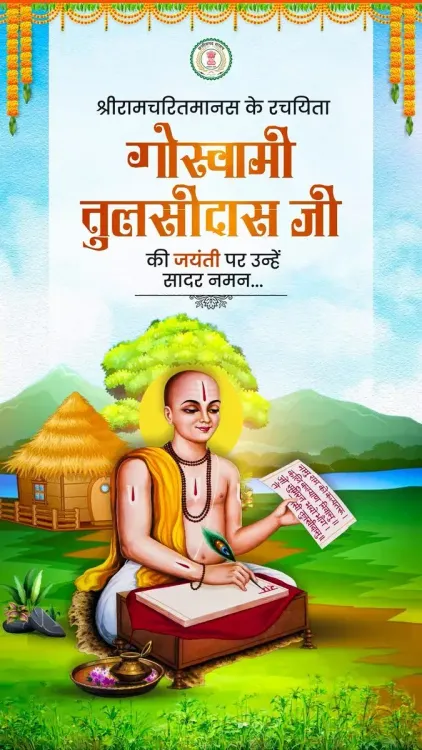
The Chief Minister's Office of Chhattisgarh offered respectful homage to Goswami Tulsidas on his birth anniversary on Wednesday, 19 August 2026, honouring the 16th-century saint-poet whose devotional masterpiece continues to shape the spiritual life of millions across India.
Posting in Hindi, the CMO wrote: 'श्रीरामचरितमानस के रचयिता गोस्वामी तुलसीदास जी की जयंती पर उन्हें सादर नमन' — 'Respectful salutations to Goswami Tulsidas, composer of the Shri Ramcharitmanas, on his birth anniversary.'
The poet who rewrote the Ramayana in the language of the people
Goswami Tulsidas composed the Ramcharitmanas in Awadhi, a dialect of Hindi, in the 16th century — a radical act of democratisation at a time when Sanskrit held a near-monopoly on sacred literature. By rendering the story of Lord Ram in a tongue that ordinary people could read, sing, and memorise, Tulsidas transformed devotional practice across North India. The Ramcharitmanas remains one of the most widely recited texts in the Hindi-speaking world to this day.Why state governments mark Tulsidas Jayanti
Official tributes to medieval bhakti poets have become a fixture of Indian state governance — a way of signalling cultural continuity and regional pride without legislative action. For Chhattisgarh, a state carved from the Hindi heartland, honouring Tulsidas carries particular resonance: his Awadhi verse is woven into the devotional fabric of communities across the region. The gesture is routine in form, but the figure being honoured is anything but ordinary.Point of View
Functioning as low-cost, high-resonance cultural signalling. For the Chhattisgarh CMO, invoking Tulsidas on Jayanti aligns the administration with a broadly venerated figure who transcends caste and community lines in the Hindi belt. The gesture fits a wider pattern in which state governments use saint-poet anniversaries to project cultural stewardship ahead of electoral cycles. It carries no policy content, but in the grammar of Indian political communication, the choice of whom to honour — and when — is rarely accidental.
NationPress
3 Oct 2026
Frequently Asked Questions
Who was Goswami Tulsidas?
Goswami Tulsidas was a 16th-century Indian saint-poet best known for composing the Ramcharitmanas, an Awadhi-language retelling of the Ramayana that remains central to North Indian Hindu devotional practice.
What is the Ramcharitmanas?
The Ramcharitmanas is a devotional epic composed by Goswami Tulsidas in the Awadhi dialect of Hindi. It retells the story of Lord Ram and is one of the most widely recited texts in the Hindi-speaking world.
Why is Tulsidas Jayanti celebrated?
Tulsidas Jayanti marks the birth anniversary of Goswami Tulsidas and is observed by devotees, cultural organisations, and state governments across India, particularly in Hindi-speaking states, through prayers, recitations, and official tributes.
Why did the Chhattisgarh CMO post about Tulsidas Jayanti?
The Chief Minister's Office of Chhattisgarh posted a tribute on 19 August 2026 as part of the broader practice of Indian state governments officially honouring medieval bhakti poets on their birth anniversaries to signal cultural continuity and regional pride.
In which language did Tulsidas write the Ramcharitmanas?
Tulsidas composed the Ramcharitmanas in Awadhi, a dialect of Hindi, making the sacred narrative of the Ramayana accessible to ordinary people who could not read Sanskrit.