Chhattisgarh CMO: Women Build Gabions in Raigarh Under VB-G Ram Ji Yojana
Synopsis
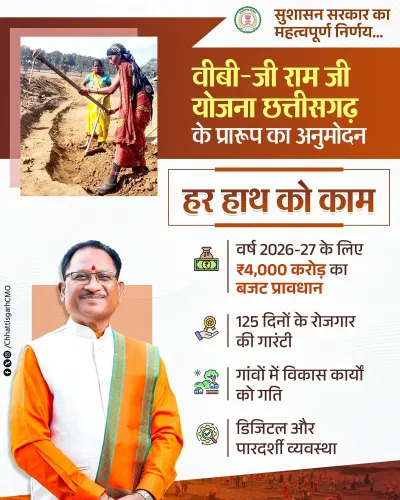
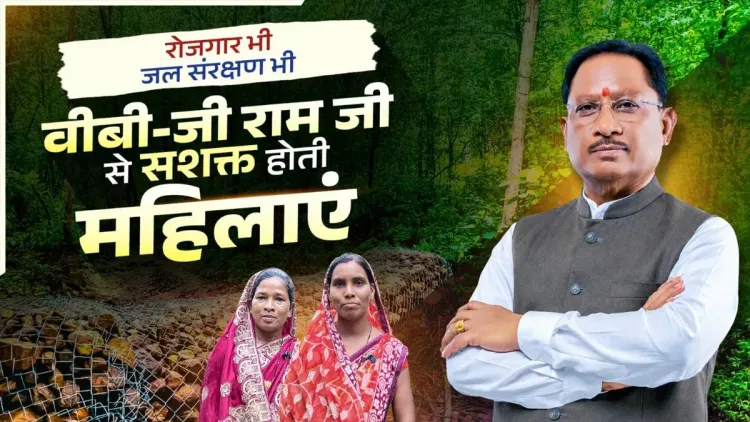
Women in Nawapali village, Pusaur block, Raigarh are constructing gabion structures under the VB-G Ram Ji Yojana, a Chhattisgarh state scheme that pairs rural employment with water conservation to reduce soil erosion and boost groundwater levels.
Key Takeaways
Rural women in Nawapali, Pusaur block, Raigarh district are building gabion structures under the VB-G Ram Ji Yojana .
Gabions are wire-mesh stone barriers designed to slow runoff, trap sediment, and recharge groundwater.
The scheme simultaneously generates rural employment and delivers water-conservation infrastructure.
Expected outcomes include rainwater retention, reduced soil erosion, and higher groundwater levels.
The initiative aligns with CM Vishnu Deo Sai's broader rural development agenda since December 2023 .
Raigarh district in eastern Chhattisgarh is a priority zone for decentralised water harvesting works.
In the village of Nawapali in Pusaur block, Raigarh district, rural women are not waiting for rain to solve their water problems — they are building the infrastructure to capture it. The Chief Minister's Office of Chhattisgarh on Thursday, August 13, 2026, highlighted how women under the VB-G Ram Ji Yojana (VB-GRAM Ji Yojana) are constructing gabion structures — wire-mesh stone barriers that slow runoff, trap sediment, and push water back into the ground.
What a gabion does — and why Nawapali needs it
A gabion is deceptively simple: a wire cage packed with local stone, placed across a drainage channel. When monsoon water hits it, the flow slows, silt drops, and water seeps into the soil rather than racing downhill and carrying topsoil with it. In rain-fed districts like Raigarh, where agriculture depends on groundwater and seasonal streams, that difference between runoff and recharge can decide whether a well holds water through April or runs dry in February.
The CMO's post spelled out the three-part promise of these structures: rainwater conservation, reduced soil erosion, and a rise in groundwater levels — three problems that have historically compounded each other across eastern Chhattisgarh's undulating terrain.
Employment woven into conservation
The programme's design is deliberate: the workers building these structures are the same women whose families depend on the land they are protecting. Chief Minister Vishnu Deo Sai, who has anchored his administration's rural agenda around convergence — linking livelihood generation with environmental outcomes — has made schemes like this a recurring feature of the state's development pitch since taking office in December 2023.
Chhattisgarh has a pattern of bundling small-scale water harvesting — check dams, farm ponds, gabions — with rural employment guarantees, so that conservation work generates income for the households most exposed to climate variability. Nawapali's gabion sites are one node in that larger network.
Raigarh's place in the state's water map
Raigarh district, in eastern Chhattisgarh, sits in a zone where monsoon intensity can be high but groundwater retention poor without intervention. Pusaur block's villages have been identified for exactly this kind of decentralised water infrastructure. Whether the recharge gains in Nawapali are tracked and scaled to neighbouring villages is the next question worth watching.
For now, the women of Nawapali are doing the work — stone by stone, cage by cage — turning a monsoon liability into a year-round asset.
Point of View
So conservation work also functions as a social safety net. For CM Sai's BJP government, publicising women-led field work serves a dual political purpose — demonstrating on-the-ground delivery in tribal and agrarian belts while reinforcing a women's empowerment narrative ahead of future electoral cycles. The broader policy question is whether these decentralised, village-level structures are being systematically monitored for groundwater impact, or whether they remain largely symbolic in scale. If Chhattisgarh can demonstrate measurable recharge data from Pusaur block, it could become a replicable model for other rain-fed districts across central India.
NationPress
13 Aug 2026
Frequently Asked Questions
What is the VB-G Ram Ji Yojana in Chhattisgarh?
The VB-G Ram Ji Yojana (also written VB-GRAM Ji Yojana) is a Chhattisgarh state scheme that engages rural communities, particularly women, in constructing small-scale water conservation structures such as gabions, linking livelihood generation with environmental outcomes. Exact funding details and launch date are not publicly verified.
What is a gabion structure and how does it help conserve water?
A gabion is a wire-mesh cage filled with stones, placed across drainage channels or slopes. It slows water runoff, reduces soil erosion, and allows rainwater to percolate into the ground, thereby recharging groundwater levels.
Where is Nawapali village located in Chhattisgarh?
Nawapali is a village in Pusaur block, Raigarh district, in eastern Chhattisgarh.
How does the Chhattisgarh government link women's employment with water conservation?
Under schemes like the VB-G Ram Ji Yojana, rural women are employed directly in building water harvesting infrastructure such as gabions, ensuring that conservation work also generates income for households most vulnerable to climate and water stress.
Who is the Chief Minister of Chhattisgarh in 2026?
Vishnu Deo Sai of the BJP has served as Chief Minister of Chhattisgarh since December 2023.