CM Sai Makes Chhattisgarh First State With Ease of Doing Business Act
Synopsis
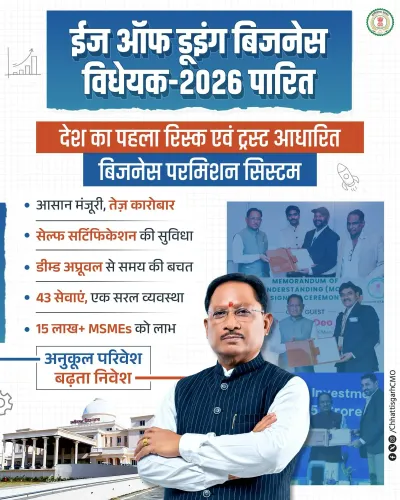
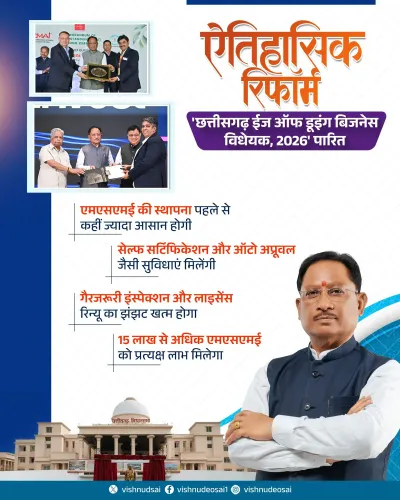
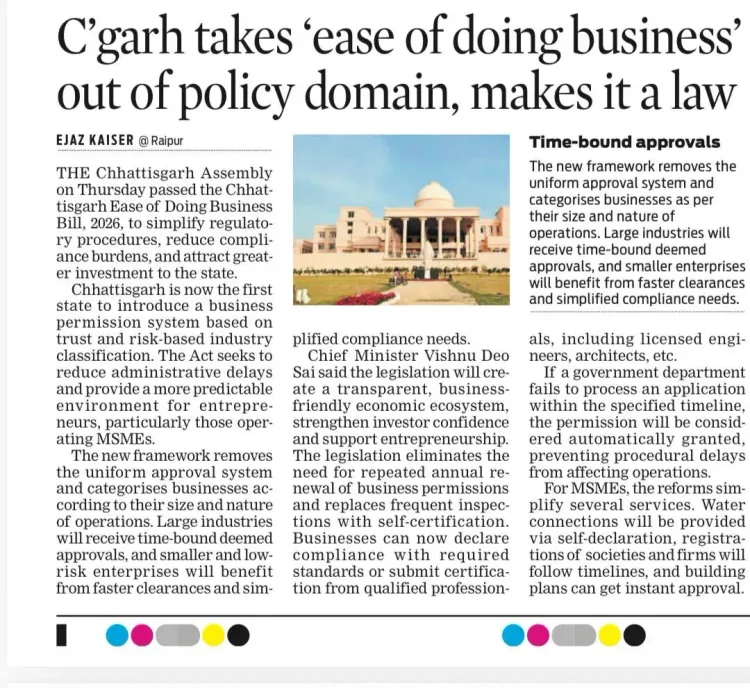
Chhattisgarh has enacted the Ease of Doing Business Act, 2026, becoming the first Indian state to legislate a trust- and risk-based business permission system. The move, announced by the Chief Minister's Office on 17 July 2026, is aimed at attracting investment and reducing compliance burdens on MSMEs under CM Vishnu Deo Sai.
Key Takeaways
Chhattisgarh is declared the first state in India to enact a dedicated Ease of Doing Business Act .
The Chhattisgarh Ease of Doing Business Act, 2026 introduces a pioneering trust- and risk-based business permission system.
The legislation was enacted under the leadership of Chief Minister Vishnu Deo Sai , who took office after the December 2023 assembly elections.
MSMEs and investors are identified as the primary beneficiaries of the new regulatory framework.
The Act gives the reform framework the force of law, going beyond the executive-level single-window systems adopted by other states.
The development aligns with the central government's Business Reforms Action Plan (BRAP) and Make in India programme.
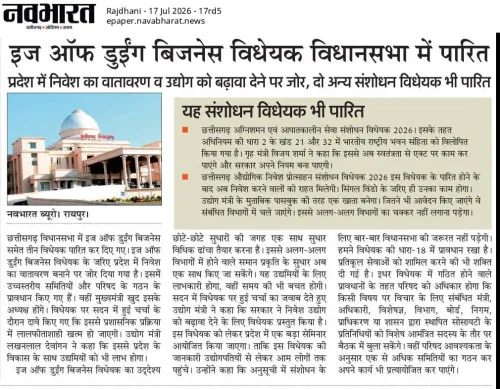
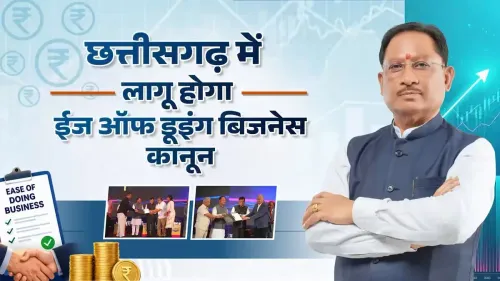
The Chief Minister's Office of Chhattisgarh announced on Friday, 17 July 2026 that the state has become the first in India to enact a dedicated Chhattisgarh Ease of Doing Business Act, 2026, introducing a trust- and risk-based business permission system under the leadership of Chief Minister Vishnu Deo Sai.
Context
The official account of the Chief Minister's Office of Chhattisgarh described the development as a move 'from vision to legislation, from reform to transformation.' The new law is positioned as a landmark shift in how the state grants permissions to businesses, replacing a discretion-heavy framework with one built on trust and risk calibration. The announcement was accompanied by hashtags including #ViksitChhattisgarh (Developed Chhattisgarh) and #InvestorFriendly, signalling the government's intent to attract investment and ease the compliance burden on entrepreneurs.
Policy Backdrop
India's regulatory simplification drive dates to 2014, when the central government launched the Make in India programme to overhaul the business environment. The following year, the Department for Promotion of Industry and Internal Trade (DPIIT) introduced the Business Reforms Action Plan (BRAP), an annual framework that ranks states on the quality and depth of their ease-of-doing-business reforms. Since then, states across the country have competed to streamline approvals, introduce single-window clearances, and digitise compliance processes.
Chhattisgarh, a mineral-rich central Indian state formed in 2000, has historically relied on its natural resource base to attract industry. The enactment of a standalone Ease of Doing Business law — if it stands as the first of its kind nationally — would represent a qualitative leap beyond administrative orders or executive-level single-window systems that other states have adopted. A dedicated statute gives the trust- and risk-based permission framework the force of law, making it harder for future administrations to roll back without legislative action.
Stakeholders and Impact
Micro, Small and Medium Enterprises (MSMEs) are among the primary beneficiaries identified by the government. MSMEs have long faced disproportionate compliance costs relative to their size, and a risk-based permission system — which in principle reserves stricter scrutiny for higher-risk activities while fast-tracking low-risk ones — could meaningfully reduce the time and cost of starting or expanding a business in the state. Larger investors eyeing Chhattisgarh's mineral and manufacturing sectors are also expected to find a more predictable regulatory environment.
Chief Minister Vishnu Deo Sai, who took office after the Bharatiya Janata Party won the December 2023 state assembly elections, has made economic governance a central plank of his administration. The Act is likely to be cited prominently at investor summits and in DPIIT's next BRAP assessment cycle as evidence of Chhattisgarh's reform credentials.
What's Next
The immediate focus will shift to the rollout of the new permission system — how quickly departments operationalise the trust- and risk-based framework, and whether the digital infrastructure to support it is in place. Chhattisgarh's performance in subsequent BRAP rankings and its ability to demonstrate measurable improvements in business registration timelines, inspection regimes, and investor sentiment will be the real test of the legislation's impact. If the state can show tangible outcomes, the model could influence other states to move from administrative reform to statutory reform.
Point of View
The Sai government is betting that legislative permanence will be a stronger signal to investors than administrative circulars. The move fits neatly into the BJP's national narrative of governance-as-reform, and positions Chhattisgarh to score well in DPIIT's BRAP rankings ahead of what could be a pre-election showcase cycle. The real test, however, will be implementation: India has a long history of progressive business legislation that stalls at the departmental level.
NationPress
15 Oct 2026
Frequently Asked Questions
What is the Chhattisgarh Ease of Doing Business Act 2026?
The Chhattisgarh Ease of Doing Business Act, 2026 is a state law that introduces a trust- and risk-based business permission system, making Chhattisgarh the first state in India to legislate such a framework.
Who enacted the Chhattisgarh Ease of Doing Business Act?
The Act was enacted under the leadership of Chief Minister Vishnu Deo Sai, whose government announced the legislation on 17 July 2026.
What is a trust- and risk-based business permission system?
A trust- and risk-based permission system calibrates regulatory scrutiny according to the risk level of a business activity — fast-tracking low-risk businesses while applying stricter checks to higher-risk ones, reducing the overall compliance burden.
How does this affect MSMEs in Chhattisgarh?
MSMEs in Chhattisgarh are among the primary beneficiaries, as the new framework is designed to reduce the time and cost of obtaining business permissions, easing the disproportionate compliance burden smaller enterprises typically face.
Is Chhattisgarh the first state in India to have an Ease of Doing Business law?
According to the announcement by the Chief Minister's Office of Chhattisgarh on 17 July 2026, Chhattisgarh is the first state in India to enact a dedicated Ease of Doing Business Act.