Chhattisgarh CMO: State First to Pass Ease of Doing Business Act
Synopsis
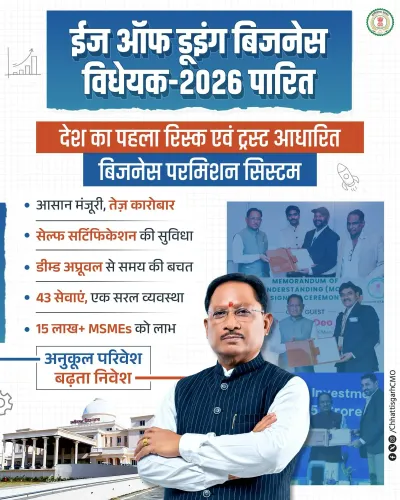
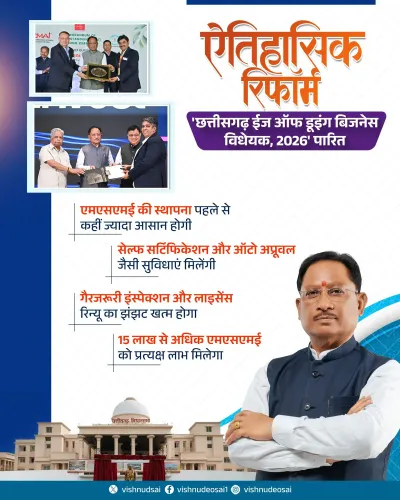
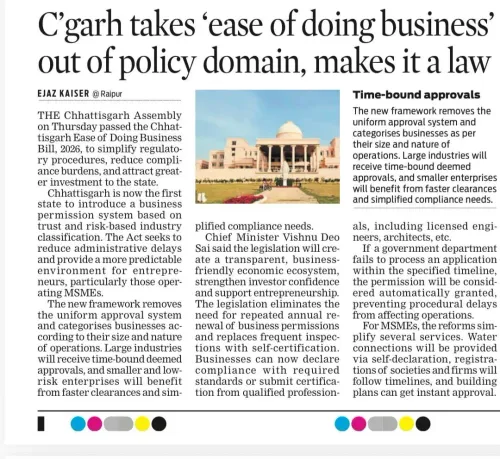
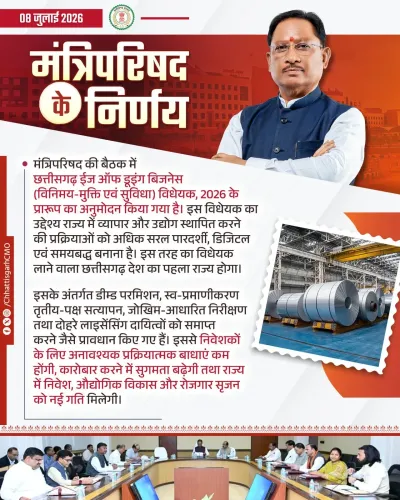
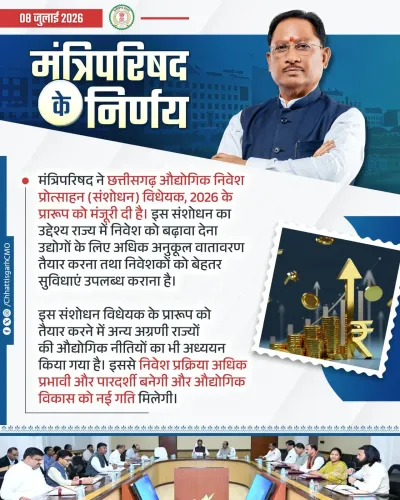
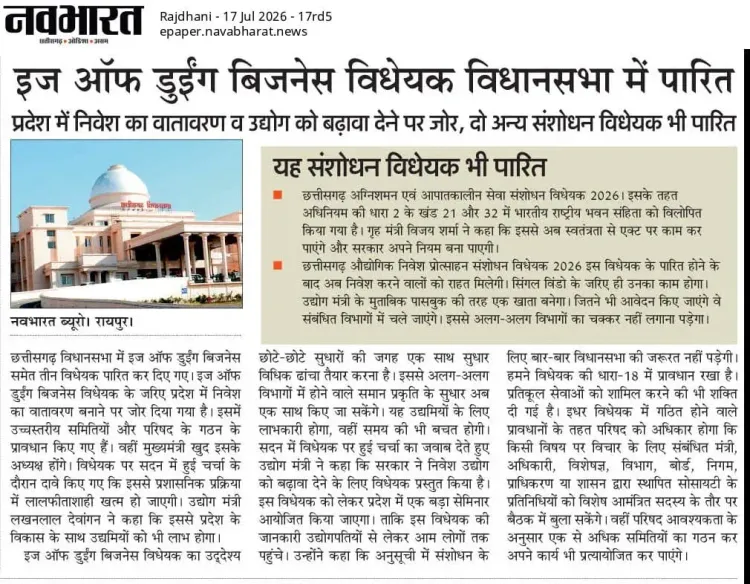
Chhattisgarh has declared itself the first Indian state to enact a dedicated Ease of Doing Business Act, according to the Chief Minister's Office. The legislation is intended to give investors legal certainty, reduce regulatory friction, and accelerate the state's emergence as an industrial hub.
Key Takeaways
The Chief Minister's Office of Chhattisgarh announced on 17 July 2026 that the state has enacted a dedicated Ease of Doing Business Act .
The government claims Chhattisgarh is the first state in India to pass such a standalone law.
The Act is intended to build investor confidence and reduce regulatory compliance burdens for industries and MSMEs .
The move builds on Chhattisgarh's Industrial Policy 2019–2024 and the national DPIIT Business Reform Action Plan framework active since 2015 .
Key watchpoints include the Act's specific provisions, its grievance-redressal mechanism, and the state's performance in the next DPIIT BRAP rankings.
The Chief Minister's Office of Chhattisgarh announced on Friday, 17 July 2026 that Chhattisgarh has become the first state in India to enact a dedicated Ease of Doing Business Act, a move the government says will build investor confidence and position the state as a strong centre of progress.
Posting on X, the Chief Minister's Office declared: 'Ease of Doing Business Adhiniyam banane wala pehla rajya bana Chhattisgarh' ('Chhattisgarh has become the first state to enact an Ease of Doing Business Act'), adding that industries will receive assurance and the state will become a strong hub of growth.
Context
The announcement marks a significant legislative step in Chhattisgarh's ongoing effort to attract industrial investment. The state, carved out of Madhya Pradesh in 2000, is endowed with substantial reserves of coal, iron ore and bauxite, making it a natural candidate for heavy industry and manufacturing. However, regulatory friction has historically been cited as a barrier to converting resource wealth into broader economic activity. By framing the legislation as a first-of-its-kind statute in the country, the state government is signalling a shift from administrative circulars and policy documents toward binding legal reform — a distinction that proponents argue gives investors greater certainty.Policy Backdrop
The broader push for ease of doing business in India dates to 2015, when the Department for Promotion of Industry and Internal Trade (DPIIT) launched the Business Reform Action Plan (BRAP), an annual framework that ranks states on regulatory reforms including single-window clearances, labour-law simplifications and environmental approvals. Chhattisgarh had previously released an Industrial Policy 2019–2024 offering incentives for manufacturing and infrastructure projects. The new Act, if it codifies and strengthens these provisions in statute, would represent an escalation from policy-level commitments to enforceable legal obligations — a model other states may watch closely. Across India, states have competed aggressively on BRAP rankings as a proxy for investment readiness, with several introducing single-window systems and time-bound approval mechanisms. Chhattisgarh's claimed legislation fits squarely within this framework of competitive federalism.Stakeholders and Impact
The primary beneficiaries identified by the government are investors, micro, small and medium enterprises (MSMEs), and existing industrial units operating in the state. A statutory framework, rather than an executive policy, offers businesses a legal basis to seek redress if approval timelines or regulatory commitments are not met — a concern frequently raised by industry bodies. For MSMEs in particular, compliance costs and approval delays have long been cited as disproportionate burdens. A dedicated Act that streamlines these processes could lower the entry barrier for smaller enterprises looking to set up operations in the state. The move also carries symbolic weight in the context of national investment summits and state-level investor conclaves, where legislative credibility increasingly shapes capital allocation decisions.What's Next
Attention will now turn to the specific provisions of the Act — including which approvals it covers, the timelines it mandates, and the grievance-redressal mechanism it establishes. The publication of the next DPIIT Business Reform Action Plan rankings will offer an independent measure of whether the legislation translates into improved regulatory outcomes on the ground. Investment proposals and industrial announcements in the months following the Act's notification will be the clearest indicator of whether the legislation achieves its stated aim of making Chhattisgarh a 'strong centre of progress.'Point of View
If the provisions are substantive, could set a precedent in competitive federalism. The timing aligns with a broader national pattern where resource-rich but industrially underleveraged states seek to differentiate themselves through legislative credibility rather than incentive packages alone. The real test will be implementation: whether the Act delivers measurable reductions in approval timelines and compliance costs, or remains largely aspirational. Independent assessment through the next DPIIT BRAP cycle will be the most credible gauge of its real-world impact.
NationPress
15 Oct 2026
Frequently Asked Questions
What is the Chhattisgarh Ease of Doing Business Act?
It is a law enacted by the Chhattisgarh state government that the Chief Minister's Office says makes Chhattisgarh the first state in India to have a dedicated statutory framework for easing business regulations and reducing compliance burdens for industries and MSMEs.
Is Chhattisgarh really the first state in India to pass an Ease of Doing Business Act?
The Chief Minister's Office of Chhattisgarh has claimed this distinction as of 17 July 2026. The specific provisions and the formal passage date of the Act are yet to be independently detailed in the public domain.
How does this Act relate to the DPIIT Business Reform Action Plan?
The DPIIT has ranked Indian states on business reform since 2015 through the Business Reform Action Plan. Chhattisgarh's new Act is positioned as a legislative escalation of the administrative reforms that states have been undertaking to improve their BRAP rankings.
Who benefits from the Chhattisgarh Ease of Doing Business Act?
The primary beneficiaries are investors, MSMEs, and existing industrial units in the state, who stand to gain from streamlined approvals, reduced compliance costs, and a legal basis for grievance redressal.
What should investors watch for after this announcement?
Investors and analysts should watch for the publication of the Act's detailed provisions, any new investment proposals announced for Chhattisgarh, and the state's performance in the next DPIIT Business Reform Action Plan rankings.