Chhattisgarh Ease of Doing Business Act 2026: Risk-based law passed

Synopsis
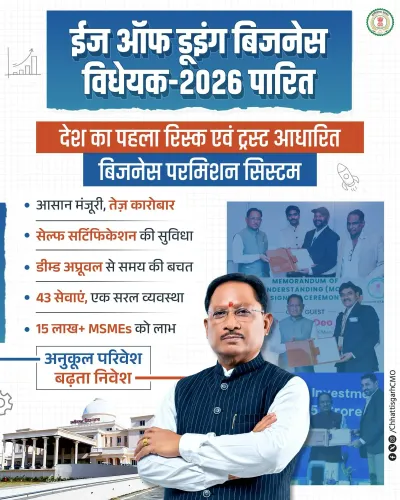
Chhattisgarh has enacted a risk-based business approval law that automatically grants clearances if departments miss deadlines, replaces routine inspections with self-certification for MSMEs, and places a Chief Minister-chaired apex council at the top of a three-tier oversight structure — a structural overhaul that could redefine how over 15 lakh small businesses interact with the state.
Key Takeaways
The Chhattisgarh Ease of Doing Business Act, 2026 was passed by voice vote on 16 July 2025 in the state legislative assembly.
The law introduces a risk-based categorisation system; low-risk MSMEs and startups will benefit from self-certification, deemed approvals, and minimal inspections.
If a department misses its prescribed deadline, approval is deemed granted automatically , ending chronic file-clearance delays.
Over 15 lakh MSMEs in Chhattisgarh are expected to benefit from reduced compliance costs and faster clearances.
A three-tier monitoring structure — Chief Secretary at state level, District Collector at district level, and Chief Minister-chaired apex council — will oversee implementation.
Several permits will shift from annual renewals to a risk-based compliance framework; water connections, firm registrations, and building plan sanctions will be fast-tracked.
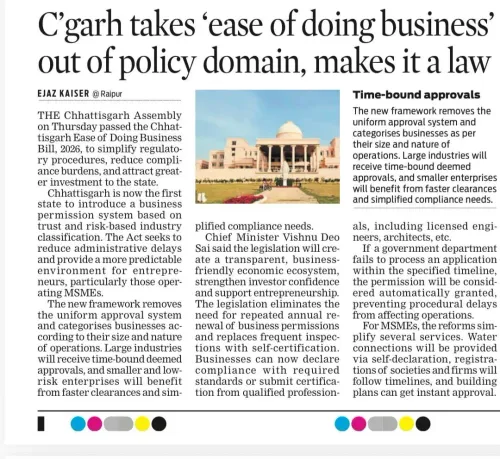
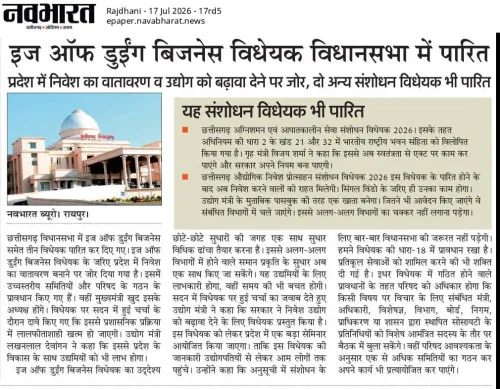
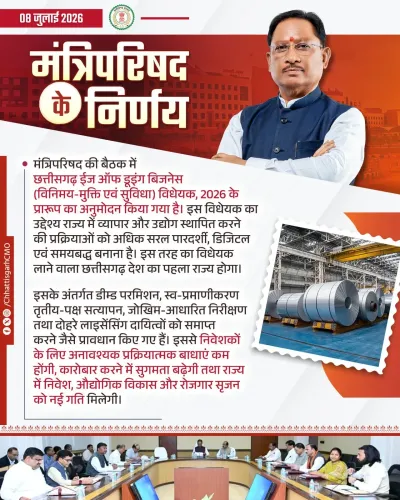
The Chhattisgarh Legislative Assembly has passed the Chhattisgarh Ease of Doing Business Act, 2026, establishing a comprehensive risk-based business approval framework that promises to cut red tape for over 15 lakh MSMEs operating in the state. The legislation, passed by voice vote on 16 July 2025 in Raipur, introduces automatic approvals, self-certification, and a tiered oversight structure designed to make the state a more attractive investment destination.
What the Act Changes
At its core, the law categorises businesses by risk profile — factoring in size, investment, and the nature of operations. Low-risk enterprises, including MSMEs and startups, will benefit from simplified documentation, self-certification, and deemed approvals, with minimal direct government intervention. High-risk and large industries will continue to face the regulatory oversight that their scale and complexity warrant.
One of the most significant departures from existing practice is the replacement of routine government inspections with self-certification or certification by licensed professionals — engineers and architects among them — for a wide range of low-risk businesses. This shifts compliance responsibility to the enterprise level while reducing the scope for inspector-level discretion, which critics have long identified as a source of delays and informal costs.
Deemed Approvals and Faster Clearances
The Act introduces a strict timeline mechanism: if a government department fails to act on an application within the prescribed period, the approval is deemed granted automatically. This provision directly targets the chronic problem of file-clearance delays that have historically discouraged smaller entrepreneurs from formalising or expanding their operations.
Several permits will also move away from annual renewal cycles to a risk-based compliance framework, reducing recurring administrative burden. Approvals for water connections, firm and society registrations, and building plan sanctions are among the categories slated for fast-tracking under the new rules.
Three-Tier Monitoring Structure
To prevent implementation from stalling — a common fate for business-reform legislation — the Act establishes a structured oversight architecture. A state-level committee chaired by the Chief Secretary will oversee departmental compliance. At the district level, the District Collector will lead monitoring. An apex council headed by the Chief Minister will oversee both tiers, providing political accountability at the top of the chain.
Notably, the Bill was amended during legislative debate to replace the term 'coordinator' with 'Secretary' — referring to the state's chief secretary — before being passed by voice vote, signalling that the oversight roles carry formal administrative weight rather than being advisory in nature.
Industry Response and Projected Impact
Industry stakeholders have broadly welcomed the legislation, describing it as a progressive step that positions Chhattisgarh as a forward-looking investment destination. The state government projects that the Act will attract fresh capital inflows and generate additional employment by lowering compliance costs and increasing procedural transparency.
This comes amid a broader national push by several state governments to improve their rankings in the Ease of Doing Business assessments, where regulatory efficiency and clearance timelines carry significant weight. Whether Chhattisgarh's implementation matches the ambition of the legislation will depend on how rigorously the three-tier monitoring mechanism is enforced in the months ahead.
Point of View
With mixed results; departments often find procedural workarounds to reset timelines. The real test for Chhattisgarh is whether the Chief Minister-chaired apex council actively penalises non-compliance or functions as a ceremonial layer. For the 15 lakh MSME figure to translate into measurable economic outcomes, the three-tier monitoring structure must have teeth — not just a mandate.
NationPress
15 Oct 2026
Frequently Asked Questions
What is the Chhattisgarh Ease of Doing Business Act, 2026?
It is a state law passed by the Chhattisgarh Legislative Assembly that introduces a risk-based business approval system, replacing routine inspections with self-certification for low-risk enterprises and mandating automatic approvals if departments miss prescribed deadlines. The Act is designed to reduce red tape for over 15 lakh MSMEs in the state.
What is the deemed approval provision in the new Act?
Under the Act, if a government department does not decide on a business application within the prescribed timeframe, the approval is automatically deemed granted. This provision is intended to eliminate long delays in file clearances that have historically burdened smaller businesses.
Which businesses benefit most from the new law?
Low-risk businesses — particularly MSMEs and startups — stand to benefit the most. They will face simplified documentation, self-certification options, fewer government inspections, and reduced annual renewal requirements under the risk-based framework.
How will the Act be monitored and enforced?
The Act establishes a three-tier oversight structure: a state-level committee chaired by the Chief Secretary, district-level monitoring led by the District Collector, and an apex council headed by the Chief Minister. This hierarchy is meant to hold departments accountable for timely implementation.
What amendment was made to the Bill before it was passed?
During legislative debate, the Bill was amended to replace the term 'coordinator' with 'Secretary' — referring specifically to the state's Chief Secretary — before being passed by voice vote, clarifying the formal administrative role within the oversight structure.