Chhattisgarh gets 250 MBBS seats across 5 new govt medical colleges
Synopsis
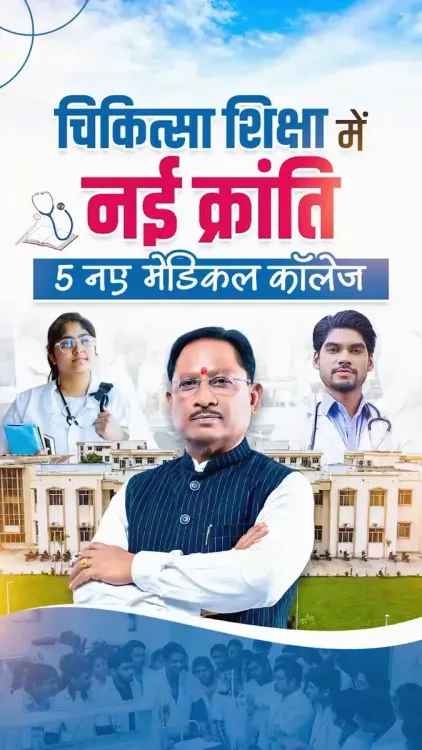
The Chief Minister's Office of Chhattisgarh announced on 13 July 2026 that the state has secured central approval for 250 new MBBS seats across five government medical colleges in remote districts including Dantewada, Jashpur, Janjgir-Champa, Kabirdham, and MCB, under the BJP's 'double engine government' framework.
Key Takeaways
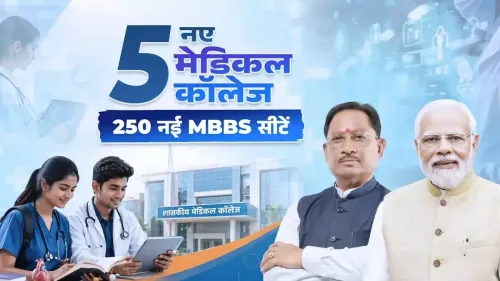
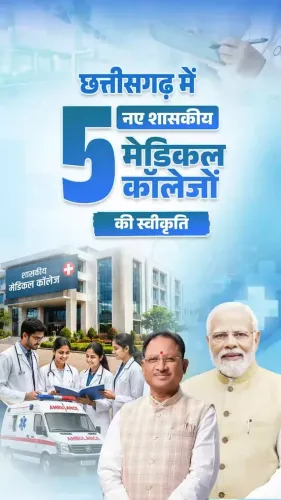
250 new MBBS seats have been approved for Chhattisgarh across five new government medical colleges .
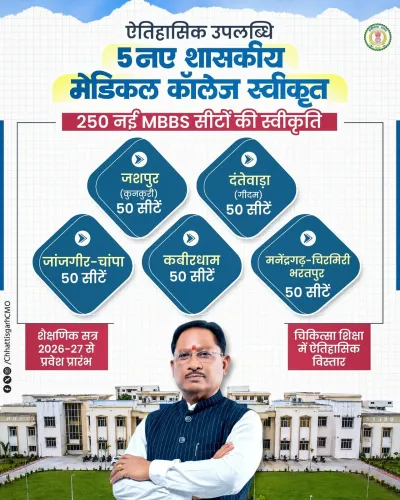
The colleges are to be established in Dantewada, Jashpur, Janjgir-Champa, Kabirdham , and Manendragarh-Chirmiri-Bharatpur (MCB) districts.
The approval is attributed to the 'double engine government' — coordinated action between the BJP state government and the Union administration.
The announcement was made on 13 July 2026 by the Chief Minister's Office of Chhattisgarh and tagged PM Narendra Modi and the Ministry of Health and Family Welfare .
The expansion targets historically under-served tribal and rural districts, with the earliest possible student intake expected in the 2027 academic session .
The move aligns with the Union government's centrally sponsored scheme to open medical colleges in under-served districts, running since 2014 .
The Chief Minister's Office of Chhattisgarh announced on Monday, 13 July 2026 that the state has received central approval for 250 new MBBS seats spread across five new government medical colleges, a move credited to coordinated action between the state government and the Union administration.
Context
The CMO post, written in Hindi, declared: 'Yuvaon ke sapnon ko naye pankh, swasthya vyavastha ko milegi nayi takat' — 'New wings for the dreams of youth, new strength for the healthcare system.' It attributed the approval to the efforts of the 'double engine government', the phrase used by the Bharatiya Janata Party to describe aligned BJP governments at the state and Centre working in tandem.
The post tagged Prime Minister Narendra Modi, JP Nadda, Chief Minister Vishnu Deo Sai, and the Ministry of Health and Family Welfare, signalling that the sanction involved coordination at the highest levels of both governments. The districts of Dantewada, Manendragarh-Chirmiri-Bharatpur (MCB), Jashpur, Janjgir-Champa, and Kabirdham were tagged, indicating these are the locations of the five new colleges.
Policy Backdrop
Since 2014, the Union government has run a centrally sponsored scheme specifically aimed at opening new government medical colleges in under-served districts, with a focus on states in central and eastern India that have historically lagged in doctor availability. This scheme has been a primary driver of the significant rise in national MBBS seat counts over the past decade.
Chhattisgarh, a state with large tribal and rural populations, has been a priority target under this framework. The five districts named — Dantewada, Jashpur, Janjgir-Champa, Kabirdham, and MCB — are among the state's more remote and historically under-served regions, where access to both medical education and healthcare infrastructure has long been limited.
Stakeholders and Impact
The most direct beneficiaries are medical aspirants from Chhattisgarh, particularly those from rural and tribal districts who face geographic and financial barriers to pursuing MBBS education in distant cities. Each of the five colleges is expected to offer 50 MBBS seats, adding a combined 250 seats to the state's government medical education capacity.
Beyond students, the expansion is expected to improve healthcare delivery in these districts over time. New government medical colleges typically serve as district referral hospitals, bringing specialist care to populations that currently travel long distances for secondary and tertiary treatment. The CMO described the colleges as 'the strong foundation of a developed Chhattisgarh' — 'Viksit Chhattisgarh ki mazboot neev.'
What's Next
The immediate milestones to watch are formal admission notifications and construction or infrastructure timelines for each of the five colleges. The earliest realistic target for student intake, given regulatory requirements by the National Medical Commission, would be the 2027 academic session. Subsequent phases could bring additional seat approvals as each college matures.
The announcement reinforces a broader national pattern where single-party alignment between state and central governments has become the primary mechanism for fast-tracking large healthcare infrastructure projects, with Chhattisgarh now positioned as a model for similar expansions in other BJP-governed states in central India.
Point of View
Demonstrating how party alignment between Raipur and New Delhi can accelerate central clearances that have historically stalled for opposition-ruled states. For CM Vishnu Deo Sai, who took office in December 2023, this announcement provides a concrete healthcare deliverable ahead of future electoral cycles. The choice of districts — all remote, tribal-heavy, and medically under-served — also signals a deliberate attempt to address longstanding regional inequity in medical education rather than concentrating new infrastructure in urban centres. The broader implication is that central India's doctor shortage, among the worst in the country, may begin to ease if construction and regulatory timelines are met.
NationPress
13 Jul 2026
Frequently Asked Questions
How many new MBBS seats has Chhattisgarh received approval for?
Chhattisgarh has received central approval for 250 new MBBS seats distributed across five new government medical colleges, as announced by the Chief Minister's Office on 13 July 2026.
In which districts will the new medical colleges in Chhattisgarh be set up?
The five new government medical colleges are to be established in Dantewada, Jashpur, Janjgir-Champa, Kabirdham , and Manendragarh-Chirmiri-Bharatpur (MCB) districts of Chhattisgarh.
Who approved the new medical colleges in Chhattisgarh?
The approval came through coordinated action between the Chhattisgarh state government under CM Vishnu Deo Sai and the Union government , with the Ministry of Health and Family Welfare tagged in the official announcement.
When can students expect admissions in these new Chhattisgarh medical colleges?
Given regulatory requirements by the National Medical Commission , the earliest realistic target for student admissions is the 2027 academic session , subject to construction and inspection timelines.
What is the 'double engine government' referred to in the Chhattisgarh medical college announcement?
'Double engine government' is a phrase used by the Bharatiya Janata Party to describe a situation where the same party governs both the state and the Centre, enabling faster coordination on projects like central approval for new medical colleges.