Chhattisgarh no-confidence motion defeated after 14-hour Assembly debate
Synopsis
The Chhattisgarh Assembly sat through the night as Congress threw a no-confidence motion at the BJP government — and lost. After 14 hours of combat over ration cards, farmer bonuses, and a flagship women's welfare scheme, Chief Minister Vishnu Deo Sai's majority held. The session exposed live fault lines on food security and welfare delivery that will not disappear before December.
Key Takeaways
Congress moved a no-confidence motion against the BJP government of Chief Minister Vishnu Deo Sai in the Chhattisgarh Assembly on 18 July 2026 .
The debate ran for over 14 hours , concluding at 2:45 am on 19 July 2026 ; the motion was defeated by voice vote.
The House was adjourned sine die, ending the monsoon session; the next sitting is set for the second week of December 2026 .
Key flashpoints included discrepancies in PDS ration cards , a ₹136.35 crore state exchequer burden, and 27,050 post-instalment exclusions under Mahatari Vandan Yojana .
CM Sai cited paddy procurement at ₹3,100 per quintal and ₹3,716 crore in farmer bonuses as proof of delivery.
Over one lakh women reportedly affected by e-KYC issues under Mahatari Vandan Yojana; deadline extended to 30 July 2026 .
The Chhattisgarh Legislative Assembly concluded one of its longest and most turbulent sessions as the Indian National Congress (INC) moved a no-confidence motion against the Bharatiya Janata Party (BJP) government led by Chief Minister Vishnu Deo Sai. The debate ran for over 14 hours — from 12:30 pm on Friday, 18 July 2026 into the early hours of the next day — before the motion was defeated by voice vote at 2:45 am on Saturday, 19 July 2026. The House was subsequently adjourned sine die, bringing the monsoon session to a close.
How the Session Unfolded
The Assembly had convened at 11:00 am under Speaker Dr Raman Singh, with proceedings beginning on listed questions around rice distribution, ration cards, e-KYC compliance, and the flagship Mahatari Vandan Yojana. Tensions escalated quickly, with Congress members staging a walkout at approximately 11:39 am after exchanges turned chaotic. The no-confidence motion debate formally commenced at 12:30 pm and stretched through the night.
Speaker Dr Raman Singh announced the next sitting date for the second week of December 2026, confirming the monsoon session had ended.
The No-Confidence Debate: Key Arguments
Leader of the Opposition Dr Charan Das Mahant spearheaded the Congress offensive, alleging the BJP had betrayed voters and left farmers burdened, tribals marginalised, and youth disillusioned. He questioned the government's record on poverty alleviation, citing discrepancies between official beneficiary figures and ground realities under the National Food Security Act (NFSA).
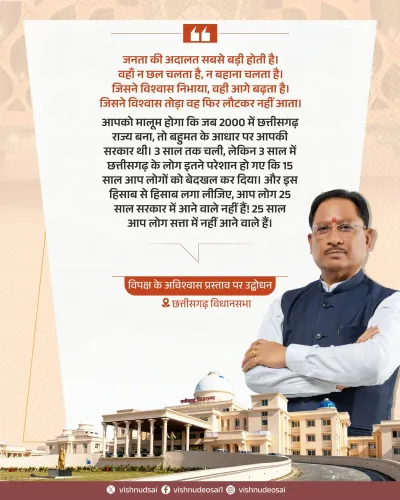
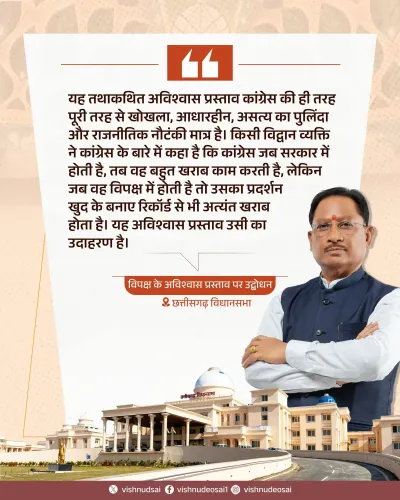
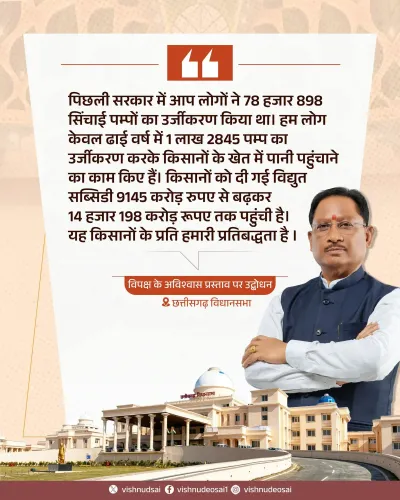
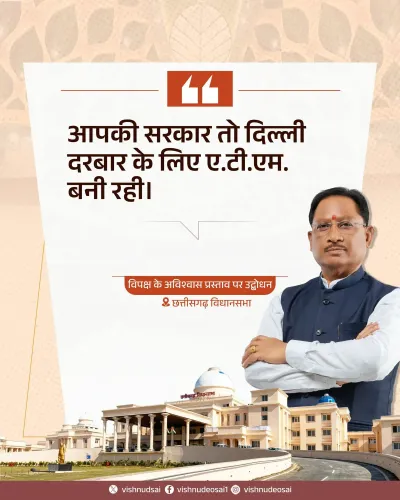
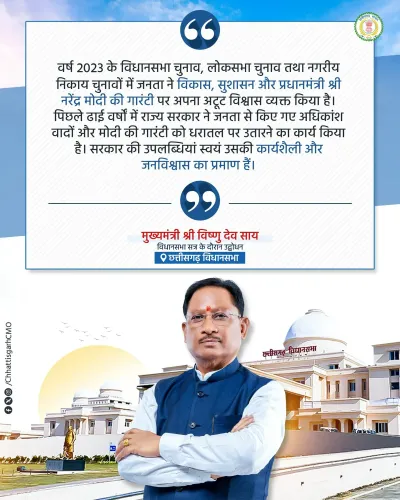
Chief Minister Vishnu Deo Sai mounted a firm defence, dismissing the motion as 'hollow, baseless, and politically motivated.' He cited paddy procurement at ₹3,100 per quintal, disbursement of ₹3,716 crore in farmer bonuses, and expanded irrigation coverage as evidence of delivery. Sai declared the BJP was not only stable but positioned to govern Chhattisgarh for the next 25 years. Remarks by Deputy Chief Minister Vijay Sharma triggered sharp protests and noisy interruptions from the Opposition benches.
Food Security and PDS Under the Microscope
Congress MLA Sheshraj Harbansh questioned Food Minister Dayaldas Baghel on the status of Antyodaya, priority, and other ration cards, pointing to 57.25 lakh central cards and 25.76 lakh state cards. She questioned the rationale behind 25.36 lakh additional state-supported families and the resulting financial burden of ₹136.35 crore on the state exchequer.
Minister Baghel outlined distribution norms — 35 kg for Antyodaya families and 10–20 kg slabs for priority households — and maintained that central supplies were adequate. Congress MLA Sushant Shukla alleged irregularities in ration shops in the Beltara constituency between April 2025 and March 2026, prompting the minister to table annexures while acknowledging some complaints.
Mahatari Vandan Yojana Row
The sharpest exchanges centred on the Mahatari Vandan Yojana. Congress MLA Umesh Patel pressed Women and Child Development Minister Laxmi Rajwade on eligibility gaps and e-KYC pendency. Of 70.27 lakh applications received, approximately 68.54 lakh women were receiving benefits as of June 2026. Patel flagged a discrepancy of roughly 1.55 lakh beneficiaries after the first instalment and pressed on 27,050 post-instalment exclusions.
He criticised the e-KYC mandate, noting over one lakh women — approximately 0.2–0.25% of beneficiaries according to the minister — were affected by technical issues, deaths, age mismatches, and Aadhaar errors. Minister Rajwade clarified that exclusions stemmed from ineligibility rather than e-KYC failures alone, and extended the compliance deadline to 30 July 2026. Opposition members repeatedly alleged data manipulation and implementation failures.
Outcome and What It Signals
The Congress, despite its vocal and sustained assault, could not muster the numbers needed to challenge the BJP's majority. The defeat by voice vote reaffirmed the ruling party's dominance in the House. Notably, this was among the longest single-day legislative debates in recent Chhattisgarh Assembly history, underscoring deep divisions over food security, public distribution efficiency, and welfare delivery in the state. The next sitting is scheduled for the second week of December 2026.
Point of View
The real purpose was to force the government to defend its record on ration cards, farmer bonuses, and Mahatari Vandan Yojana on the public record. The e-KYC exclusions and the ₹136.35 crore ration-card burden are the kind of granular welfare failures that rarely make headlines but accumulate into electoral liability. The BJP survived the night; whether it has answered the underlying questions is a different matter entirely.
NationPress
17 Oct 2026
Frequently Asked Questions
What was the no-confidence motion in the Chhattisgarh Assembly about?
The Congress moved a no-confidence motion against the BJP government led by Chief Minister Vishnu Deo Sai, alleging failures on farmer welfare, tribal rights, food security, and welfare scheme delivery. The motion was debated for over 14 hours before being defeated by voice vote in the early hours of 19 July 2026.
What is the Mahatari Vandan Yojana and why was it controversial in this session?
Mahatari Vandan Yojana is a Chhattisgarh government scheme providing financial benefits to women. Congress MLA Umesh Patel raised concerns over 27,050 post-instalment exclusions and over one lakh women affected by e-KYC technical issues. The government extended the e-KYC deadline to 30 July 2026 and maintained that exclusions were due to ineligibility rather than system failures alone.
When will the Chhattisgarh Assembly meet next?
The Assembly was adjourned sine die after the monsoon session concluded on 19 July 2026. Speaker Dr Raman Singh announced the next sitting is scheduled for the second week of December 2026.
What did Chief Minister Vishnu Deo Sai say in defence of his government?
CM Sai called the motion 'hollow, baseless, and politically motivated' and cited paddy procurement at ₹3,100 per quintal, disbursement of ₹3,716 crore in farmer bonuses, and expanded irrigation as key achievements. He asserted the BJP was stable and positioned to govern Chhattisgarh for the next 25 years.
What were the key issues raised over the Public Distribution System in Chhattisgarh?
Congress MLA Sheshraj Harbansh questioned the rationale for 25.36 lakh additional state-supported ration card families beyond central coverage, placing a ₹136.35 crore burden on the state exchequer. Discrepancies in BPL figures and alleged irregularities in ration shops in the Beltara constituency between April 2025 and March 2026 were also raised.