CM Sai Tells Opposition: 25 Years Out of Power in Chhattisgarh
Synopsis
Chhattisgarh Chief Minister Vishnu Deo Sai, addressing a no-confidence motion in the state assembly on 18 July 2026, invoked the state's electoral history to declare the opposition would remain out of power for 25 years, citing the public's rejection of their initial three-year government after statehood in 2000.
Key Takeaways
CM Vishnu Deo Sai addressed a no-confidence motion in the Chhattisgarh Vidhan Sabha on 18 July 2026 .
He declared the opposition will not return to power for 25 years , drawing on the state's post-2000 electoral record.
Chhattisgarh was formed on 1 November 2000 ; the initial Congress-led government lasted only three years before the BJP won in 2003 .
The BJP then governed continuously for 15 years until 2018 , the period Sai cited as evidence of prolonged voter rejection.
The BJP returned to power in the 2023 elections, with Sai becoming Chief Minister in December 2023 .
The no-confidence motion debate sets the tone for political competition ahead of the 2028 Chhattisgarh assembly elections.
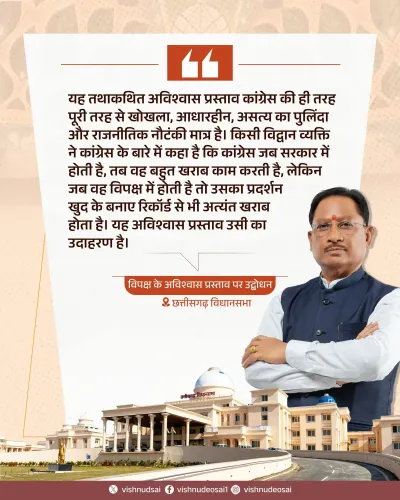
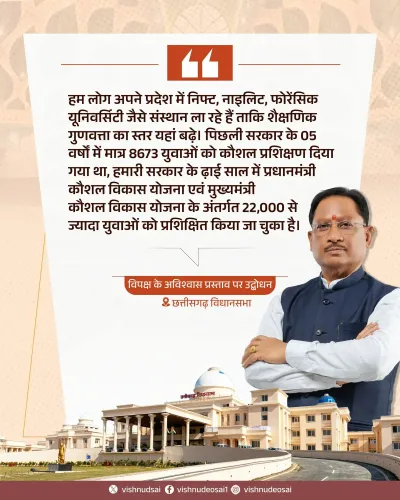
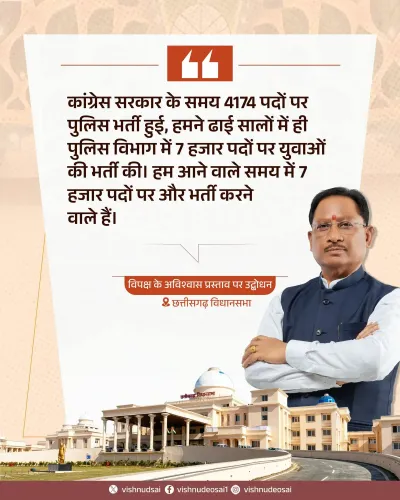
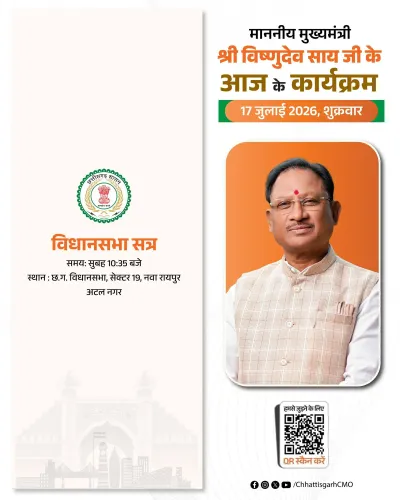
Chhattisgarh Chief Minister Vishnu Deo Sai delivered a sharp rebuke to the opposition on Saturday, 18 July 2026, addressing a no-confidence motion on the floor of the Chhattisgarh Vidhan Sabha and warning that the opposition would remain out of power for 25 years.
Context
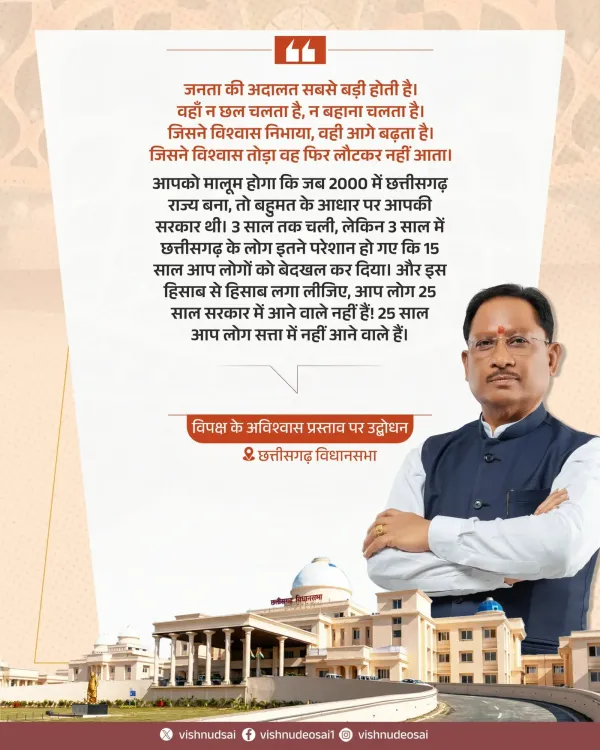
Speaking during the no-confidence debate, CM Sai invoked the principle of public accountability, saying in Hindi: 'जनता की अदालत सबसे बड़ी होती है' ('The court of the people is the highest court'). He argued that neither deception nor excuses can survive the electorate's verdict, and that only those who honour public trust are allowed to continue.
Sai directly addressed opposition members, recalling that when Chhattisgarh was formed on 1 November 2000, the opposition party came to power with a majority but governed for only three years. He said the people of Chhattisgarh became so disillusioned in those three years that they ousted the party for 15 years thereafter.
Policy Backdrop
Chhattisgarh was carved out of Madhya Pradesh on 1 November 2000. A Congress-led government under Ajit Jogi took charge initially but lost the 2003 assembly elections to the BJP, which then governed the state continuously until 2018. The Congress returned to power in 2018 and held office until the BJP reclaimed it in the 2023 elections, bringing Vishnu Deo Sai to the Chief Minister's chair in December 2023.
Drawing on this electoral history, CM Sai told opposition lawmakers: 'By this calculation, you are not going to be in government for 25 years.' The remark drew on the pattern of the opposition's initial three-year tenure followed by a 15-year absence, projecting a similar or longer exclusion from power going forward.
Stakeholders and Impact
The no-confidence motion, a constitutional instrument available to the legislature's opposition, triggered the debate in which CM Sai made these remarks. Such motions in Indian state assemblies rarely succeed when the ruling party holds a clear majority, but they serve as a platform for both sides to consolidate political narratives.
For Chhattisgarh's voters — particularly in tribal-majority districts that have historically swung elections — the exchange signals that both the ruling BJP and the opposition are already framing the contest ahead of the 2028 state assembly elections. The Chief Minister's rhetoric is aimed at reinforcing the ruling party's mandate and casting doubt on the opposition's long-term electoral prospects.
What's Next
The immediate focus is on the outcome of the no-confidence motion vote in the current assembly session. With the BJP holding a working majority in the Chhattisgarh Vidhan Sabha, the motion is widely expected to be defeated. Beyond the current session, the political temperature in the state will be watched closely through any by-elections and as parties begin positioning for the 2028 assembly polls.
Chief Minister Sai's remarks underscore that governance performance and public trust will remain the central themes of political competition in Chhattisgarh — a state that has alternated between the two major parties since its formation and where voter accountability has historically been decisive.
Point of View
Anchoring the BJP's narrative in Chhattisgarh's own political memory rather than abstract ideology. By quantifying the opposition's absence — three years in, fifteen years out — he frames the electorate as an impartial judge that has already delivered its verdict, making the 25-year projection sound like historical logic rather than partisan boast. This kind of arithmetic rhetoric is a well-worn tool in Indian legislative politics, designed to demoralise opposition cadres and signal to fence-sitters that backing the ruling party is the safer bet. The durability of this message will ultimately depend on the BJP's delivery on governance in the state's tribal heartlands, where electoral loyalty remains contingent on tangible outcomes.
NationPress
17 Oct 2026
Frequently Asked Questions
What did CM Vishnu Deo Sai say in the Chhattisgarh assembly on 18 July 2026?
CM Vishnu Deo Sai said the opposition would remain out of power for 25 years, arguing that voters had already punished them for their poor three-year tenure after Chhattisgarh's formation in 2000 by keeping them out for 15 years, and a similar or longer rejection awaited them.
What is a no-confidence motion in an Indian state assembly?
A no-confidence motion is a constitutional mechanism by which the opposition formally challenges the ruling government's majority on the floor of the legislature. If the motion passes, the government must resign; if it fails, the ruling party's mandate is reaffirmed.
When was Chhattisgarh formed and who first governed it?
Chhattisgarh was carved out of Madhya Pradesh on 1 November 2000. A Congress-led government under Ajit Jogi took charge initially but lost the 2003 assembly elections to the BJP, which then governed the state for 15 consecutive years until 2018.
Who is Vishnu Deo Sai and when did he become Chief Minister?
Vishnu Deo Sai is a BJP leader who became Chief Minister of Chhattisgarh in December 2023 after the BJP won the state assembly elections that year, ending five years of Congress rule.
What are the next major elections in Chhattisgarh?
The next Chhattisgarh state assembly elections are due in 2028. The current no-confidence motion debate and the political rhetoric around it are seen as early indicators of how both the BJP and the opposition will frame their campaigns ahead of that contest.