CM Sai Touts 22,000 Skill Trainees in No-Confidence Reply
Synopsis
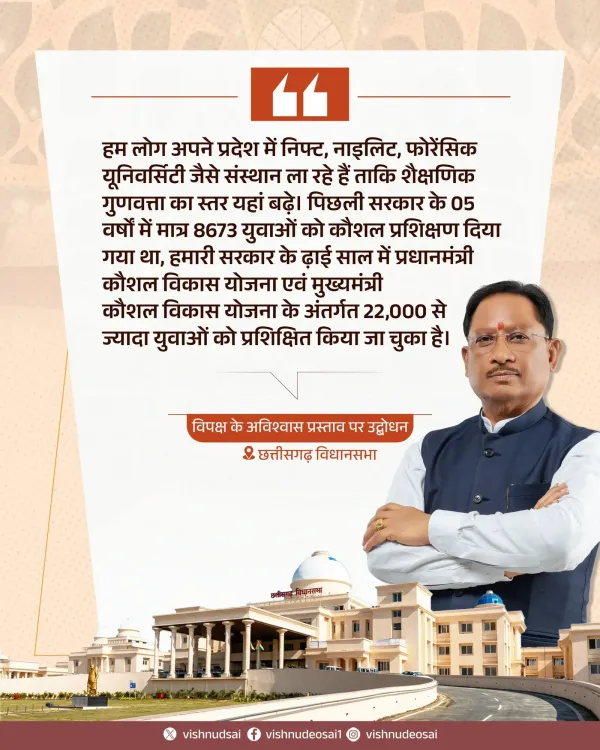
Responding to an opposition no-confidence motion in the Chhattisgarh assembly on 18 July 2026, CM Vishnu Deo Sai said his government trained over 22,000 youth in two-and-a-half years under PMKVY and the state skill scheme, compared with 8,673 in the previous government's five-year tenure. He also announced plans to bring NIFT, NIELIT, and a Forensic University to the state.
Key Takeaways
CM Vishnu Deo Sai addressed the Chhattisgarh Legislative Assembly on 18 July 2026 in response to an opposition no-confidence motion.
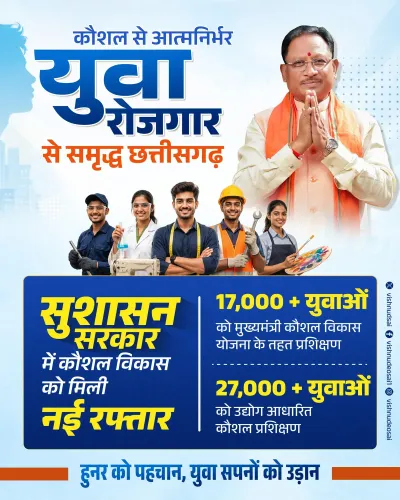
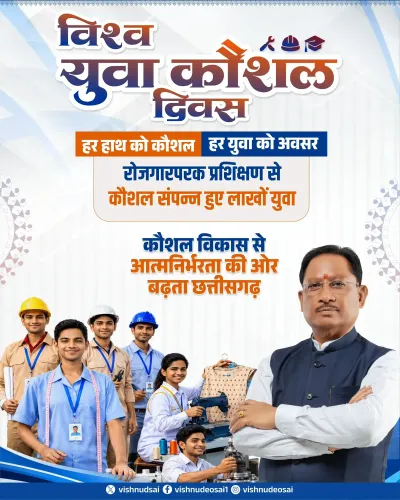
He claimed his government trained over 22,000 youth in two-and-a-half years under PMKVY and the Mukhyamantri Kaushal Vikas Yojana .
The previous government reportedly trained 8,673 youth over its full five-year term, according to the CM's statement.
The state government is pursuing establishment of NIFT , NIELIT , and a Forensic University in Chhattisgarh to improve higher-education quality.
The announcements form part of a broader BJP governance narrative since the party returned to power in December 2023 .
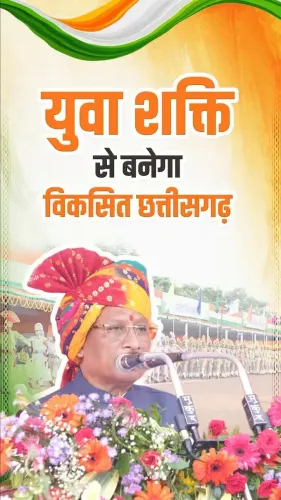
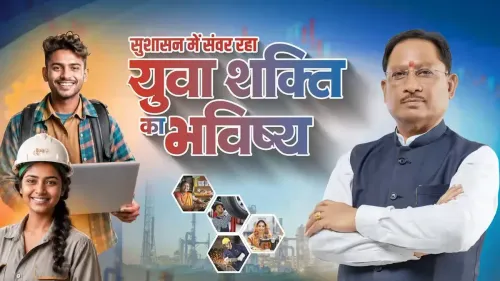
Chhattisgarh Chief Minister Vishnu Deo Sai addressed the state assembly on Saturday, 18 July 2026, responding to the opposition's no-confidence motion by highlighting his government's education and skill-development record, claiming that more than 22,000 youth had been trained in two-and-a-half years — against 8,673 trained over the previous government's full five-year term.
Context
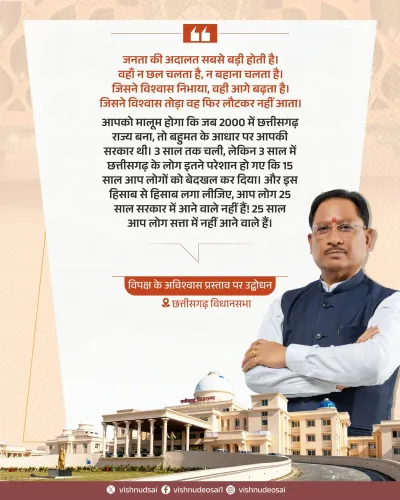
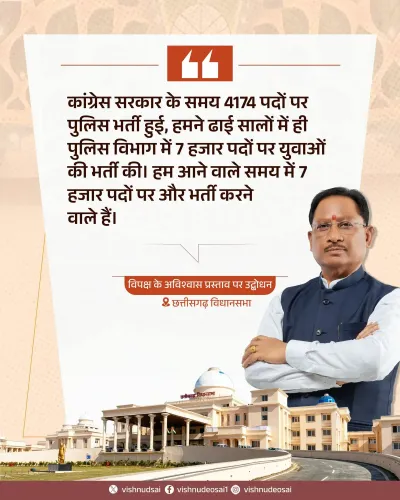
Speaking from the floor of the Chhattisgarh Legislative Assembly, CM Sai delivered the remarks as part of his formal address on the opposition's no-confidence motion — viपक्ष के अविश्वास प्रस्ताव पर उद्बोधन (address on the opposition's no-confidence motion). He stated that institutions such as NIFT (National Institute of Fashion Technology), NIELIT (National Institute of Electronics and Information Technology), and a Forensic University are being brought to the state to raise the quality of education.
The Chief Minister directly contrasted the present government's performance with that of the previous administration, arguing that the numbers reflect a decisive shift in how skill development is being prioritised in the state since the BJP's return to power in December 2023.
Policy Backdrop
The training figures cited by CM Sai reference two schemes: the centrally-sponsored Pradhan Mantri Kaushal Vikas Yojana (PMKVY), launched by the Government of India in 2015 to scale vocational training nationwide, and the state-level Mukhyamantri Kaushal Vikas Yojana. Together, he said, these programmes have trained over 22,000 youth in the current government's first two-and-a-half years.
NIFT, established in 1986, is a premier central institute for design and fashion education, while NIELIT functions as an autonomous scientific society under the Ministry of Electronics and Information Technology. State governments across India have increasingly sought to establish campuses of such specialised central institutions in tier-2 cities since the mid-2010s, using them as anchors for broader higher-education ecosystems.
Stakeholders and Impact
The primary beneficiaries of the initiatives cited are Chhattisgarh's youth — particularly those seeking vocational and technical education in a state that has historically lacked the density of specialised institutions found in larger urban centres. The proposed Forensic University, if established, would be among a small number of such dedicated institutions in India, potentially drawing students from across the region.
The figures and institutional announcements carry political weight as well: the no-confidence motion provides the opposition an opportunity to scrutinise delivery on these promises, while the ruling BJP uses the floor debate to consolidate its narrative of governance improvement over the previous Congress-led administration.
What's Next
Attention will now turn to whether formal agreements — such as MoUs with NIFT, NIELIT, and relevant central ministries — are signed and whether state budget allocations for new campuses are announced in upcoming assembly sessions. The opposition is likely to press for verifiable timelines and land-allocation details for the proposed institutions. The outcome of the no-confidence motion itself will also determine the immediate political trajectory for the Sai government.
Point of View
Shifting the burden of proof onto the challenger. The announcement of NIFT, NIELIT, and a Forensic University — institutions with strong central-government branding — also reinforces the BJP's 'double-engine government' narrative that ties state delivery to central schemes. However, the figures cited remain unverified in the public record, and the opposition will likely demand audited data before the session closes. The broader pattern of states competing to host specialised central institutions reflects a structural shift in how educational prestige is being distributed beyond metro centres.
NationPress
17 Oct 2026
Frequently Asked Questions
What did Chhattisgarh CM Vishnu Deo Sai say in the no-confidence motion debate?
CM Vishnu Deo Sai said his government trained over 22,000 youth in two-and-a-half years under central and state skill schemes, compared with 8,673 trained in the previous government's five-year term, and announced plans to bring NIFT, NIELIT, and a Forensic University to Chhattisgarh.
What is the Pradhan Mantri Kaushal Vikas Yojana?
The Pradhan Mantri Kaushal Vikas Yojana (PMKVY) is a Government of India scheme launched in 2015 to provide short-term vocational and skill training to youth across the country to improve their employability.
Is NIFT coming to Chhattisgarh?
CM Vishnu Deo Sai stated in the Chhattisgarh assembly on 18 July 2026 that his government is working to establish a NIFT campus in the state, though formal MoUs and timelines have not yet been publicly confirmed.
What is the Mukhyamantri Kaushal Vikas Yojana in Chhattisgarh?
The Mukhyamantri Kaushal Vikas Yojana is a state-level skill development scheme in Chhattisgarh that runs alongside the central PMKVY to provide vocational training to local youth.
What happened in the Chhattisgarh assembly no-confidence motion in July 2026?
The opposition moved a no-confidence motion in the Chhattisgarh Legislative Assembly, to which CM Vishnu Deo Sai responded by citing his government's education and skill-training achievements, including training over 22,000 youth and plans to set up new specialised institutions.