CM Pema Khandu marks 10 years with governance reflections
Synopsis
Chief Minister Pema Khandu marks ten years in office in Arunachal Pradesh with a reflective publication titled 'Ten Lessons from 10 Years in the Land of the Rising Sun', shared by the official CMO account on 18 July 2026, cataloguing a decade of leadership and governance in India's northeasternmost state.
Key Takeaways
Pema Khandu completed 10 years as Chief Minister of Arunachal Pradesh in July 2026 , having first taken office on 17 July 2016 .
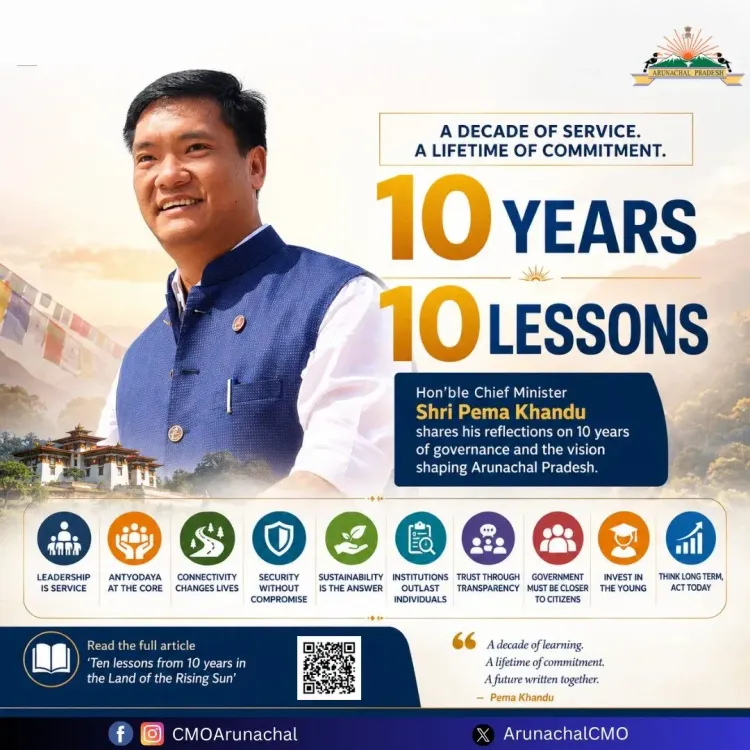
The Chief Minister's Office shared a publication titled 'Ten Lessons from 10 Years in the Land of the Rising Sun' to mark the milestone.
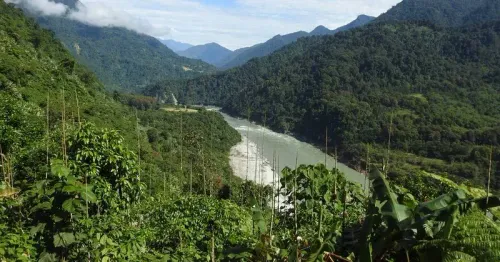
Arunachal Pradesh , bordering China , Myanmar , and Bhutan , is popularly known as the Land of the Rising Sun .
Khandu 's tenure has been associated with border connectivity, infrastructure expansion, and alignment with the Centre's Act East Policy .
The publication is framed as a structured governance reflection, not merely a ceremonial anniversary statement.
Wider release of the full text and any linked policy directions are expected to follow in the coming weeks.
The Chief Minister's Office of Arunachal Pradesh on Saturday, 18 July 2026 shared a reflective piece by Chief Minister Shri Pema Khandu, marking a full decade of leadership in the state with a publication titled 'Ten Lessons from 10 Years in the Land of the Rising Sun' — a personal account of governance, service, and transformation across his tenure.
Context
Pema Khandu was first sworn in as Chief Minister of Arunachal Pradesh on 17 July 2016, making July 2026 the completion of an uninterrupted decade at the helm of India's northeasternmost state. The CMO's post, framed around the tagline '10 Years. 10 Lessons. One Vision.', positions the publication as both a personal milestone and a governance document. The state, popularly known as the Land of the Rising Sun, borders China, Myanmar, and Bhutan, giving its administration a strategic weight that extends well beyond routine state politics.
The ten-year mark is notable because continuity of this length is rare in Arunachal Pradesh, a state that witnessed considerable political flux before Khandu's consolidation of power under the BJP. His tenure began with a dramatic transition from the Congress to the BJP fold, and has since been defined by an emphasis on border connectivity, infrastructure development, and alignment with the Centre's Act East Policy.
Policy Backdrop
Reflections on state leadership tenures have grown increasingly common across India's Northeast, particularly as BJP-led governments seek to document and communicate governance outcomes under the broader Act East framework that has been central to New Delhi's Northeast policy since 2014. Publishing a structured, lesson-based account of a decade in office signals an intent to shape the political narrative ahead of future electoral and legislative cycles.
Under Khandu's watch, Arunachal Pradesh has seen investments in road and tunnel connectivity along sensitive border areas, expansion of digital infrastructure in remote districts, and sustained engagement with central schemes targeting tribal welfare and mountain ecology. The 'Ten Lessons' format suggests a structured self-assessment rather than a ceremonial anniversary statement, though the full contents of the linked publication could not be independently verified at the time of publication.
Stakeholders and Impact
The primary audience for this reflection is the 3.5 million residents of Arunachal Pradesh, whose daily lives — from road access in frontier districts to educational and health infrastructure — have been shaped by a decade of policy decisions under Khandu's administration. The state's civil service, elected representatives, and district administrations are equally stakeholders in any governance audit of this kind.
Beyond the state, the document carries relevance for Northeast India watchers, policy researchers, and the central government, which has consistently positioned Arunachal Pradesh as a flagship demonstration of its border-state development agenda. The publication also arrives at a moment when the state's strategic significance — given ongoing boundary sensitivities with China — keeps it in the national spotlight.
What's Next
Wider circulation of the full 'Ten Lessons' text is expected to follow, and observers will watch for whether specific policy commitments or new administrative directions are embedded within it. Any linked announcements ahead of upcoming assembly sessions in Arunachal Pradesh will determine whether the publication functions as a retrospective alone or doubles as a forward-looking policy statement.
For Pema Khandu, the ten-year milestone also sets the stage for a broader conversation about the next chapter of governance in a state where geography, geopolitics, and development imperatives converge in ways unique in the Indian federal landscape.
Point of View
And the CMO's decision to frame this milestone as '10 Lessons' rather than a victory lap signals a deliberate effort to project administrative credibility. The publication lands at a moment when the BJP's Northeast narrative is under increasing scrutiny, making a structured governance self-assessment a useful political instrument. Connecting the tenure to the broader Act East framework also ties state-level outcomes to national policy, reinforcing the Centre-state alignment that has been central to the BJP's Northeast strategy. Whether the 'lessons' translate into concrete policy announcements will determine if this is legacy-building or simply brand management.
NationPress
18 Jul 2026
Frequently Asked Questions
How long has Pema Khandu been Chief Minister of Arunachal Pradesh?
Pema Khandu has been Chief Minister of Arunachal Pradesh for 10 years , having first taken oath on 17 July 2016 . As of July 2026 , he has completed an uninterrupted decade in office.
What is 'Ten Lessons from 10 Years in the Land of the Rising Sun'?
It is a reflective publication by Chief Minister Pema Khandu , shared by the Arunachal Pradesh CMO on 18 July 2026 , cataloguing personal and governance lessons from his decade-long tenure as Chief Minister.
Why is Arunachal Pradesh called the Land of the Rising Sun?
Arunachal Pradesh is the easternmost state of India and receives the first rays of the sun each morning, earning it the popular title 'Land of the Rising Sun.' The name is also reflected in the Sanskrit meaning of Arunachal — 'land of the dawn-lit mountains.'
Which party does Pema Khandu belong to?
Pema Khandu is a member of the Bharatiya Janata Party (BJP) . He began his political career in the Congress before aligning with the BJP during his tenure as Chief Minister.
What is the Act East Policy and how does it relate to Arunachal Pradesh?
The Act East Policy is India's strategic framework for deepening engagement with Southeast Asia, with the Northeast serving as the gateway. Arunachal Pradesh , sharing borders with China , Myanmar , and Bhutan , has been a focal point for infrastructure and connectivity investments under this policy.