CM Sai Distributes Bicycles to Girls in Samoda, Chhattisgarh
Synopsis
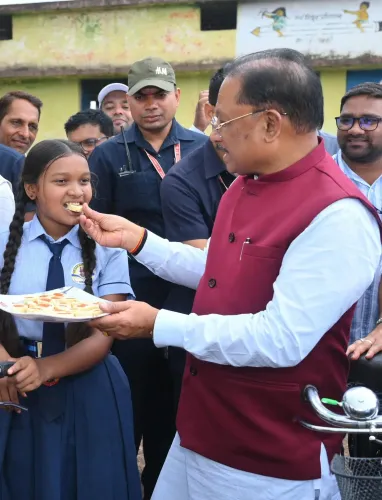
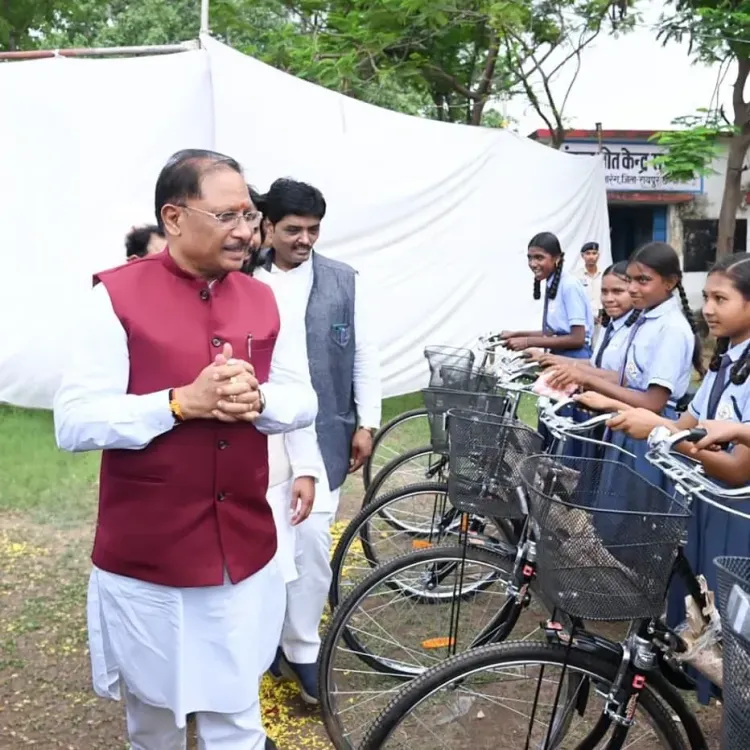
Chhattisgarh Chief Minister Vishnu Deo Sai attended a bicycle distribution event for schoolgirls at Samoda on 9 July 2026, saying educated and self-reliant daughters are the state's greatest strength and a pillar of its development vision.
Key Takeaways
CM Vishnu Deo Sai personally participated in a bicycle distribution event for girl students at Samoda, Chhattisgarh on 9 July 2026 .
The Chief Minister stated that states with educated, capable and self-reliant daughters reach new heights of development.
Chhattisgarh has run bicycle distribution programmes for schoolgirls since the early 2010s , modelled on Bihar's Mukhyamantri Balika Cycle Yojana of 2007 .
The initiative aligns with the national Beti Bachao Beti Padhao framework launched in 2015 , which guides state-level girls' education and safety interventions.
Bicycle transfers are widely documented to reduce secondary school dropout rates among girls in rural India by addressing distance-related barriers.
Future budget allocations and enrolment data will indicate whether the government's welfare commitments produce measurable gains in female literacy and retention.
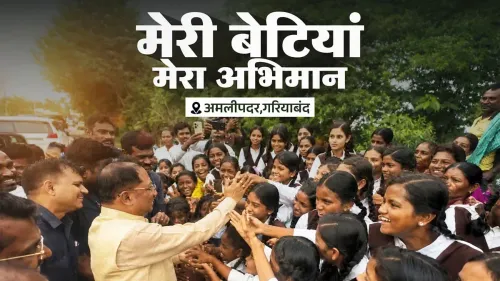
Chhattisgarh Chief Minister Vishnu Deo Sai on 9 July 2026 attended a bicycle distribution event for schoolgirls at Samoda, reaffirming his government's commitment to girls' education and self-reliance. Sharing his experience on X, Sai said the joy and confidence visible on the girls' faces strengthened his belief that educated and empowered daughters are the greatest strength of a developing Chhattisgarh.
In his post, written in Hindi, Sai stated: 'मेरा दृढ़ विश्वास है कि जिस राज्य की बेटियाँ शिक्षित, सक्षम और आत्मनिर्भर होती हैं, वही राज्य विकास की नई ऊँचाइयों को छूता है' ['It is my firm belief that the state whose daughters are educated, capable and self-reliant is the state that touches new heights of development']. He added that empowered daughters do not merely change their family's future — they change the direction of society and the condition of the state.
Context
The event at Samoda forms part of a broader pattern of asset-transfer programmes that Chhattisgarh has run for girl students since the early 2010s. Bicycle distribution schemes are designed to address one of the most persistent barriers to secondary schooling for girls in rural India: the distance between home and school. Chief Minister Sai, who took office in December 2023, has positioned such welfare events as central to his government's human development agenda.
Policy Backdrop
Chhattisgarh's bicycle programmes for girls draw from a model pioneered in Bihar in 2007 under the Mukhyamantri Balika Cycle Yojana, which demonstrated measurable gains in girls' secondary school enrolment. At the national level, the Beti Bachao Beti Padhao scheme, launched in 2015, provided a policy framework for state-level interventions on girls' education, safety and equal opportunity — a framework Chhattisgarh continues to build upon. Sai's post explicitly echoes the scheme's core philosophy, calling for 'quality education, a safe environment, equal opportunities and a full chance to hone every girl's talent.'
Stakeholders and Impact
The immediate beneficiaries are girl students in and around Samoda, drawn largely from rural and tribal households that make up a significant share of Chhattisgarh's population. Research across Indian states consistently shows that bicycle transfers reduce dropout rates at the secondary level and increase girls' mobility and confidence. For rural families, the bicycle also lowers the indirect cost of schooling by cutting commute time and removing dependence on paid transport.
What's Next
Attention will now turn to Chhattisgarh's next budget cycle and whether allocations for education and women-and-child welfare schemes are scaled up to match the government's stated ambitions. Published enrolment and retention data for secondary school girls will serve as a key measure of whether these on-ground events translate into sustained improvements in female literacy and workforce participation across the state.
Point of View
Giving this gesture substantive policy weight beyond symbolism. The move fits a wider BJP-ruled-state pattern of coupling human development optics with national schemes like Beti Bachao Beti Padhao to consolidate support among rural and tribal communities. The real test, however, will come when enrolment, retention and literacy data are published — numbers that will determine whether the government's stated vision translates into structural change.
NationPress
8 Oct 2026
Frequently Asked Questions
What did Chhattisgarh CM Vishnu Deo Sai do at Samoda on 9 July 2026?
CM Vishnu Deo Sai distributed bicycles to schoolgirls at Samoda, Chhattisgarh, and shared that the joy and confidence on the girls' faces reinforced his belief in girls' education as the foundation of the state's development.
What is the bicycle distribution scheme for girls in Chhattisgarh?
Chhattisgarh has operated bicycle distribution programmes for girl students since the early 2010s to reduce distance-related barriers to secondary schooling, modelled on Bihar's Mukhyamantri Balika Cycle Yojana launched in 2007.
How does Beti Bachao Beti Padhao relate to Chhattisgarh's girls' welfare programmes?
The national Beti Bachao Beti Padhao scheme, launched in 2015, provides the policy framework for state-level interventions on girls' education, safety and equal opportunity that Chhattisgarh continues to implement under CM Sai's government.
Why are bicycles given to girls in Indian states?
Bicycles are given to schoolgirls to address the distance barrier between home and school, which is a leading cause of dropout at the secondary level in rural India. Research shows such asset transfers improve enrolment and retention rates.
Who is Vishnu Deo Sai and when did he become Chhattisgarh CM?
Vishnu Deo Sai is a BJP leader who became Chief Minister of Chhattisgarh in December 2023. His government has prioritised social welfare programmes, including girls' education initiatives, as part of its development agenda.