CM Sai Champions Women's Empowerment in Chhattisgarh
Synopsis
Chhattisgarh Chief Minister Vishnu Deo Sai on 30 May 2026 underlined his government's commitment to women's empowerment, calling self-reliant women the economic and social backbone of a prosperous society and the foundation of a developed Chhattisgarh.
Key Takeaways
CM Vishnu Deo Sai posted on 30 May 2026 reaffirming the Chhattisgarh government's focus on women's empowerment.
He stated that self-reliant women give 'new direction to the economic and social strength' of families and society.
The government frames its approach under the 'Sushasan Sarkar' (good governance government) label, pledging to ensure women's dignity, security and self-reliance.
Chhattisgarh's Nari Shakti is described as the 'strong foundation' for building a Viksit Pradesh (developed state).
The messaging aligns with the national Mission Shakti framework launched in 2021 , which the state has integrated into its governance agenda.
Budget allocations and scheme implementation reports in the next assembly session will be the key test of these commitments.
Chhattisgarh Chief Minister Vishnu Deo Sai on Saturday, 30 May 2026, reaffirmed his government's commitment to women's empowerment, declaring that self-reliant women are the foundation of a prosperous society and a developed state.
Context
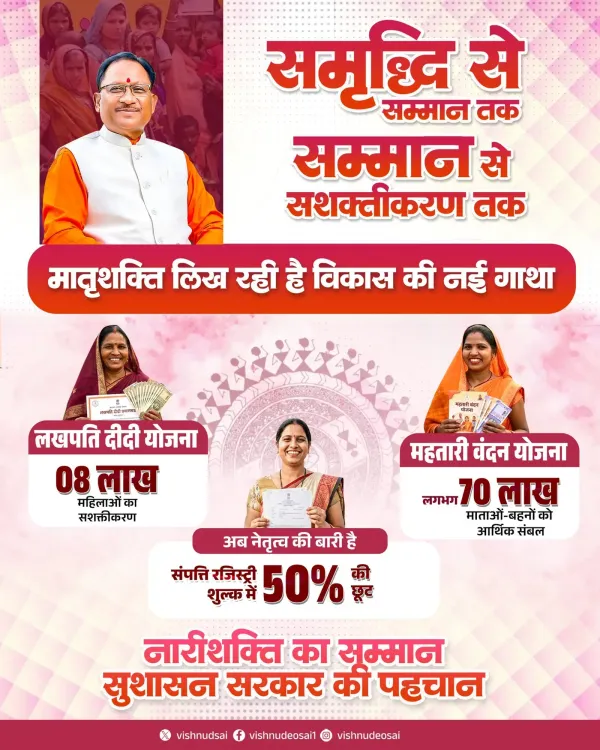
Posting in Hindi, CM Sai wrote: 'जहाँ नारी सशक्त होती है, वहाँ समाज समृद्ध होता है' ['Where women are empowered, society prospers']. He described self-reliant women as forces that give 'new direction to the economic and social strength of the entire society, along with the family.'
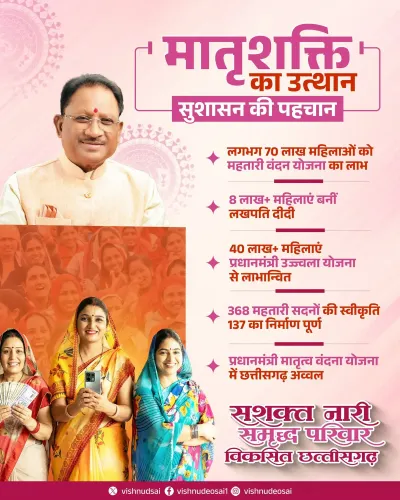
The post was accompanied by an image and comes as the BJP-led Chhattisgarh government continues to position women's welfare as a central pillar of its governance agenda following its return to power after the 2023 assembly elections.
Policy Backdrop
The messaging aligns with the national Mission Shakti framework, launched in 2021, which consolidated multiple schemes targeting women's safety, security, and economic empowerment under a single umbrella. Chhattisgarh has since incorporated these priorities into its state-level programming.
CM Sai's statement invokes the concept of 'Sushasan Sarkar' — 'good governance government' — a phrase his administration uses to describe its policy orientation. He stated that this government 'continuously works to ensure the dignity, security and self-reliance of women.'
The framing of women's empowerment as an economic multiplier — not merely a welfare outcome — is consistent with a broader BJP governance narrative seen across multiple states, where 'Nari Shakti' is presented as integral to development targets.
Stakeholders and Impact
The primary beneficiaries of the policies invoked in the post are Chhattisgarh's women across rural and urban areas, particularly those engaged with self-help groups, skill development programmes, and state-sponsored livelihood schemes. Their participation is increasingly cited by the government as evidence of progress toward a 'Viksit Pradesh' — a developed state.
Families across the state are also identified as indirect stakeholders, with the government arguing that women's economic independence strengthens household and community resilience. Civil society organisations monitoring gender indicators in central India will watch whether this rhetorical commitment translates into measurable budget allocations.
What's Next
Attention will now turn to the next Chhattisgarh assembly session, where budget allocations and scheme implementation reports for women-centric programmes will provide a concrete measure of the government's stated priorities. Analysts will assess whether the 'Nari Shakti' framing is backed by new fiscal commitments or expanded programme coverage.
As CM Sai continues to build his administration's governance record ahead of future electoral cycles, women's empowerment is expected to remain a prominent theme in both policy announcements and political communication from Raipur.
Point of View
The messaging attempts to bridge welfare politics with economic aspiration, a formulation that has proven electorally effective for the party nationally. The invocation of 'Sushasan Sarkar' also serves a dual purpose: it distances the current administration from the previous Congress government while setting a self-defined benchmark against which its own performance can be measured. Whether this rhetorical consistency is matched by programme delivery will determine its long-term political dividend.
NationPress
14 Oct 2026
Frequently Asked Questions
What did Chhattisgarh CM Vishnu Deo Sai say about women's empowerment?
CM Vishnu Deo Sai stated on 30 May 2026 that where women are empowered, society prospers, and that his government continuously works to ensure women's dignity, security and self-reliance as part of its 'Sushasan Sarkar' agenda.
What is Mission Shakti and how does it relate to Chhattisgarh?
Mission Shakti is a national framework launched in 2021 that consolidates schemes for women's safety, security and economic empowerment. Chhattisgarh's BJP government has aligned its state-level women's welfare programmes with this framework since assuming office after the 2023 elections.
What does 'Nari Shakti' mean in Indian politics?
'Nari Shakti' translates to 'women's power' or 'women's strength' in Hindi. In Indian political discourse, it is widely used by BJP-led governments to frame women's empowerment as both a welfare goal and an economic and social development multiplier.
What is Vishnu Deo Sai's position and which party does he belong to?
Vishnu Deo Sai is the Chief Minister of Chhattisgarh and a senior leader of the Bharatiya Janata Party (BJP). He assumed office following the BJP's victory in the 2023 Chhattisgarh assembly elections.
What schemes does the Chhattisgarh government run for women's empowerment?
The Chhattisgarh government has aligned with the national Mission Shakti framework and runs state-level programmes focused on women's safety, self-help groups, skill development and livelihood support, though no new specific scheme was announced in this particular post.