Nvidia's Jensen Huang Meets Macron at Élysée Over France AI Push
Synopsis
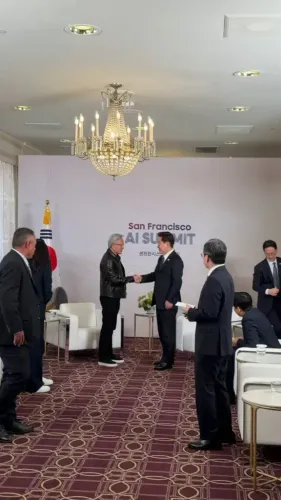
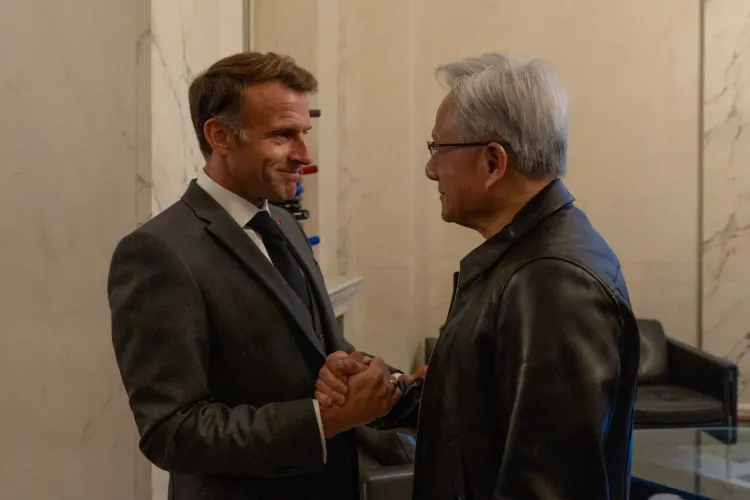
Nvidia CEO Jensen Huang met French President Emmanuel Macron at the Élysée Palace in Paris on 14 October 2026, holding talks on Nvidia's investments in France's AI ecosystem, open-source AI, and safety frameworks — a high-profile prelude to NVIDIA GTC Berlin.
Key Takeaways
Jensen Huang met President Emmanuel Macron at the Élysée Palace in Paris on 14 October 2026 .
Discussions covered Nvidia's investments in France's AI ecosystem , open-source AI models, and AI safety.
France launched a national AI strategy in 2018 with €1.5 billion in committed investment, making it Europe's most active AI policy mover.
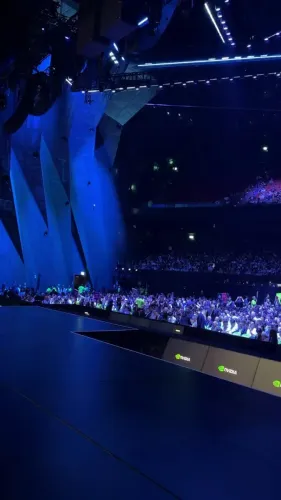
The meeting precedes NVIDIA GTC Berlin , where European AI investment and partnership announcements are anticipated.
Nvidia regularly engages European heads of state as it navigates the EU AI Act and digital-sovereignty policy debates.
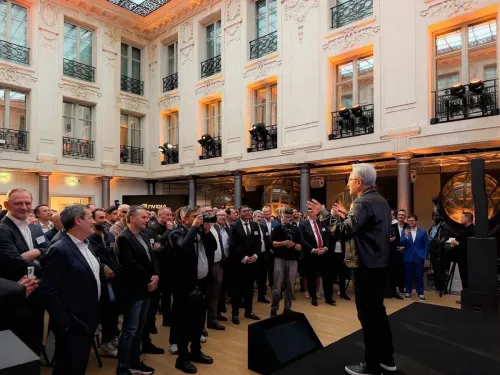
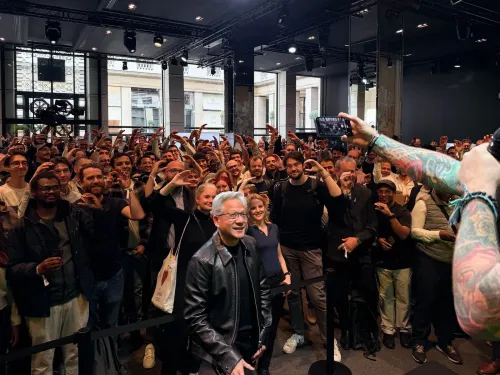
Before NVIDIA GTC Berlin even opens its doors, the company's road to Europe has already made a high-stakes detour through the French presidency. Nvidia CEO Jensen Huang concluded his Paris visit at the Élysée Palace on Wednesday, 14 October 2026, sitting down with French President Emmanuel Macron to discuss Nvidia's investments in France's AI ecosystem, open-source development, and AI safety.
What Huang and Macron Discussed at the Élysée
The meeting covered three interlocking themes: Nvidia's financial and infrastructure commitments to France, the role of open-source AI models in accelerating research, and the guardrails that AI safety frameworks must provide. The Élysée — France's seat of executive power and the venue for its most consequential bilateral engagements — lent the encounter unmistakable diplomatic weight. Nvidia confirmed the discussion in a post on X, noting that 'our road to #NVIDIAGTC Berlin continues,' signalling the Paris stopover as a deliberate warm-up act before a major European tech showcase.
Macron's AI Ambitions and the French Ecosystem Bet
France has been one of Europe's most aggressive movers on AI policy. In 2018, President Macron launched a national AI strategy backed by €1.5 billion in committed investment, targeting research talent, compute infrastructure, and industrial application. That foundation has since anchored a string of high-profile foreign tech engagements, with Paris positioning itself as the preferred European gateway for global AI capital. A sit-down with the world's dominant GPU maker fits squarely inside that playbook.
Nvidia's European Diplomatic Cadence
The Paris meeting is no isolated event. Nvidia leadership has built a steady rhythm of engaging European heads of state and ministers as the company expands its data-centre footprint and navigates the continent's regulatory landscape — most prominently the EU AI Act, which sets binding rules on high-risk AI systems and shapes procurement decisions across member states. Open-source AI models sit at the centre of that regulatory conversation: whether and how foundation models are released openly has become a flashpoint between innovation advocates and safety regulators.
For Nvidia, whose revenue engine runs on the chips that power every major AI training cluster in Europe, being in the room when those norms are written is not optional — it is strategy.
Eyes Now on NVIDIA GTC Berlin
With the Paris leg complete, attention shifts to NVIDIA GTC Berlin, where the company is expected to make announcements with direct European resonance — potentially covering investment commitments, partnership frameworks, or hardware roadmap details tailored to EU digital-sovereignty requirements. GTC events have historically served as Nvidia's primary platform for major product and ecosystem reveals, and a European edition carries obvious geopolitical staging.
The sequence — Élysée meeting, then GTC stage — suggests Nvidia is not merely selling chips in Europe. It is shaping the continent's AI conversation from the very top.
Point of View
Nvidia positions itself as a partner in European digital sovereignty rather than a foreign vendor subject to it. France's early-mover AI strategy and its willingness to court US tech capital gives Nvidia a politically credible European beachhead. The open-source and AI safety agenda items also signal that Nvidia is proactively engaging with the normative debates that will shape EU AI Act implementation — a calculation that hardware dominance alone no longer insulates a company from policy risk.
NationPress
14 Oct 2026
Frequently Asked Questions
Why did Jensen Huang visit Paris and meet President Macron?
Jensen Huang visited Paris to meet French President Emmanuel Macron at the Élysée Palace to discuss Nvidia's investments in France's AI ecosystem, open-source AI development, and AI safety frameworks, ahead of the NVIDIA GTC Berlin event.
What is NVIDIA GTC Berlin?
NVIDIA GTC Berlin is a major European edition of Nvidia's GPU Technology Conference, where the company is expected to announce AI investments, partnerships, and hardware roadmap details relevant to the European market.
What is France's national AI strategy?
France launched its national AI strategy in 2018 under President Macron, committing €1.5 billion to AI research, talent development, and compute infrastructure to strengthen Europe's position in the global AI race.
How does the EU AI Act affect Nvidia's European business?
The EU AI Act sets binding rules on high-risk AI systems and influences procurement across EU member states. Nvidia, as the dominant AI chip supplier in Europe, actively engages with policymakers to shape how these rules are written and implemented.
What is the significance of Nvidia engaging European heads of state?
Nvidia's regular engagement with European leaders reflects a strategic move to embed itself in digital-sovereignty and regulatory conversations — ensuring its hardware and software ecosystem is treated as a partner in Europe's AI future, not merely a commercial vendor.