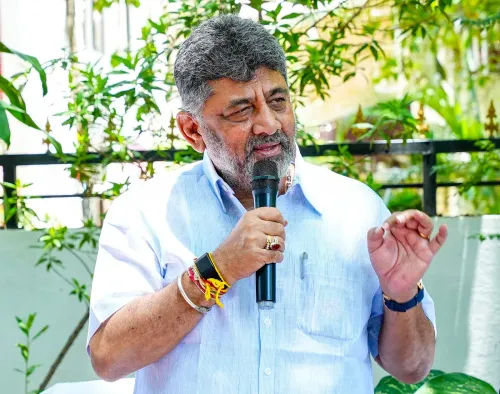
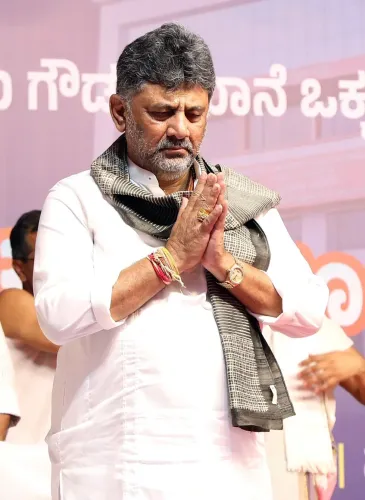
Rijiju Dares Shivakumar to Defy Rahul Gandhi Over 'Humiliation'

Synopsis
Union Minister Kiren Rijiju publicly challenged Karnataka CM D.K. Shivakumar to stand up against Rahul Gandhi over an alleged humiliation, drawing a pointed comparison with Himanta Biswa Sarma's exit from the Congress to the BJP.
Key Takeaways
Kiren Rijiju posted on October 14, 2026 daring Karnataka CM D.K.
Shivakumar to confront Rahul Gandhi over an alleged humiliation.
Rijiju invoked Himanta Biswa Sarma's departure from the Congress to the BJP in 2015 as the template for Shivakumar to follow.
Shivakumar is known for strongly emphasising his Kannadiga identity and ties to Karnataka's language and culture.
The specific incident of 'humiliation' cited by Rijiju has not been independently confirmed.
The move continues a broader BJP pattern of publicly highlighting perceived tensions between Congress's central leadership and state-level leaders.
No response from Shivakumar's office or the Congress had been issued at the time of publication.
A sharp political dare landed Wednesday morning when Union Parliamentary Affairs Minister Kiren Rijiju publicly challenged Karnataka Chief Minister D.K. Shivakumar to stand up against Congress leader Rahul Gandhi, alleging the senior party figure had humiliated him — and invoking Assam Chief Minister Himanta Biswa Sarma's break from the Congress as the template.
Rijiju's post, shared on October 14, 2026, reads: 'Chief Minister of Karnataka Shri D.K. Shivakumar ji identifies himself as a proud Kannadiga and frequently emphasizes his deep ties to Karnataka's language, culture, and people. He will surely stand up against Rahul Gandhi Ji for humiliating him, the way Himanta Ji stood.'
The Himanta Parallel: A Loaded Historical Reference
The reference to Himanta Biswa Sarma carries unmistakable political weight. Sarma served for years as a powerful Congress minister in Assam before a very public falling-out with the party's national leadership — a rupture he attributed partly to feeling sidelined — led him to cross over to the BJP in 2015. He subsequently became one of the party's most prominent figures in the Northeast and was sworn in as Assam Chief Minister. By invoking Sarma, Rijiju is essentially pointing to the BJP's most successful example of poaching a Congress heavyweight by spotlighting internal friction.
Shivakumar, meanwhile, has long cultivated his identity as a deeply rooted Kannadiga — a political brand built on pride in the state's Kannada language, its culture, and its people. That identity now becomes the rhetorical lever Rijiju is pulling: if Shivakumar truly puts Karnataka above party, the argument goes, he cannot absorb a humiliation from a national Congress figure in silence.
BJP's Recurring Play on Congress's Internal Tensions
This is not the first time senior BJP voices have publicly amplified perceived friction between Congress's central leadership and its state-level heavyweights. The party has periodically highlighted such fault lines — particularly in states where the Congress governs — as part of a broader messaging strategy. The pattern is familiar: identify a regional leader with strong local identity, assert that the national leadership has slighted them, and frame defection or rebellion as a principled, identity-driven move.
Whether Shivakumar responds — publicly or pointedly through silence — will now be watched closely by Karnataka's political class. His position as both Chief Minister and one of the Congress's most reliable fund-raisers gives him considerable leverage within the party, making any sign of discord newsworthy well beyond state borders.
The specific incident Rijiju describes as a 'humiliation' cannot be independently confirmed at this stage, and neither Shivakumar's office nor the Congress has responded as of publication. But the dare is on the record — and in Indian politics, unanswered dares have a habit of asking the question again.
Point of View
The BJP makes any non-response look like an identity compromise. The Himanta Sarma reference is not incidental — it is the party's clearest proof of concept that this playbook can deliver a Chief Minister. Whether Shivakumar's entrenched position inside the Congress makes him immune to such overtures, or whether underlying tensions give the jibe traction, will define how this plays out in Karnataka's politically volatile landscape.
NationPress
14 Oct 2026
Frequently Asked Questions
Why did Kiren Rijiju mention Himanta Biswa Sarma in the post about Shivakumar?
Rijiju cited Sarma as a precedent — Sarma was a senior Congress leader who left the party after feeling sidelined by the national leadership and later became BJP's Chief Minister of Assam. Rijiju implied Shivakumar could follow the same path if he has been humiliated by Rahul Gandhi.
What is the alleged humiliation of D.K. Shivakumar by Rahul Gandhi?
The specific incident Rijiju refers to has not been independently confirmed as of publication. Rijiju's post alleges it without providing details, and neither the Congress nor Shivakumar's office had responded publicly at the time of this report.
Who is D.K. Shivakumar?
D.K. Shivakumar is the Chief Minister of Karnataka from the Indian National Congress. He is known as a powerful organiser and fund-raiser for the party and has long emphasised his identity as a proud Kannadiga.
Why does BJP frequently comment on Congress's internal matters?
The BJP uses public commentary on Congress's internal tensions as a political messaging strategy — particularly to highlight friction between national leadership and state leaders, and to signal that regional identities are better protected outside the Congress.
Has D.K. Shivakumar responded to Rijiju's dare?
No. As of the time of publication, neither Shivakumar nor the Congress party had issued a public response to Rijiju's post.