CM Sai Cites Pump Energisation, Subsidy Rise in No-Trust Reply
Synopsis
Chhattisgarh CM Vishnu Deo Sai, replying to an opposition no-confidence motion in the state assembly on 18 July 2026, claimed his BJP government energised over 1.02 lakh irrigation pumps in 2.5 years — surpassing the previous Congress government's 78,898 — and raised farmer electricity subsidies from Rs 9,145 crore to Rs 14,198 crore.
Key Takeaways
CM Vishnu Deo Sai addressed the Chhattisgarh Vidhan Sabha on 18 July 2026 during a debate on an opposition no-confidence motion.
The BJP government claims to have energised 1,02,845 irrigation pumps in two and a half years , compared to 78,898 under the previous Congress government.
Electricity subsidy for farmers has reportedly risen from Rs 9,145 crore to Rs 14,198 crore under the current administration.
The figures were cited as evidence of the government's commitment to farmers and as a rebuttal to the opposition's no-confidence motion.
The BJP replaced the Congress government led by Bhupesh Baghel in December 2023 after winning the state assembly elections.
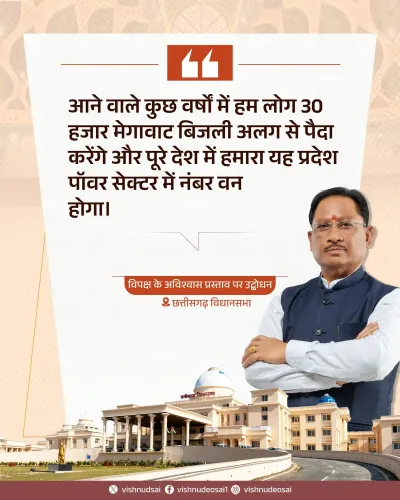
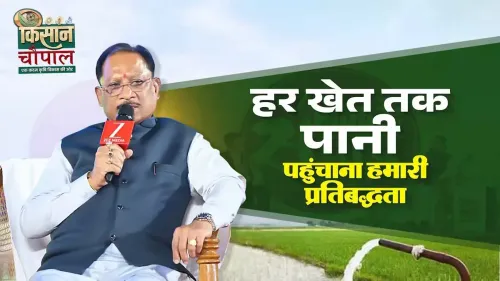
Chhattisgarh Chief Minister Vishnu Deo Sai on Saturday, 18 July 2026, addressed the Chhattisgarh Vidhan Sabha during a debate on an opposition-moved no-confidence motion, citing irrigation pump energisation numbers and electricity subsidy figures to argue that his government has outperformed the previous Congress administration on agricultural welfare.
Context
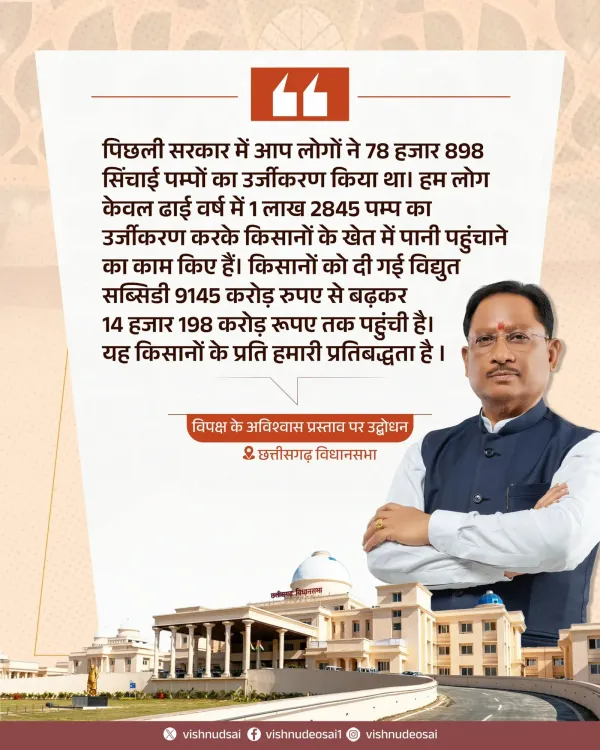
Speaking on the floor of the state assembly, CM Sai declared: 'पिछली सरकार में आप लोगों ने 78 हजार 898 सिंचाई पम्पों का उर्जीकरण किया था' ('In the previous government, you energised 78,898 irrigation pumps'). He contrasted that figure with his own government's claim of energising 1,02,845 pumps in just two and a half years, asserting that this work has delivered water directly to farmers' fields. The statement was delivered as a formal address — udbodhan — on the opposition's no-confidence motion.
Policy Backdrop
Irrigation pump energisation — connecting agricultural pump sets to the electricity grid — has been a flagship rural welfare metric for successive Chhattisgarh governments, given the state's large farming population and dependence on groundwater for kharif and rabi cultivation. The BJP government, which came to power in December 2023 after defeating the Congress administration led by Bhupesh Baghel, has consistently sought to draw a performance contrast with the five-year Congress tenure from 2018 to 2023.
On electricity subsidies for farmers, CM Sai stated that the power subsidy has risen from Rs 9,145 crore to Rs 14,198 crore, describing the increase as evidence of the government's commitment to the agrarian community. 'यह किसानों के प्रति हमारी प्रतिबद्धता है' — 'This is our commitment to farmers' — he said, closing his argument on the subsidy point.
Stakeholders and Impact
The primary beneficiaries cited in the Chief Minister's address are Chhattisgarh's farming households, who depend on subsidised electricity to run irrigation pumps, particularly in rain-shadow and semi-arid pockets of the state. A higher pump energisation count, if borne out by ground-level data, would translate to expanded irrigated acreage and reduced dependence on erratic monsoon rainfall.
The opposition's no-confidence motion itself signals that the Indian National Congress and allied parties are contesting the government's narrative on rural delivery. Such motions in state assemblies, while rarely successful for the opposition when the ruling party holds a clear majority, serve as a structured platform for accountability debates and are closely watched by rural voter blocs ahead of the next election cycle.
What's Next
The outcome of the no-confidence motion vote in the Chhattisgarh Vidhan Sabha will be the immediate political marker to watch. Beyond the floor vote, independent verification of the pump energisation and subsidy figures — through the state power department's annual report or budget documents — will determine how the claims hold up to scrutiny. Agricultural groups and opposition legislators are likely to demand audited data on actual connections established versus targets set.
Point of View
Particularly on irrigation and power subsidies that resonate deeply with Chhattisgarh's rural electorate. The choice to lead with a numerical comparison against the Baghel-era Congress government reflects the BJP's broader state-level strategy of framing governance as a performance contest rather than an ideological one. The scale of the claimed subsidy increase — from Rs 9,145 crore to Rs 14,198 crore — is politically significant, as farm power subsidies are among the most visible and electorally sensitive line items in any state budget. Whether these figures withstand independent audit will shape the credibility of the BJP's rural governance narrative heading into the next electoral cycle.
NationPress
17 Oct 2026
Frequently Asked Questions
What did CM Vishnu Deo Sai say in the Chhattisgarh assembly no-confidence debate?
CM Vishnu Deo Sai claimed his government energised over 1,02,845 irrigation pumps in two and a half years, compared to 78,898 under the previous Congress government, and raised farmer electricity subsidies from Rs 9,145 crore to Rs 14,198 crore.
How many irrigation pumps did the Chhattisgarh BJP government energise?
According to CM Sai's statement in the Vidhan Sabha, the BJP government energised 1,02,845 irrigation pumps in approximately two and a half years since taking office in December 2023.
What is the farmer electricity subsidy in Chhattisgarh in 2026?
CM Sai stated in the assembly that the electricity subsidy for farmers has reached Rs 14,198 crore, up from Rs 9,145 crore under the previous Congress administration.
Who moved the no-confidence motion in the Chhattisgarh Vidhan Sabha?
The no-confidence motion was moved by the opposition in the Chhattisgarh Vidhan Sabha; CM Sai's post identifies his speech as an address on that motion, with the Congress as the principal opposition party in the state.
How long has Vishnu Deo Sai been Chief Minister of Chhattisgarh?
Vishnu Deo Sai became Chief Minister of Chhattisgarh in December 2023 after the BJP's victory in the state assembly elections, making him approximately two and a half years into his tenure as of July 2026.