CM Chhattisgarh Approves Rs 15,000/Acre Aid for Crop Shift
Synopsis
Chhattisgarh's cabinet has approved a revised Krishi Unnati Yojana offering Rs 15,000 per acre to farmers who switch from paddy to pulses, oilseeds, maize, or millets from Kharif 2026, using AgriStack and digital crop surveys for benefit delivery.
Key Takeaways
The Chhattisgarh cabinet approved a revised Krishi Unnati Yojana on 9 June 2026 .
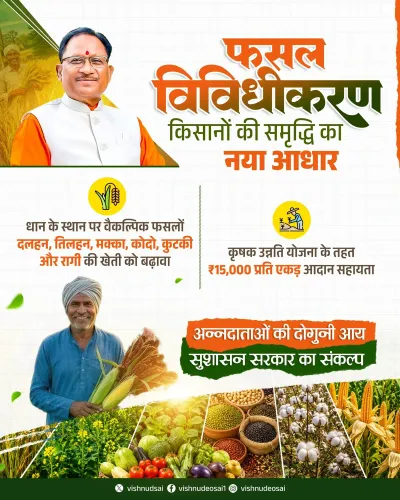
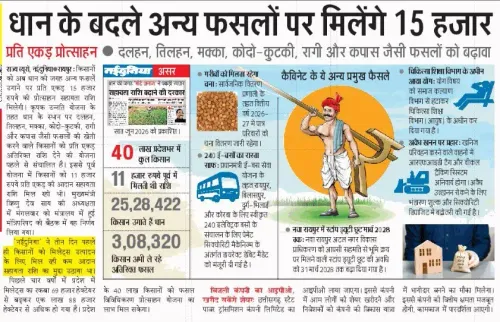
Farmers replacing paddy with pulses, oilseeds, maize, kodo, kutki, ragi, or cotton will receive Rs 15,000 per acre in input support.
Benefits will be delivered via the integrated farmer portal , AgriStack registration , and digital crop survey .
The scheme aims to reduce excessive dependence on paddy, increase farmer income, and promote water conservation .
Implementation begins from the Kharif 2026 season.
Tribal farming communities cultivating traditional millets such as kodo, kutki, and ragi are among the key beneficiaries.
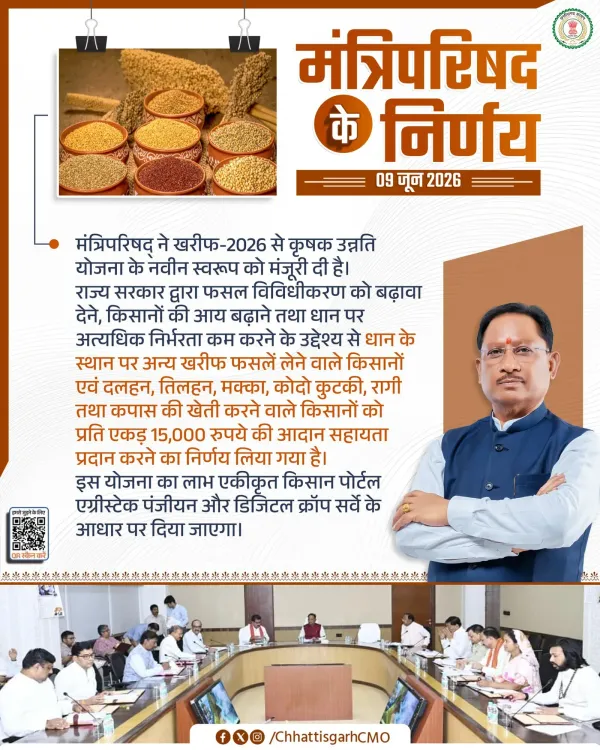
The Chief Minister's Office of Chhattisgarh announced on Tuesday, 9 June 2026 that the state cabinet has approved a revised version of the Krishi Unnati Yojana, offering farmers Rs 15,000 per acre in input support to shift away from paddy cultivation towards alternative kharif crops starting Kharif 2026.
Context
The cabinet decision, shared by the official Chief Minister's Office account, states that farmers who replace paddy with pulses, oilseeds, maize, kodo, kutki, ragi, or cotton will receive the per-acre input assistance. In the original Hindi announcement: 'धान के स्थान पर अन्य खरीफ फसलें लेने वाले किसानों को प्रति एकड़ 15,000 रुपये की आदान सहायता' — meaning 'farmers who take other kharif crops in place of paddy will receive input support of Rs 15,000 per acre.' The benefit will be delivered through the integrated farmer portal, AgriStack registration, and digital crop survey data.
Policy Backdrop
Chhattisgarh is one of central India's largest paddy-producing states, with significant tribal farming communities traditionally cultivating millets such as kodo, kutki, and ragi. Heavy dependence on paddy has long been associated with groundwater stress in the state's plains, and successive governments have sought to rebalance the crop mix. The revised Krishi Unnati Yojana builds on a national policy trajectory that includes the National Mission on Sustainable Agriculture launched in 2011, which promoted crop diversification and water conservation across rain-fed farming regions.
The move also aligns with the national spotlight on millets following the International Year of Millets 2023, during which the Government of India pushed states to expand acreage under nutritious, drought-resistant crops. By tying benefits to AgriStack — the central government's national digital agriculture stack — Chhattisgarh is positioning itself among states that use farmer registries and digital crop surveys for targeted, leakage-free subsidy delivery.
Stakeholders and Impact
The primary beneficiaries are Chhattisgarh's paddy farmers who voluntarily switch to pulses, oilseeds, maize, or millets. The government stated that the decision will increase the acreage under pulses, oilseeds, and alternative crops, improve farmer incomes, and promote long-term stability in the agriculture sector alongside water conservation. Tribal farming households in districts where kodo, kutki, and ragi are traditional crops stand to gain both financially and through the formal recognition of their crop choices within the digital agriculture ecosystem.
Several other rice-producing states have introduced similar incentive structures in recent years to address groundwater depletion and diversify dietary supply chains. Chhattisgarh's Rs 15,000-per-acre rate is among the more prominent state-level offers in this category, though direct comparisons depend on local input cost structures.
What's Next
Implementation is scheduled from the Kharif 2026 season, with eligibility determined through AgriStack farmer registration and a digital crop survey. The government's stated markers of success will be measurable shifts in area sown under alternative crops, which official digital crop survey data at the end of the season will reflect. Observers will watch whether the incentive is sufficient to overcome the price-support certainty that paddy cultivation has historically offered farmers in the state.
Point of View
Which has long been paddy-dominant due to guaranteed procurement. By anchoring the Rs 15,000-per-acre incentive to AgriStack and digital crop surveys, the government is also advancing the central agenda of building a verifiable, data-driven farm-subsidy architecture. The inclusion of traditional tribal millets — kodo, kutki, ragi — alongside commercial crops like cotton and maize suggests an attempt to bridge subsistence farming with formal income-support frameworks. Whether the financial incentive can consistently outweigh the procurement certainty of paddy will be the defining test of the scheme's uptake.
NationPress
20 Sept 2026
Frequently Asked Questions
What is the Krishi Unnati Yojana in Chhattisgarh?
Krishi Unnati Yojana is a Chhattisgarh state agricultural scheme whose revised version, approved in June 2026, provides Rs 15,000 per acre in input support to farmers who shift from paddy to alternative kharif crops such as pulses, oilseeds, maize, millets, and cotton.
How much will Chhattisgarh farmers get for not growing paddy?
Farmers in Chhattisgarh who replace paddy with qualifying alternative kharif crops will receive Rs 15,000 per acre as input assistance under the revised Krishi Unnati Yojana starting Kharif 2026.
Which crops are eligible under Chhattisgarh's crop diversification scheme?
Eligible crops include pulses, oilseeds, maize, kodo, kutki, ragi, and cotton — all grown as alternatives to paddy during the kharif season.
How will the benefit be delivered to farmers in Chhattisgarh?
The benefit will be delivered based on AgriStack farmer registration, the integrated farmer portal, and digital crop survey data to ensure targeted and verifiable disbursement.
When does the new Chhattisgarh Krishi Unnati Yojana take effect?
The revised scheme takes effect from the Kharif 2026 season, as approved by the Chhattisgarh cabinet on 9 June 2026.