Chhattisgarh CMO Announces ₹15,000/Acre Aid for Crop Diversification
Synopsis
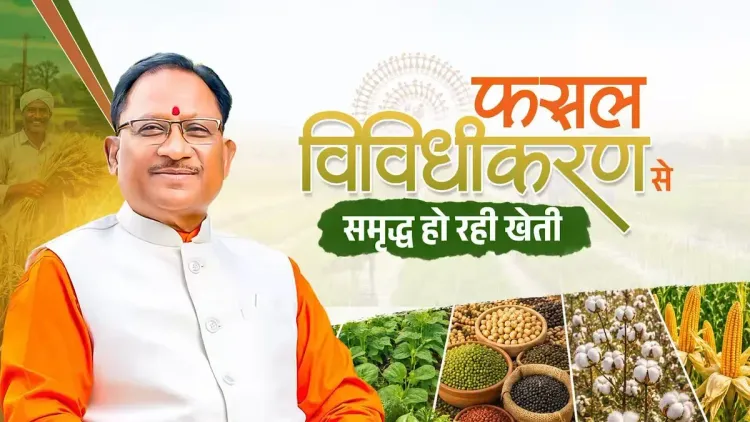
The Chhattisgarh CMO announced on 10 July 2026 that farmers cultivating pulses, oilseeds, maize, kodo, kutki and ragi under the Krishak Unnati Yojana will receive ₹15,000 per acre in input assistance, as the state government pushes crop diversification to raise farm incomes and reduce paddy monoculture.
Key Takeaways
The Chief Minister's Office of Chhattisgarh announced the decision on 10 July 2026 via its official X account.
Farmers shifting to alternative crops — pulses, oilseeds, maize, kodo, kutki, and ragi — will receive ₹15,000 per acre in input assistance.
The support is channelled through the Krishak Unnati Yojana , a state scheme targeting non-paddy cultivation.
The move targets small and tribal farmers in Chhattisgarh who are heavily dependent on paddy monoculture.
The scheme builds on Chhattisgarh's earlier Rajiv Gandhi Kisan Nyay Yojana (2020), extending direct financial support to specific crop choices.
Beneficiary registration, acreage verification, and disbursement timelines ahead of the kharif season are the critical next steps.
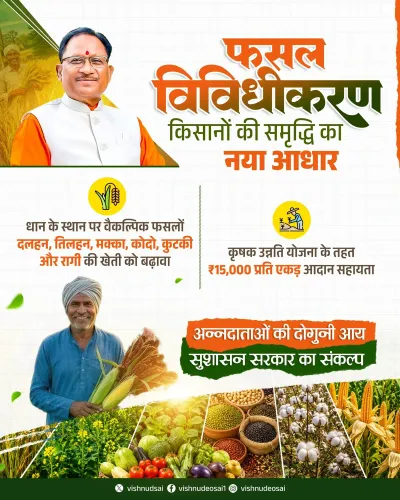
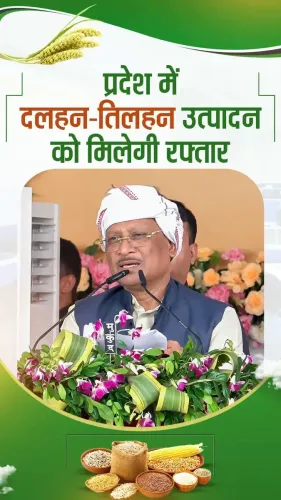
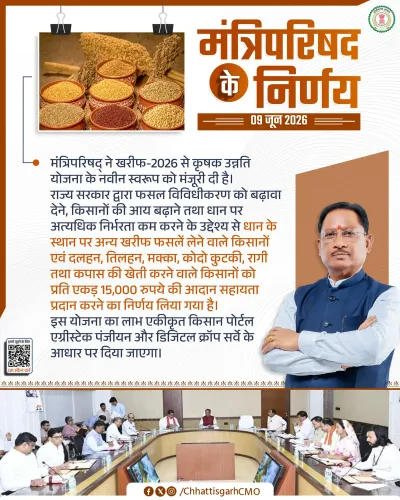
The Chief Minister's Office of Chhattisgarh announced on 10 July 2026 that the state government is actively promoting alternative crops — including pulses, oilseeds, maize, kodo, kutki, and ragi — alongside paddy, and has decided to provide input assistance of ₹15,000 per acre to farmers cultivating these crops under the Krishak Unnati Yojana.
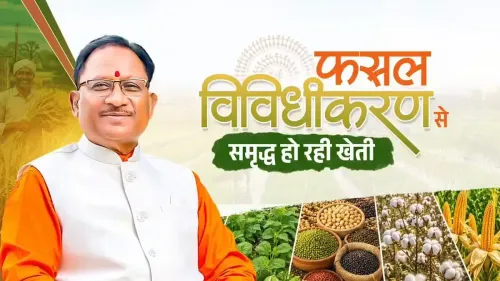
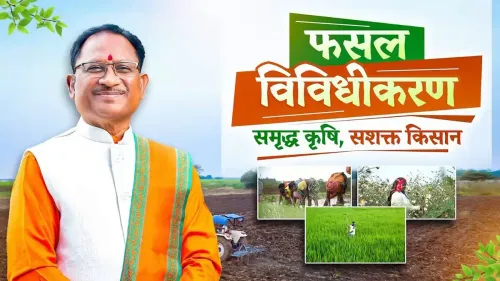
The post, shared from the official CMO handle, states: 'सुशासन सरकार धान के साथ-साथ दलहन, तिलहन, मक्का, कोदो, कुटकी और रागी जैसी वैकल्पिक फसलों को बढ़ावा दे रही है' ('The good-governance government is promoting alternative crops such as pulses, oilseeds, maize, kodo, kutki and ragi alongside paddy'). The announcement frames crop diversification as a 'strong means of increasing farmers' income and making farming more profitable.'
Context
Chhattisgarh has historically been one of India's major paddy-producing states, with a large share of its farming population — including a significant tribal farming community — dependent on a single kharif crop. While paddy cultivation has provided income stability, monoculture dependence has raised concerns around groundwater depletion, soil health, and vulnerability to price and weather shocks.
The state's pivot toward millets and pulses aligns with a broader national push. India championed millets globally during the International Year of Millets in 2023, and the National Food Security Mission has targeted pulses and oilseeds since 2007 to reduce import dependence and improve nutritional security.
Policy Backdrop
The Krishak Unnati Yojana is a state-level scheme designed to provide direct input support to farmers who shift away from paddy toward alternative crops. The ₹15,000 per acre assistance is intended to offset the initial cost differential that often discourages farmers from experimenting with less-familiar crops.
This follows the earlier Rajiv Gandhi Kisan Nyay Yojana, launched in 2020, which delivered direct income support to Chhattisgarh's farmers and established the state's template of cash-transfer-linked agricultural incentives. The Krishak Unnati Yojana builds on that architecture by tying support to specific diversification choices rather than to paddy acreage alone.
Stakeholders and Impact
The primary beneficiaries are small and tribal farmers across Chhattisgarh who currently rely on paddy as their principal crop. For these households, the per-acre input subsidy can meaningfully reduce the financial risk of switching to crops such as ragi, kodo, and kutki — millets that are nutritionally dense, drought-tolerant, and better suited to rain-fed conditions prevalent in tribal belt districts.
Oilseeds and pulses, meanwhile, address a structural gap in domestic supply chains. Several Indian states — including Madhya Pradesh, Maharashtra, and Rajasthan — have run similar diversification incentives, and Chhattisgarh's scheme mirrors those efforts by directly linking financial assistance to alternative-crop acreage.
What's Next
The immediate focus will be on beneficiary registration, acreage verification, and the disbursement schedule under Krishak Unnati Yojana ahead of the upcoming kharif season. Operational details — including eligibility criteria and the verification mechanism for alternative-crop cultivation — will determine how effectively the ₹15,000-per-acre support reaches intended beneficiaries.
If implemented at scale, the scheme could shift Chhattisgarh's cropping pattern in ways that reduce pressure on irrigation infrastructure while diversifying farmer income streams — a model that other paddy-dominant states are likely to watch closely.
Point of View
000 subsidy specifically to alternative-crop cultivation, the scheme creates a direct financial nudge rather than relying on advisory outreach alone — an approach that has shown more traction in comparable state programmes. The timing, ahead of the kharif season, suggests an intent to influence planting decisions in the near term rather than as a long-horizon policy signal. Whether the scheme achieves meaningful diversification at scale will hinge on the speed and transparency of the beneficiary verification and disbursement mechanism.
NationPress
8 Oct 2026
Frequently Asked Questions
What is the Krishak Unnati Yojana in Chhattisgarh?
The Krishak Unnati Yojana is a Chhattisgarh state scheme that provides direct input assistance to farmers who cultivate alternative crops such as pulses, oilseeds, maize, kodo, kutki and ragi instead of — or alongside — paddy. The scheme offers ₹15,000 per acre to eligible farmers.
How much financial assistance will Chhattisgarh farmers get under crop diversification?
Farmers cultivating alternative crops under the Krishak Unnati Yojana will receive ₹15,000 per acre as input assistance, according to the announcement made by the Chief Minister's Office of Chhattisgarh on 10 July 2026.
Which crops are covered under Chhattisgarh's crop diversification scheme?
The scheme covers pulses (dahan), oilseeds (tilhan), maize (makka), kodo, kutki and ragi, in addition to promoting a shift away from exclusive paddy cultivation.
Who will benefit from the Krishak Unnati Yojana in Chhattisgarh?
The primary beneficiaries are small and tribal farmers across Chhattisgarh who currently depend on paddy as their main crop and are willing to cultivate government-identified alternative crops.
Why is Chhattisgarh promoting crop diversification?
Chhattisgarh is promoting crop diversification to increase farmers' incomes, reduce dependence on water-intensive paddy monoculture, improve soil health, and build climate resilience — goals that align with national missions on millets, pulses and oilseeds.