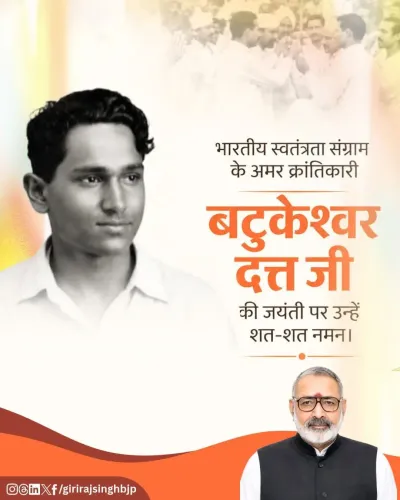
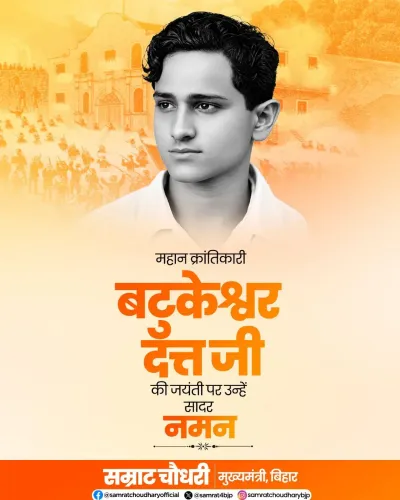
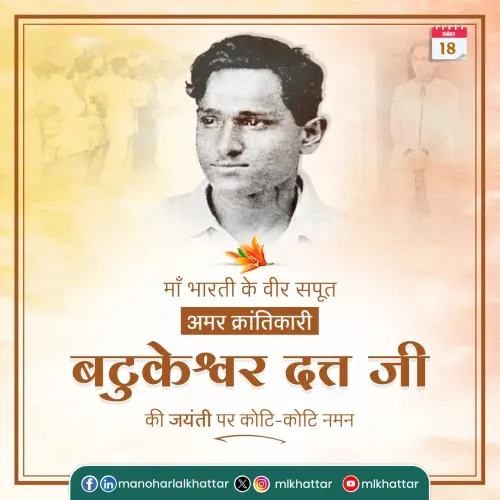
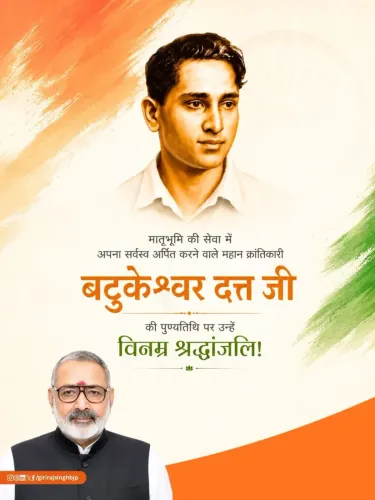
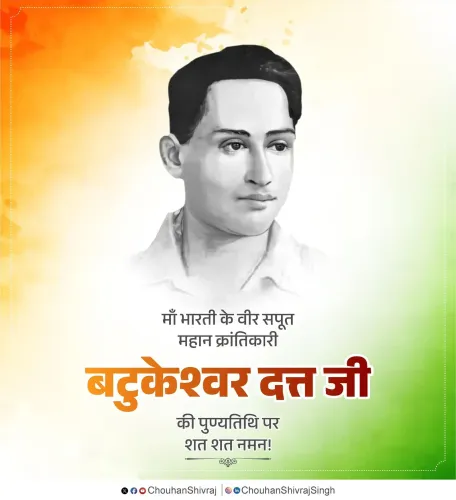
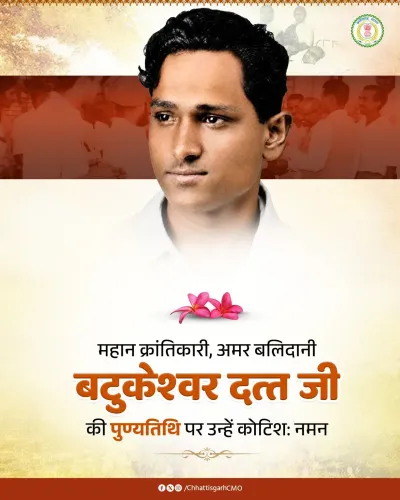
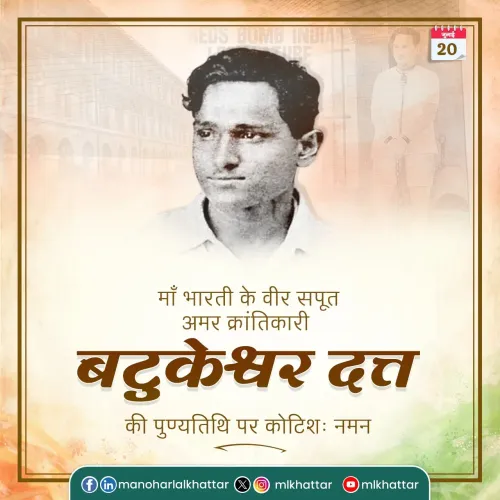
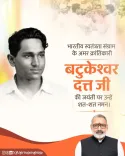
Shivraj Singh Chouhan pays tribute to revolutionary Batukeshwar Dutt on birth anniversary
Synopsis
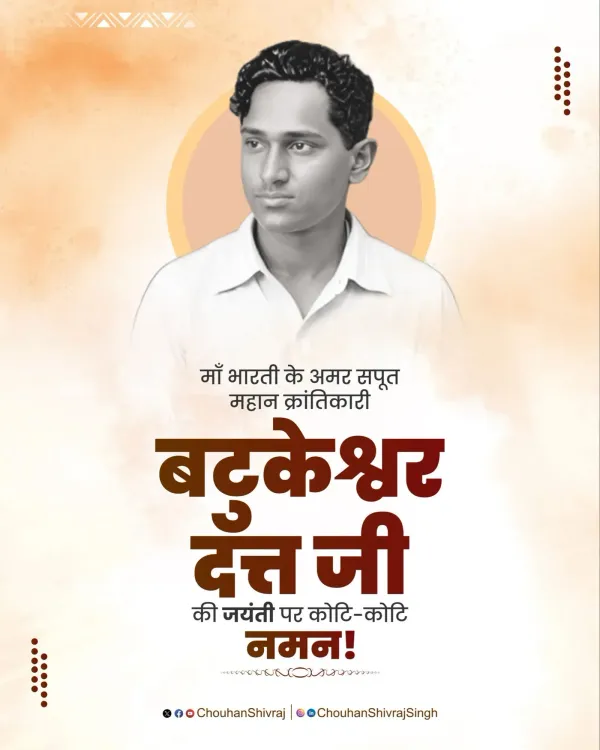
Union Agriculture Minister Shivraj Singh Chouhan on 18 November 2026 paid tribute to revolutionary Batukeshwar Dutt on his birth anniversary, honouring the HSRA member who threw bombs in the Central Legislative Assembly alongside Bhagat Singh in 1929 to protest colonial legislation.
Key Takeaways
Shivraj Singh Chouhan posted a Hindi tribute to revolutionary Batukeshwar Dutt on his birth anniversary on 18 November 2026 .
Batukeshwar Dutt was a member of the Hindustan Socialist Republican Association (HSRA) and a close associate of Bhagat Singh .
On 8 April 1929 , Dutt and Bhagat Singh threw bombs inside the Central Legislative Assembly in Delhi to protest the Public Safety Bill and Trade Disputes Bill .
Chouhan described Dutt's sacrifice as an eternal inspiration for future generations' patriotism.
The tribute reflects the established Indian political tradition of publicly honouring freedom fighters on significant anniversaries across party lines.
A freedom fighter who once shook the British empire from the floor of its own legislature — Union Agriculture Minister Shivraj Singh Chouhan paused on Wednesday, 18 November 2026, to honour that defiant legacy, paying homage to revolutionary Batukeshwar Dutt on his birth anniversary.
Posting on X in Hindi, Chouhan wrote: 'माँ भारती के अनन्य सेवक, महान क्रांतिकारी बटुकेश्वर दत्त जी की जयंती पर कोटि-कोटि नमन करता हूँ!' — 'I offer crores of salutations to the great revolutionary Batukeshwar Dutt, the unparalleled servant of Mother India, on his birth anniversary. Your incomparable struggle and contribution for the freedom of the motherland will forever kindle the spirit of patriotism in the hearts of future generations.'
Who Was Batukeshwar Dutt?
Batukeshwar Dutt occupies a singular place in India's revolutionary pantheon. A member of the Hindustan Socialist Republican Association (HSRA), he stood shoulder to shoulder with Bhagat Singh on 8 April 1929, when the two threw bombs inside the Central Legislative Assembly in Delhi — not to kill, but to make the deaf hear. The act was a dramatic protest against the Public Safety Bill and the Trade Disputes Bill, measures the colonial administration was pushing through without regard for Indian public opinion. Both men chose arrest over escape, turning the subsequent trial into a platform for anti-colonial argument.
Dutt's sacrifice did not end with the courtroom. He endured years of imprisonment, emerging into an independent India that, for a time, quietly forgot him. His later years were marked by hardship — a contrast that his admirers have long held up as a measure of true selflessness.
A Ritual of Remembrance in Indian Public Life
Chouhan's tribute follows a practice as old as the republic itself. Across party lines and ministerial portfolios, Indian leaders regularly invoke the memory of independence-era revolutionaries on birth and death anniversaries. The gesture connects the present political class to the moral authority of the freedom struggle — affirming themes of sacrifice and national duty that resonate with citizens and, particularly, with younger audiences navigating questions of identity and civic responsibility.
For a senior BJP leader and four-term former Chief Minister of Madhya Pradesh, invoking figures like Dutt also speaks to a broader cultural emphasis on reclaiming and popularising revolutionary heroes who operated outside the dominant Nehruvian narrative — a project that has gained considerable institutional momentum over the past decade.
Point of View
Dutt, Sukhdev, Rajguru — have become central to a BJP-era cultural programme that seeks to pluralise the memory of independence and broaden the pantheon of recognised heroes. While the gesture itself is cross-party and ceremonial, its cumulative political weight is not trivial. Repeated official invocations by senior ministers reinforce a contested but increasingly mainstream historical framing, one that positions sacrifice and armed resistance — not negotiation — as the truest expression of nationalism.
NationPress
18 Nov 2026
Frequently Asked Questions
Who was Batukeshwar Dutt?
Batukeshwar Dutt was an Indian revolutionary and member of the Hindustan Socialist Republican Association (HSRA) who, along with Bhagat Singh, threw bombs in the Central Legislative Assembly on 8 April 1929 to protest the Public Safety Bill and Trade Disputes Bill imposed by the British colonial government.
Why did Batukeshwar Dutt throw bombs in the Central Legislative Assembly?
The act on 8 April 1929 was a deliberate protest — not intended to cause casualties but to draw attention to repressive colonial legislation, specifically the Public Safety Bill and Trade Disputes Bill. Dutt and Bhagat Singh surrendered immediately to ensure a public trial that could become an anti-colonial platform.
What did Shivraj Singh Chouhan say about Batukeshwar Dutt?
Chouhan posted in Hindi on X, offering 'crores of salutations' to Dutt and stating that his incomparable struggle and contribution for the freedom of the motherland would forever kindle the spirit of patriotism in future generations.
What was the Hindustan Socialist Republican Association (HSRA)?
The HSRA was a revolutionary organisation active in British India during the late 1920s and early 1930s, committed to armed resistance against colonial rule. Its members included Bhagat Singh, Batukeshwar Dutt, Sukhdev, and Rajguru, among others.
Why do Indian politicians tribute freedom fighters on anniversaries?
Tributing independence-era revolutionaries on birth and death anniversaries is a long-standing practice in Indian public life, observed across party lines. It affirms themes of sacrifice, national duty, and patriotism, and connects contemporary leaders to the moral authority of the freedom struggle.