How are courts more than just buildings? CJI Gavai

Synopsis
In a powerful address, CJI B.R. Gavai emphasizes the significance of court buildings as embodiments of justice, equality, fraternity, and liberty, highlighting their role in facilitating access to justice for all citizens. This event marks a transformative step in the evolution of the judiciary in Maharashtra.
Key Takeaways
Court buildings should reflect democratic values.
New High Court complex in Mumbai aims to enhance access to justice .
Collaboration among legal professionals is essential for an efficient judicial system.
Modern technology will play a crucial role in the new judicial infrastructure.
Justice is a reflection of society's values and morals.
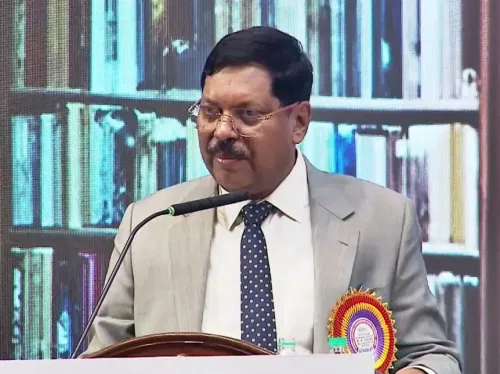
Mumbai, Nov 5 (NationPress) Chief Justice of India (CJI) B.R. Gavai stated that court buildings should transcend mere grandeur and truly reflect the values of justice, equality, fraternity, and liberty as outlined in the Constitution. He emphasized that these structures must enable access to justice for every citizen.
The CJI remarked that the development of court buildings symbolizes not just architectural excellence but also serves as a vital institution supporting the democratic values of the nation and bolstering public trust in the judiciary.
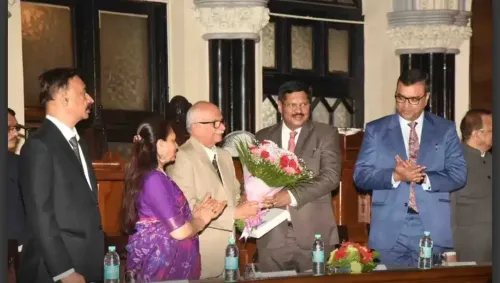
He made these statements during the groundbreaking ceremony for the new High Court complex at the Government Colony in Bandra East, located in north-west Mumbai.
CJI Gavai described the court building as not merely an architectural feat but a temple of justice and transparency.
He noted, "Citizens, lawyers, and judges will have equal access to facilities. Each project considers eco-friendly and green architecture. Maharashtra has consistently been a leader in infrastructure development. The state government is committed to providing modern structures, technology, and resources that meet the judiciary's demands. This will be a modern and magnificent construction symbolizing the state’s judiciary," he elaborated while providing insight into the new High Court complex.
Additionally, CJI Gavai highlighted that court complexes in Nagpur, Nashik, and Aurangabad would enhance transparency, speed, and convenience in the judicial process.
During the event, he acknowledged the collaboration of High Court judges, lawyers' associations, and administrative officers in Maharashtra.
"Judges and lawyers must collaborate to ensure the efficiency of the justice system. Effective management of the judiciary is feasible only when both parties work in harmony," he added.
Chief Minister Devendra Fadnavis remarked that the High Court building in Bandra East, Mumbai, will not only be aesthetically pleasing but will also be recognized as the fastest and smartest building in the country.
This building will be entirely AI-enabled, incorporating artificial intelligence technology. The new High Court is anticipated to set a benchmark for other courts across the nation. He expressed hope that it would provide adequate space and essential amenities for the numerous government lawyers in the High Court.
Chief Justice of Bombay High Court Chandrashekhar stated that justice is not solely about the application of law but is also a tool for public welfare. He asserted, "The essence of justice is to work towards the benefit of the people. Courts are not merely venues for case resolution; they mirror the morality and collective values of society. Justice aims to provide every individual with equal opportunities and safeguard their rights."
Deputy Chief Minister Eknath Shinde emphasized that the judicial system must deliver justice to the common man.
Deputy CM Ajit Pawar affirmed that justice is the foundation of democracy and asserted that every citizen deserves equal justice. He highlighted the state government's initiatives to decentralize the judicial process.
“The architect of the Indian Constitution, Dr. Babasaheb Ambedkar, consistently strives to 'deliver justice to the common man.' Ongoing efforts aim to enhance the judicial system, making it more accessible, transparent, and technology-driven in an independent India. The state government will allocate the necessary funds for this new complex,” he concluded.
Point of View
The statements made by CJI Gavai and other dignitaries underscore a collective commitment towards modernizing the judiciary. The focus on accessibility, technology, and collaboration among legal professionals paints a hopeful picture for the future of justice, making it more inclusive and efficient for every citizen.
NationPress
25 Sept 2026
Frequently Asked Questions
What is the significance of the new High Court complex?
The new High Court complex symbolizes the embodiment of justice, equality, and transparency, aiming to enhance accessibility for all citizens in the judicial process.
How will the new complex improve the judicial system?
The complex will incorporate modern technology, including AI, and promote collaboration among judges and lawyers, thereby streamlining the judicial process.
What values do court buildings represent according to CJI Gavai?
According to CJI Gavai, court buildings represent the values of justice, equality, fraternity, and liberty as enshrined in the Constitution.