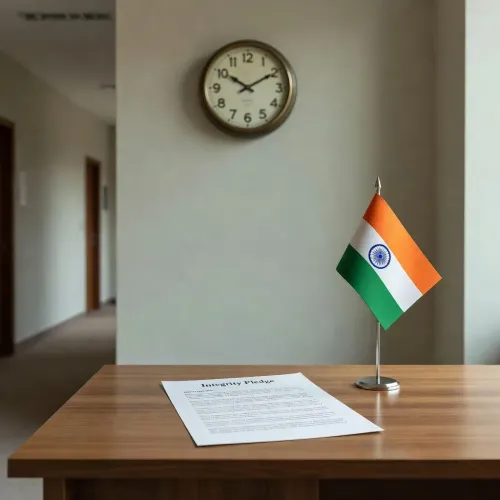
CM Assam Office Marks Vigilance Awareness Week 2026

Synopsis
The Chief Minister's Office of Assam on 29 October 2026 joined the nationwide Vigilance Awareness Week (26 Oct–1 Nov), themed 'Prosperity Through Integrity,' reminding citizens that both giving and accepting bribes are punishable under Indian law.
Key Takeaways
Vigilance Awareness Week 2026 runs from 26 October to 1 November with the theme 'Prosperity Through Integrity.' The Chief Minister's Office of Assam publicly amplified the campaign on 29 October 2026.
Both giving and accepting bribes are punishable offences under the Prevention of Corruption Act, 1988.
The observance is coordinated annually by the Central Vigilance Commission , which has directed state participation since 1999.
The 2026 theme frames integrity as an economic imperative — corruption undermines collective prosperity, not just individual ethics.
Analysts will track whether Assam issues follow-up vigilance directives or enforcement actions beyond the awareness week.
Honesty is not just a virtue — in India's public life, it is now the explicit rallying cry of a week-long national campaign. The Chief Minister's Office of Assam on Thursday, 29 October 2026 amplified the message of Vigilance Awareness Week 2026, observed from 26 October to 1 November, under the theme 'Prosperity Through Integrity' — a call to government employees and citizens alike to refuse both the giving and accepting of bribes.
A national campaign with deep roots in Assam's governance calendar
The week-long observance is coordinated every year by the Central Vigilance Commission (CVC), India's apex anti-corruption oversight body established in 1964. Since 1999, the CVC has directed all central and state government offices to mark the occasion with pledges, awareness drives, and outreach programmes designed to reinforce ethical conduct in public service delivery. Assam, like other states, participates as part of this nationwide administrative framework.
The CMO's post was direct in its legal framing: 'Both giving and accepting bribes are punishable offences.' That framing reflects the Prevention of Corruption Act, 1988, which applies uniform liability to bribe-givers and bribe-takers — a point officials have increasingly stressed to counter the common perception that only the recipient is culpable.
Why 'Prosperity Through Integrity' lands differently now
The 2026 theme makes an economic argument rather than a purely moral one: corruption is framed not as an ethical failing alone but as a drag on collective prosperity. That framing carries weight in a state like Assam, which has seen substantial infrastructure investment and welfare scheme rollouts over recent years — all of which are vulnerable to leakage if vigilance weakens at the delivery end.
The messaging targets every sphere, not just government counters. Citizens who pay facilitation money, contractors who pad invoices, and officials who extract commissions are all within the frame. Vigilance awareness campaigns of this kind serve as annual reminders that the accountability architecture — inspections, whistleblower protections, departmental inquiries — is active and watching.
What follows the week of pledges
The real test of any awareness week is what outlasts the slogans. Anti-corruption advocates and state audit bodies will watch for any Assam-specific vigilance directives, departmental circulars, or enforcement upticks that the campaign may catalyse in the weeks ahead. A pledge without a process is a poster — the government's credibility on this theme depends on what gets filed, actioned, and published after 1 November.
Integrity, the CMO reminds Assam today, is not optional — it is the foundation on which every rupee of public money is supposed to travel from treasury to citizen without disappearing on the way.
Point of View
Where abstract virtue is replaced with tangible stakes. The real policy question is whether this week generates any durable institutional action — departmental circulars, audit triggers, or whistleblower uptake — or remains a ceremonial pledge cycle. States that convert awareness weeks into measurable enforcement outcomes are the ones where the campaign's credibility compounds over time.
NationPress
29 Oct 2026
Frequently Asked Questions
When is Vigilance Awareness Week 2026 observed?
Vigilance Awareness Week 2026 is being observed from 26 October to 1 November 2026 with the theme 'Prosperity Through Integrity.'
What is the theme of Vigilance Awareness Week 2026?
The theme for Vigilance Awareness Week 2026 is 'Prosperity Through Integrity,' emphasising that corruption is an obstacle to collective economic wellbeing, not just an ethical wrong.
Who organises Vigilance Awareness Week in India?
The Central Vigilance Commission (CVC) , India's apex anti-corruption oversight body established in 1964 , coordinates Vigilance Awareness Week annually across central and state government offices.
Is giving a bribe a punishable offence in India?
Yes. Under the Prevention of Corruption Act, 1988 , both giving and accepting a bribe are punishable offences — not just the person who receives the bribe.
How does Assam participate in Vigilance Awareness Week?
The Chief Minister's Office of Assam joins the national campaign by publicly promoting its message, as state governments across India are directed by the CVC to observe the week through awareness drives and integrity pledges.