CM Bhajan Lal Pledges Best Opportunities for Rajasthan's Girls
Synopsis
Rajasthan Chief Minister Bhajan Lal Sharma on 2 July 2026 declared that daughters must receive not just the right to education but the finest opportunities — signalling a policy shift from enrolment metrics to outcome-oriented interventions for female learners in the state.
Key Takeaways
CM Bhajan Lal Sharma posted his commitment to girls' education on 2 July 2026 , emphasising 'finest opportunities' beyond mere access.
The statement aligns with the Central government's Beti Bachao Beti Padhao scheme, launched in 2015 to address gender gaps in education.
Rajasthan has run girl-child-focused scholarships and residential school programmes since 2014 under successive state governments.
The National Education Policy 2020 provides the broader framework for equitable, outcome-oriented education for female students.
Policy watchers will track Rajasthan's 2026-27 education budget for concrete allocations backing the Chief Minister's pledge.
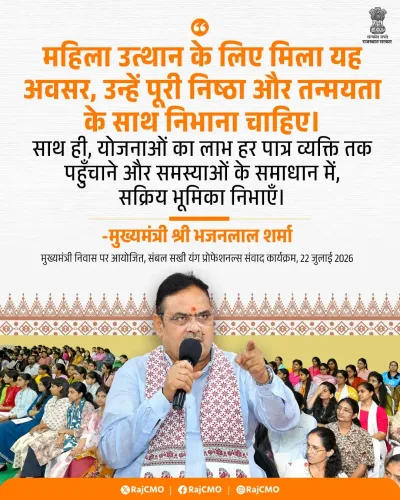
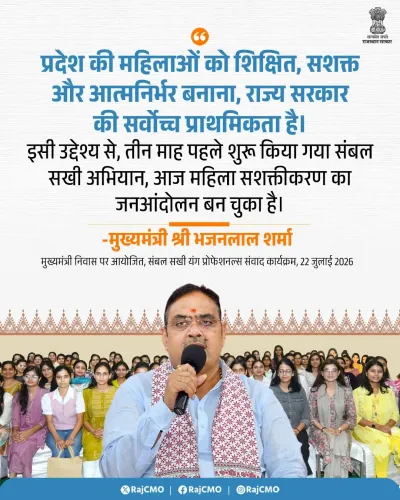
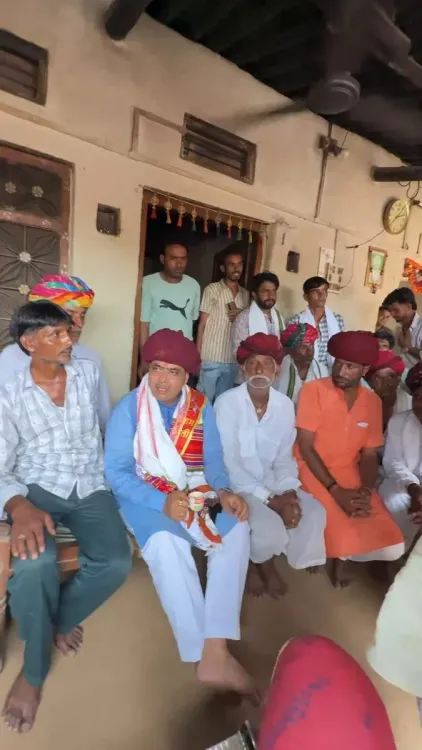
Rajasthan Chief Minister Bhajan Lal Sharma reaffirmed his government's commitment to girls' education on Thursday, 2 July 2026, declaring that daughters must receive not just the right to education but also the finest opportunities to excel. The statement, posted on his official X account, underscores a policy direction that goes beyond school enrolment to focus on outcomes for female learners across the state.
In the post, Sharma wrote: 'बेटियों को शिक्षा का अधिकार ही नहीं, श्रेष्ठ अवसर भी मिले—यही हमारी प्रतिबद्धता है.' ['Daughters must receive not just the right to education but the finest opportunities as well — this is our commitment.'] The emphasis on 'finest opportunities' signals a deliberate shift in political messaging from access-based goals to quality and outcome-oriented interventions.
Context
Bhajan Lal Sharma has led Rajasthan as Chief Minister since December 2023, when the BJP returned to power in the state. Girls' education and the welfare of the girl child have been recurring themes in BJP governance at both the Centre and state levels. His post on 2 July 2026 fits within a broader pattern of the party publicly reinforcing its commitment to female empowerment ahead of budget and policy cycles.
Policy Backdrop
The Central government's Beti Bachao Beti Padhao scheme, launched in 2015, set the national template for addressing gender gaps in education and child sex ratios. Rajasthan has, over successive governments since 2014, introduced girl-child-focused scholarships and residential school programmes that complement the Central initiative. The National Education Policy 2020 further reinforced the push for equitable and inclusive education, with specific provisions aimed at reducing dropout rates among female students.
The language used by CM Sharma — 'finest opportunities' (shreshthtam avasar) rather than merely 'access' — reflects a policy evolution visible across BJP-governed states, where the conversation has moved from enrolment numbers to skill development, higher education, and employment pathways for girls.
Stakeholders and Impact
The primary beneficiaries of any policy action stemming from this commitment would be girl students across Rajasthan, a state with a historically uneven gender gap in literacy and school completion. Women's groups and education advocates have long argued that residential schools, merit scholarships, and vocational training are essential complements to basic enrolment drives. Any new scheme or budget allocation targeting this demographic in the 2026-27 fiscal year would directly affect millions of families, particularly in rural districts of the state.
What's Next
Observers will watch the Rajasthan state education budget and forthcoming policy announcements for concrete allocations — whether in the form of expanded scholarships, new residential school seats, or skill-linked programmes for female students. The Chief Minister's public declaration of commitment sets a benchmark against which the government's actual spending and programme rollout in the current fiscal year will be measured. A formal scheme announcement or budget revision in the coming weeks would give the statement substantive policy weight.
Point of View
Positioning the BJP government as moving beyond legacy access metrics toward quality and outcomes. This mirrors a visible pattern across BJP-ruled states where girl-child welfare messaging has evolved from survival and enrolment to skill, higher education, and employability. The statement arrives ahead of a new fiscal cycle, making it a potential signal of a forthcoming policy announcement or budget revision. Whether it translates into concrete allocations will determine whether it is a policy marker or a rhetorical one.
NationPress
1 Oct 2026
Frequently Asked Questions
What did Rajasthan CM Bhajan Lal Sharma say about girls' education?
On 2 July 2026 , CM Sharma stated that daughters must receive not just the right to education but the finest opportunities to excel, calling it his government's core commitment.
What is the Beti Bachao Beti Padhao scheme?
Beti Bachao Beti Padhao is a Central government scheme launched in 2015 to improve the child sex ratio and promote education and empowerment of the girl child across India, including in Rajasthan.
What girl-child education schemes exist in Rajasthan?
Rajasthan has introduced girl-child-focused scholarships and residential school programmes since 2014, complementing the Central Beti Bachao Beti Padhao initiative and the provisions of the National Education Policy 2020 .
What does the National Education Policy 2020 say about girls' education?
The National Education Policy 2020 emphasises equitable and inclusive education with specific provisions aimed at reducing dropout rates and improving learning outcomes for female students.
What should we watch for next on girls' education in Rajasthan?
The key indicator will be Rajasthan's 2026-27 state education budget and any new scheme announcements — particularly scholarships, residential school expansions, or skill-linked programmes — that give CM Sharma's commitment concrete policy form.