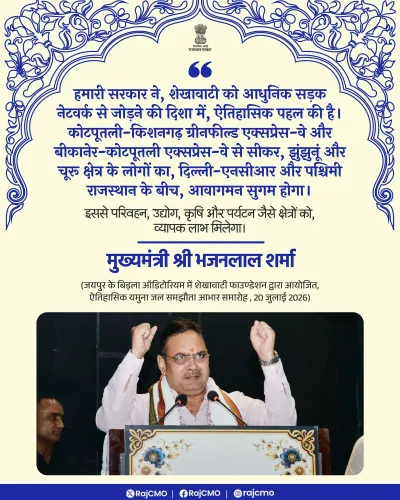
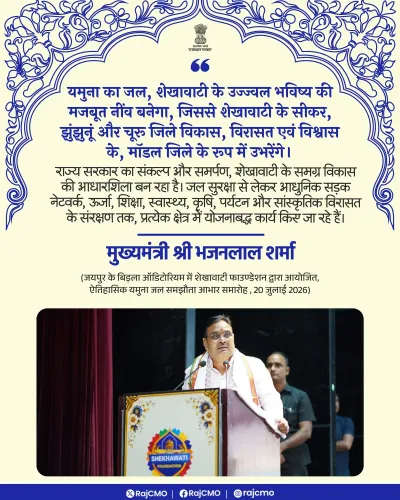
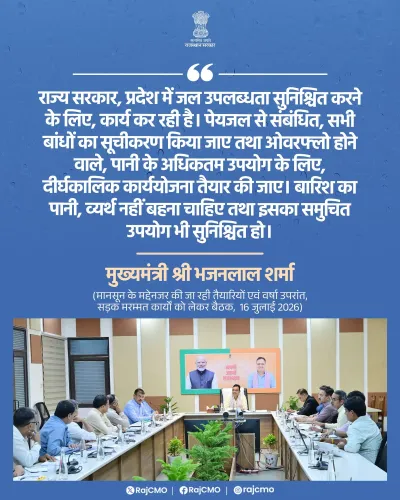
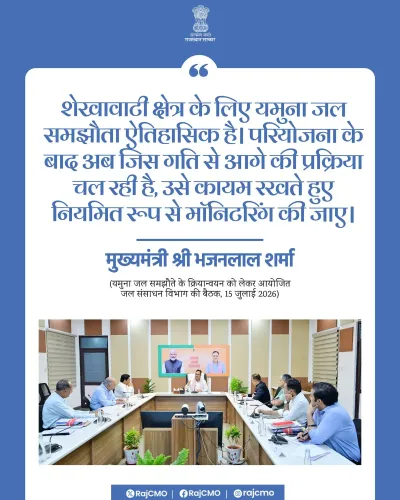
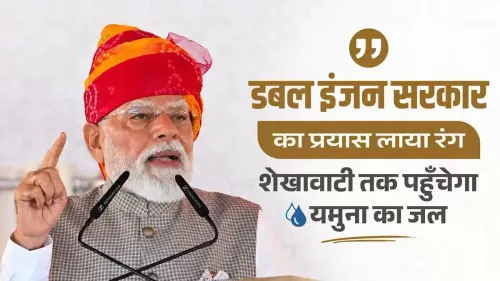
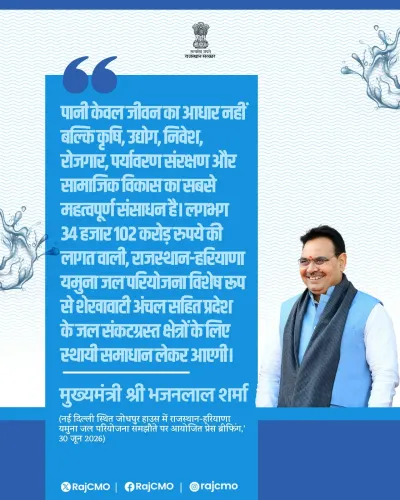
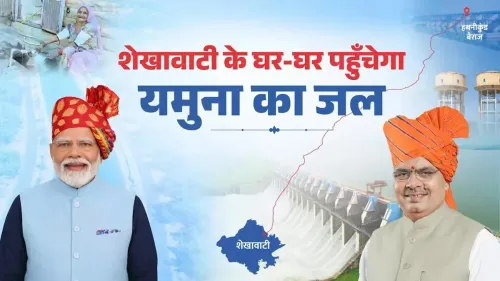
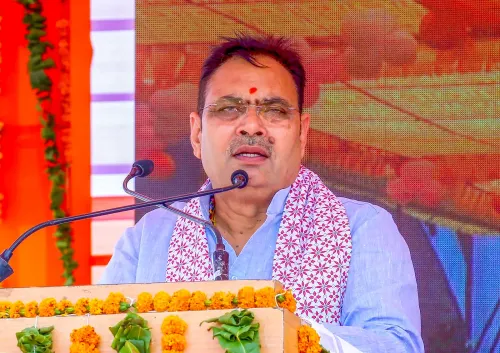
CM Bhajan Lal flags water as Shekhawati's biggest challenge
Synopsis
The Rajasthan Chief Minister's Office has publicly identified water as the single biggest development challenge for the Shekhawati region, tagging CM Bhajan Lal Sharma. The statement underscores a long-standing crisis spanning Sikar, Jhunjhunu and Churu districts and signals renewed political attention to water infrastructure in the semi-arid belt.
Key Takeaways
The Rajasthan CMO posted on 21 July 2026 identifying water as Shekhawati's most critical development question.
Shekhawati covers the semi-arid districts of Sikar , Jhunjhunu , and Churu in northern Rajasthan.
CM Bhajan Lal Sharma was directly tagged, indicating the issue is a stated priority of the current BJP government.
The Mukhya Mantri Jal Swavalamban Abhiyan , launched in 2016 , remains the key policy framework for water conservation in Rajasthan.
The post was accompanied by the campaign hashtag #आपणो_अग्रणी_राजस्थान , linking water security to the government's broader development narrative.
Concrete budget allocations and project tenders for Shekhawati water infrastructure are the key developments to watch next.
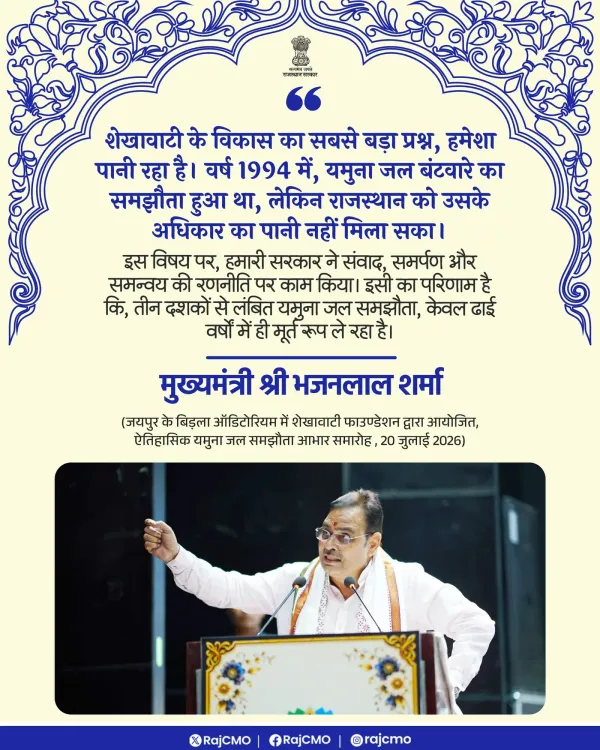
The Chief Minister's Office of Rajasthan on Tuesday, 21 July 2026, posted on X highlighting that water has always been the most critical development question for the Shekhawati region, tagging Chief Minister Bhajan Lal Sharma and invoking the campaign hashtag #आपणो_अग्रणी_राजस्थान ('Our Leading Rajasthan').
Context
The post, in Hindi, states plainly: 'शेखावाटी के विकास का सबसे बड़ा प्रश्न, हमेशा पानी रहा है' — 'The biggest question of Shekhawati's development has always been water.' The framing is deliberate: by calling water a perennial question rather than a solved problem, the Chief Minister's Office signals that the issue remains at the top of the state's regional development agenda.
Shekhawati encompasses the districts of Sikar, Jhunjhunu, and Churu in northern Rajasthan — a semi-arid belt where erratic monsoons, shallow groundwater, and limited canal reach have historically constrained agriculture and daily life for millions of residents.
Policy Backdrop
Rajasthan's struggle with water scarcity is structural, rooted in its desert geography and dependence on the Indira Gandhi Canal system for western districts, while eastern and northern zones like Shekhawati rely heavily on groundwater and seasonal harvesting. Successive state governments have pursued canal extensions, johad (step-tank) restoration, and watershed programmes to address the deficit.
A significant policy milestone was the launch of the Mukhya Mantri Jal Swavalamban Abhiyan in 2016, a flagship scheme promoting rainwater harvesting and watershed development across Rajasthan's arid zones. BJP-led administrations since 2013 have continued and expanded such efforts as part of a broader regional equity and agricultural resilience strategy. The current government under CM Bhajan Lal Sharma, in office since December 2023, has maintained this policy lineage.
Stakeholders and Impact
The communities most directly affected are Shekhawati's farming households, who depend on groundwater for irrigation and face declining water tables year after year. Residents of smaller towns and villages in Sikar, Jhunjhunu, and Churu districts also contend with seasonal drinking-water shortages, making water security a politically and socially charged issue in the region.
The post's use of the hashtag #आपणो_अग्रणी_राजस्थान ('Our Leading Rajasthan') links the water issue to the state government's wider development narrative, suggesting the administration intends to present Shekhawati water projects as a marker of governance delivery ahead of future political cycles.
What's Next
Observers will watch for concrete follow-through in the form of state budget allocations, project tenders, and assembly floor discussions specifically addressing Shekhawati's water infrastructure. Any announcement of a dedicated scheme, canal extension, or groundwater recharge programme for the three districts would mark a tangible step beyond the acknowledgement made in this post.
With the Rajasthan government having publicly identified water as Shekhawati's foremost development challenge, the political and administrative pressure to translate that acknowledgement into measurable outcomes will only intensify in the months ahead.
Point of View
Spotlighting Shekhawati aligns with the BJP's strategy of demonstrating governance reach in constituencies that have historically swung on development promises. The real test will come when rhetoric is matched against budget lines and project timelines in a region where water pledges have a long and often unfulfilled history.
NationPress
21 Jul 2026
Frequently Asked Questions
Why is water scarcity such a big problem in Shekhawati, Rajasthan?
Shekhawati, covering Sikar, Jhunjhunu and Churu districts, is a semi-arid region with erratic monsoons and declining groundwater tables. Limited canal connectivity and dependence on seasonal rainfall have made water scarcity a chronic and worsening challenge for farmers and residents alike.
What did the Rajasthan CMO post about Shekhawati on 21 July 2026?
The Chief Minister's Office of Rajasthan posted on X stating that water has always been the most critical development question for the Shekhawati region, tagging CM Bhajan Lal Sharma under the campaign hashtag #आपणो_अग्रणी_राजस्थान.
Who is Bhajan Lal Sharma and what is his role in Rajasthan?
Bhajan Lal Sharma is the BJP Chief Minister of Rajasthan, in office since December 2023. He leads the state administration responsible for water management, infrastructure, and regional development across Rajasthan.
What is the Mukhya Mantri Jal Swavalamban Abhiyan?
The Mukhya Mantri Jal Swavalamban Abhiyan is a Rajasthan government scheme launched in 2016 to promote rainwater harvesting and watershed development across the state's arid and semi-arid zones, including areas like Shekhawati.
What districts are included in the Shekhawati region of Rajasthan?
The Shekhawati region primarily comprises three districts: Sikar, Jhunjhunu, and Churu, all located in northern Rajasthan and characterised by semi-arid conditions and recurring water shortages.