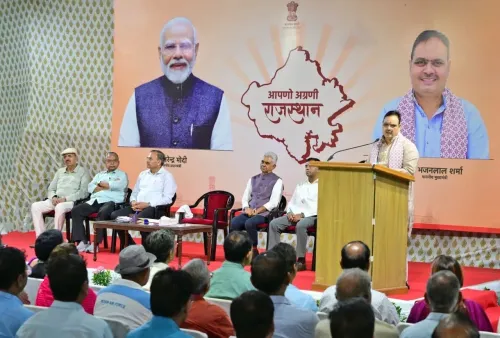
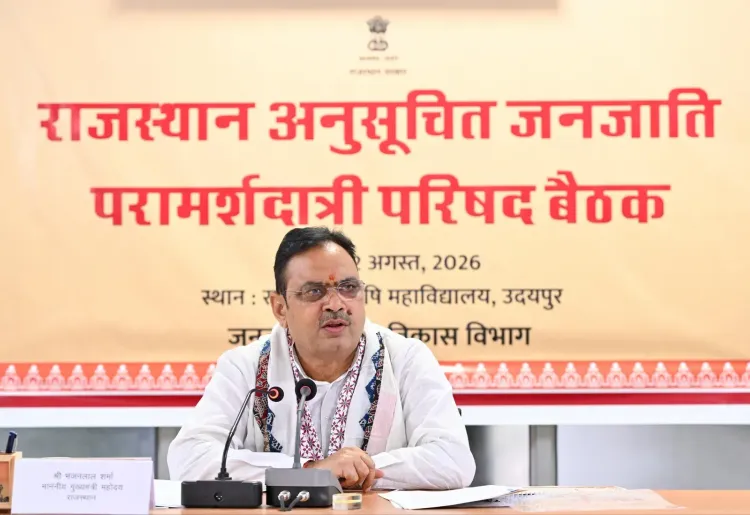
CM Bhajan Lal chairs ST Advisory Council meet in Udaipur
Synopsis
Rajasthan CM Bhajan Lal Sharma chaired the Scheduled Tribe Advisory Council meeting in Udaipur on 2 August 2026, reviewing tribal welfare scheme progress, rights protection, and formulating a concrete action plan with legislators and senior officials.
Key Takeaways
CM Bhajan Lal Sharma chaired the Scheduled Tribe Advisory Council meeting at Rajasthan Agricultural College, Udaipur on 2 August 2026 .
The meeting reviewed tribal welfare scheme progress, rights protection, and formulated a forward-looking action plan with legislators and senior administrative officers.
The Advisory Council is a constitutional mechanism under the Fifth Schedule , mandated specifically to oversee tribal welfare and governance in Scheduled Areas.
Udaipur borders Rajasthan's most tribal-dense districts — Dungarpur, Banswara, and Pratapgarh — giving the venue strategic significance.
Scheduled Tribes constitute approximately 13 percent of Rajasthan's population, a constituency with strong constitutional protections and electoral weight.
No specific decisions or new scheme announcements from the meeting have been independently confirmed; follow-up action plans are the key indicator to watch.
In the lecture halls of Rajasthan Agricultural College, Udaipur, a constitutional obligation came to life on Sunday, 2 August 2026 — Rajasthan Chief Minister Bhajan Lal Sharma convened the state's Scheduled Tribe Advisory Council, gathering elected representatives and senior administrative officers to take stock of tribal welfare, rights protection, and the road ahead for Rajasthan's tribal communities.
Posting on X after the meeting, CM Sharma said the discussions covered 'जनजातीय समाज के सर्वांगीण विकास' — the all-round development of tribal society — along with rights protection, the progress and effectiveness of welfare schemes, and a concrete action plan for the period ahead. He described the exchange as 'detailed and positive.' His government's stated core resolve, he added, is 'the upliftment of every section of the state, protection of rights, and the empowerment of the last person standing at the end of the line.'
What the Advisory Council actually does
The Scheduled Tribe Advisory Council is not a ceremonial body. It is a constitutional mechanism — rooted in the Fifth Schedule of the Constitution of India — through which states with Scheduled Areas are required to consult tribal representatives on matters affecting their welfare and governance. Article 46 of the Constitution separately directs states to promote the educational and economic interests of Scheduled Tribes and shield them from exploitation.
Layered on top of that is the Scheduled Tribes and Other Traditional Forest Dwellers (Recognition of Forest Rights) Act, 2006, which created a national framework for recognising tribal rights over forest resources — a law whose implementation at the state level remains a live and closely watched issue across India.
Udaipur as a tribal governance hub
Udaipur, situated in southern Rajasthan, is not an incidental venue. The region sits at the edge of some of the state's most densely tribal districts — including Dungarpur, Banswara, and Pratapgarh — making it a natural administrative centre for consultations of this kind. Rajasthan governments across political lines have periodically used the Advisory Council framework to assess scheme delivery and recalibrate development plans for tribal areas, a pattern that mirrors similar processes in other states with significant Scheduled Tribe populations.
The choice of Rajasthan Agricultural College as the venue also carries a quiet signal: land, forest, and agricultural access remain among the most consequential policy levers for tribal households in the region.
What follows the meeting
The post does not specify decisions taken or new schemes announced — and none can be independently confirmed from the meeting. What the Council session does set in motion, however, is a formal expectation of follow-through: advisory councils of this kind typically feed into departmental action plans and budget allocations for tribal welfare. Whether CM Sharma's government translates Sunday's 'positive discussion' into measurable outcomes for Rajasthan's tribal communities is the question that will define the meeting's real weight.
Rajasthan has roughly 13 percent of its population belonging to Scheduled Tribes — a constituency too large, and constitutionally too protected, to be addressed by words alone.
Point of View
Who took office in December 2023, the meeting signals an intent to demonstrate administrative follow-through on tribal welfare ahead of any future electoral cycle. The emphasis on 'empowering the last person in line' echoes the ruling party's national 'Antyodaya' framing, suggesting deliberate alignment between state messaging and central BJP ideology. Whether this translates into verifiable scheme delivery or remains a consultative exercise will be the true test of the council's utility.
NationPress
16 Sept 2026
Frequently Asked Questions
What is the Scheduled Tribe Advisory Council in Rajasthan?
The Scheduled Tribe Advisory Council is a constitutional body under the Fifth Schedule of the Indian Constitution, mandated to advise the state government on matters related to tribal welfare, rights, and the administration of Scheduled Areas in Rajasthan.
Why was the ST Advisory Council meeting held in Udaipur?
Udaipur in southern Rajasthan is a key administrative centre close to the state's most tribal-dense districts, including Dungarpur, Banswara, and Pratapgarh, making it a natural venue for tribal governance consultations.
What did CM Bhajan Lal Sharma discuss at the Udaipur tribal meeting?
CM Sharma discussed the all-round development of tribal society, protection of tribal rights, the progress and effectiveness of welfare schemes, and a concrete action plan for the period ahead, alongside elected representatives and senior officials.
What constitutional provisions protect tribal welfare in India?
Article 46 of the Constitution directs states to promote the educational and economic interests of Scheduled Tribes and protect them from exploitation. The Forest Rights Act of 2006 further recognises tribal rights over forest land and resources.
What percentage of Rajasthan's population belongs to Scheduled Tribes?
Scheduled Tribes account for approximately 13 percent of Rajasthan's total population, making them a significant demographic in the state's governance and electoral landscape.