CM Bhajan Lal Marks Yamuna Water Deal at Jaipur Event
Synopsis
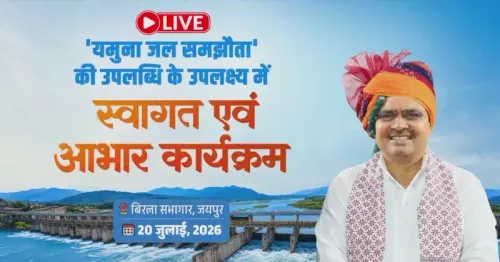
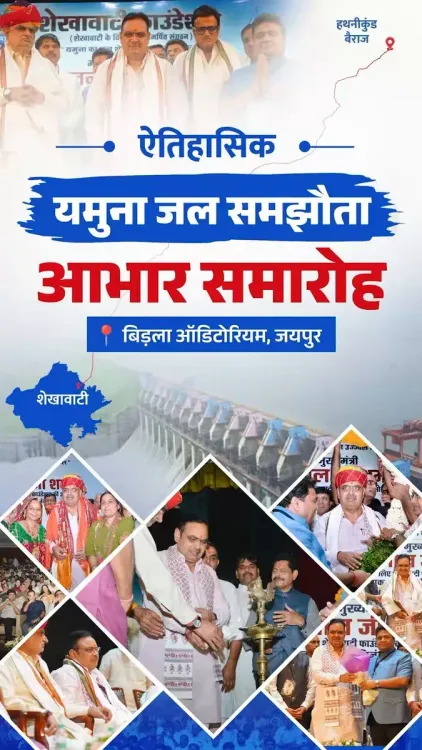
Rajasthan CM Bhajan Lal Sharma marked a Yamuna water agreement gratitude ceremony at Birla Auditorium in Jaipur on 21 July 2026, sharing video highlights on X. The development is significant for eastern Rajasthan farmers who face chronic water scarcity in the semi-arid region.
Key Takeaways
Rajasthan CM Bhajan Lal Sharma posted highlights from a ceremony at Birla Auditorium, Jaipur on 21 July 2026 .
The event was described as a historic Yamuna water agreement gratitude ceremony ( ऐतिहासिक यमुना जल समझौता आभार समारोह ).
The 1994 MoU on Yamuna waters covers five states: Delhi, Haryana, Rajasthan, Uttar Pradesh and Himachal Pradesh .
Eastern Rajasthan farmers are the primary stakeholders who stand to benefit from improved water allocations.
Key next steps include official gazette notification of water shares and infrastructure timelines for delivery.
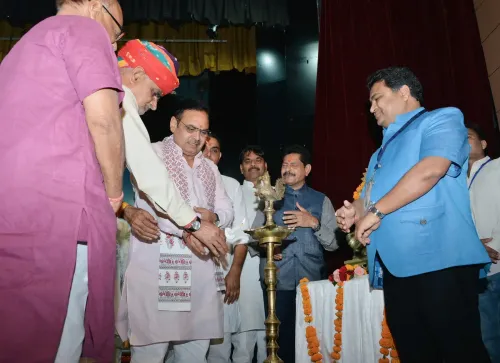
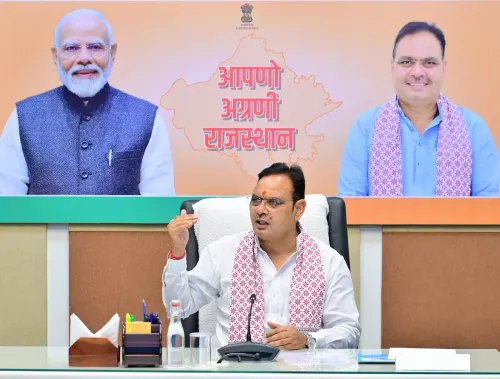
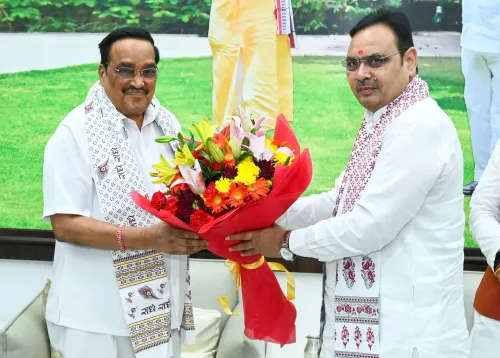
Rajasthan Chief Minister Bhajan Lal Sharma shared highlights from a ceremony held at Birla Auditorium, Jaipur, on Tuesday, 21 July 2026, marking what he described as a historic Yamuna water agreement gratitude event. The Chief Minister posted a video on X capturing key moments from the function, calling it an 'ऐतिहासिक यमुना जल समझौता आभार समारोह' ('historic Yamuna water agreement gratitude ceremony').
Context
The ceremony at Birla Auditorium was framed as a public expression of gratitude following what the state government has characterised as a significant inter-state agreement on Yamuna river water sharing. CM Bhajan Lal Sharma used the occasion to publicly acknowledge the development, positioning it as a milestone for Rajasthan.
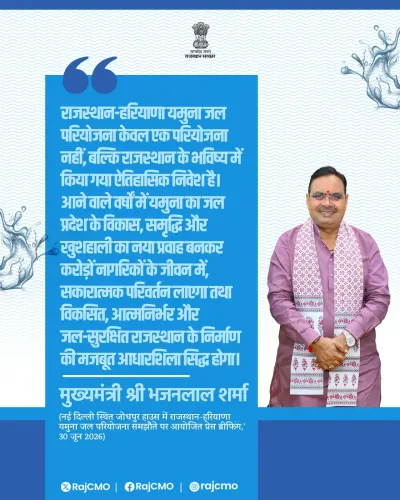
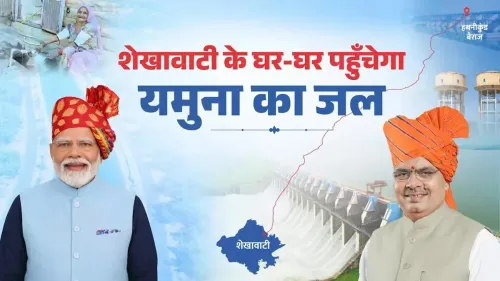
Rajasthan has long sought a larger share of Yamuna waters to address acute scarcity in its semi-arid eastern districts. The state's agricultural communities, particularly farmers in the eastern belt, depend heavily on assured water supply for irrigation.
Policy Backdrop
Inter-state river water sharing has been a recurring and often contentious governance issue across India. The Yamuna basin involves multiple states — Delhi, Haryana, Rajasthan, Uttar Pradesh and Himachal Pradesh — all of which were party to a 1994 Memorandum of Understanding that allocated river flows among them.
Rajasthan's share under that arrangement has historically been considered insufficient relative to the state's agricultural and urban water needs. Any revision or supplementary agreement to that framework would carry significant policy weight for the state's eastern regions, where groundwater depletion has intensified pressure on surface water sources.
Stakeholders and Impact
The primary beneficiaries of an enhanced Yamuna water allocation for Rajasthan would be farmers in eastern Rajasthan districts, where semi-arid conditions make rain-fed agriculture unreliable. Urban water supply in cities along the eastern corridor would also stand to gain from improved river water access.
Beyond agriculture, the agreement carries political significance for the BJP-led state government, which has made water security a central plank of its governance agenda in Rajasthan. A formal gratitude ceremony of this scale signals that the state government views this as a deliverable worth celebrating publicly.
What's Next
The critical next steps will be the official gazette notification of revised water shares and the announcement of timelines for associated infrastructure — particularly canal networks or lift-irrigation projects — needed to physically deliver the allocated water to end users in Rajasthan.
Until implementation details are formalised and notified, the agreement's practical impact on farmers and urban consumers will remain to be seen. Observers will watch closely for inter-state coordination mechanisms and any legal or technical challenges from co-riparian states.
Point of View
Not merely an administrative outcome. For a BJP-led state government operating in a water-stressed state, translating a complex inter-state negotiation into a visible public event is a calculated move to build credibility with farming communities ahead of future electoral cycles. However, the durability of this narrative will depend entirely on whether the agreement moves from ceremony to concrete infrastructure delivery — a transition that inter-state water pacts in India have historically struggled to make swiftly. The broader pattern of Yamuna basin politics suggests that legal and technical disputes among co-riparian states could yet complicate implementation.
NationPress
20 Oct 2026
Frequently Asked Questions
What is the Yamuna water agreement involving Rajasthan?
It refers to an inter-state arrangement on sharing Yamuna river waters. The original framework dates to a 1994 MoU among Delhi, Haryana, Rajasthan, Uttar Pradesh and Himachal Pradesh . Rajasthan has sought enhanced allocations to address scarcity in its eastern districts.
What happened at Birla Auditorium Jaipur on 21 July 2026?
Rajasthan CM Bhajan Lal Sharma presided over a gratitude ceremony at Birla Auditorium, Jaipur , celebrating what the state government called a historic Yamuna water agreement. The event was documented and shared on social media by the Chief Minister.
Who benefits from the Yamuna water deal for Rajasthan?
The primary beneficiaries are farmers in eastern Rajasthan , where semi-arid conditions make water access critical for agriculture. Urban populations in eastern Rajasthan cities would also benefit from improved surface water supply.
What was the 1994 Yamuna water MoU?
The 1994 Memorandum of Understanding was an inter-state agreement that allocated Yamuna river water shares among Delhi, Haryana, Rajasthan, Uttar Pradesh and Himachal Pradesh . It remains the foundational framework for Yamuna water-sharing arrangements.
What are the next steps after the Yamuna water agreement ceremony?
The critical next steps are official gazette notification of revised water allocations and announcement of timelines for canal or lift-irrigation infrastructure needed to deliver water to eastern Rajasthan districts.