CM Bhajan Lal Sharma Celebrates Yamuna Water Agreement in Jaipur
Synopsis
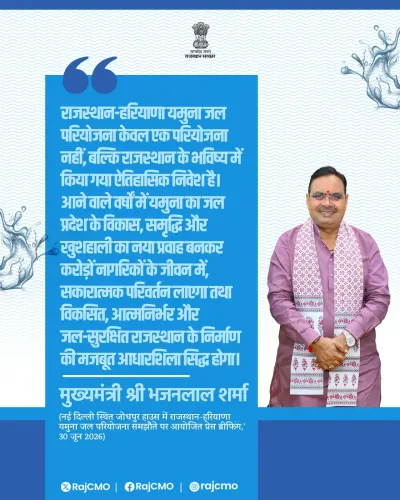
Rajasthan Chief Minister Bhajan Lal Sharma attended a thanksgiving event in Jaipur on 20 July 2026 to celebrate the Yamuna Jal Samjhauta, an interstate water-sharing agreement that could boost water supply to the state's parched eastern districts and support the Eastern Rajasthan Canal Project.
Key Takeaways
Rajasthan CM Bhajan Lal Sharma attended a felicitation programme in Jaipur on 20 July 2026 to mark the Yamuna Jal Samjhauta .
The Yamuna Water Agreement governs allocation among five states: Rajasthan, Haryana, Delhi, Uttar Pradesh , and Himachal Pradesh .
The foundational framework dates to the 1994 MoU , which created the Upper Yamuna River Board .
The agreement has direct implications for the Eastern Rajasthan Canal Project , designed to bring water to drought-prone eastern districts.
Key beneficiaries include farmers in eastern Rajasthan and urban water users in Jaipur .
Revised water-release schedules from the Upper Yamuna River Board are the next expected milestone.
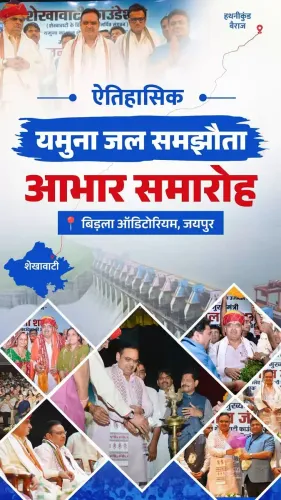
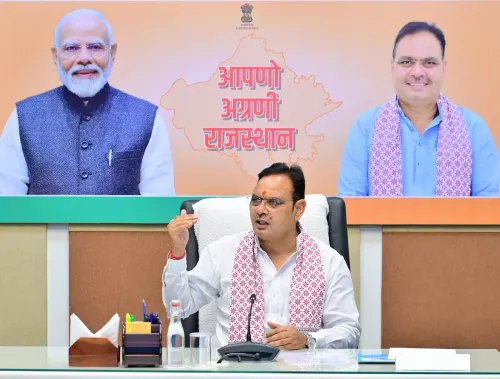
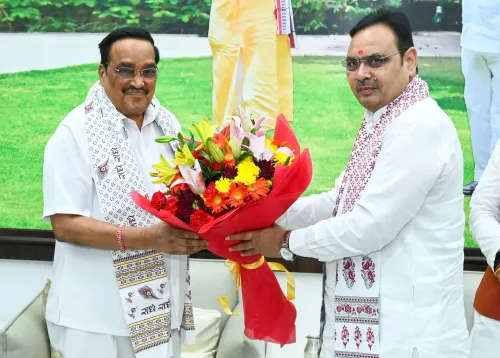
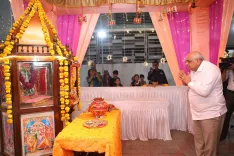
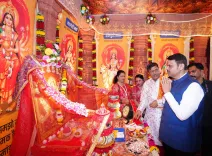
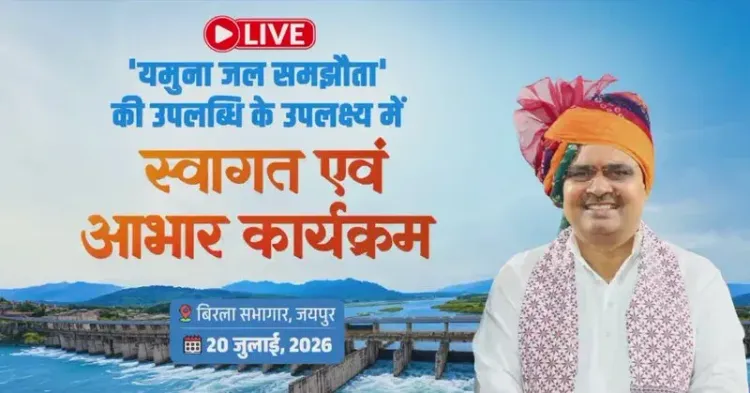
Rajasthan Chief Minister Bhajan Lal Sharma on Monday, 20 July 2026, attended a felicitation and thanksgiving programme in Jaipur to mark the achievement of the Yamuna Jal Samjhauta (Yamuna Water Agreement), signalling a significant milestone in the state's long-running effort to secure additional river-water allocations for its water-scarce regions.
Context
The event, livestreamed under the hashtag #Live, was described by CM Sharma's office as a 'swagat evam aabhar karyakram' — a 'welcome and gratitude programme' — held in honour of the agreement's conclusion. The Yamuna Water Agreement refers to an interstate compact governing the allocation of Yamuna river waters among the five riparian states: Rajasthan, Haryana, Delhi, Uttar Pradesh, and Himachal Pradesh. For Rajasthan, securing a reliable share of Yamuna flows has been a long-standing administrative priority, given the state's dependence on groundwater and its vulnerability to drought in the eastern districts.
Policy Backdrop
The foundational framework for Yamuna water sharing dates to the 1994 Memorandum of Understanding, which fixed percentage shares for each riparian state and established the Upper Yamuna River Board as the statutory body responsible for regulating distribution and resolving operational disputes. Review meetings of the Board during 2017–2019 had already addressed Rajasthan's demands for enhanced allocation and improved release schedules, laying the groundwork for further negotiations. The current agreement, celebrated at Monday's event, is positioned by the state government as a diplomatic achievement in cooperative federalism.
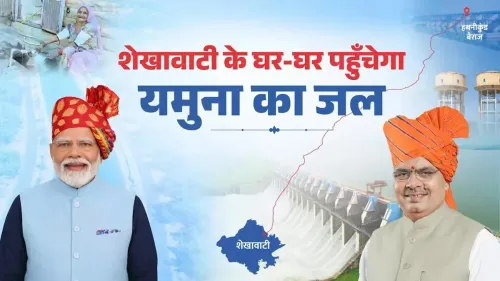
The Eastern Rajasthan Canal Project (ERCP) adds a further layer of significance. The project, designed to channel Yamuna and Chambal waters to water-scarce eastern Rajasthan districts, stands to benefit directly from any improvement in the state's Yamuna water entitlement. A stronger interstate agreement could unlock better release schedules and volumes critical to ERCP's viability.
Stakeholders and Impact
The most immediate beneficiaries of an improved Yamuna water compact are farmers in eastern Rajasthan, who have historically depended on erratic monsoon rains and depleting groundwater tables. Urban water supply in Jaipur — a city whose population has grown substantially over the past two decades — also stands to gain from additional surface-water flows. The thanksgiving event in Jaipur underscores the political salience of water security in a state where river-water diplomacy directly affects livelihoods across multiple constituencies.
For the BJP government in Rajasthan, the agreement represents a deliverable on resource diplomacy that can be communicated to voters in both urban and rural belts. Interstate water agreements, while technically complex, carry strong symbolic weight in Indian electoral politics.
What's Next
Attention will now turn to the Upper Yamuna River Board, which is expected to publish revised water-release schedules reflecting the new terms. Progress on new canal linkages under the Eastern Rajasthan Canal Project will serve as a practical test of whether the agreement translates into tangible water delivery on the ground. Civil society groups and farmer organisations in eastern Rajasthan are likely to monitor implementation closely in the months ahead.
Point of View
Voter-facing achievement for the BJP government in Rajasthan. Water scarcity in the state's eastern belt has been a persistent electoral pressure point, and CM Sharma's public celebration of the Yamuna Jal Samjhauta signals that the administration intends to own this win visibly. The move also fits a broader BJP pattern of using cooperative federalism milestones — typically the domain of technocratic back-channels — as platforms for governance optics. The real test, however, lies in implementation: whether the Upper Yamuna River Board converts the agreement into reliable, on-ground water flows before the next electoral cycle.
NationPress
20 Oct 2026
Frequently Asked Questions
What is the Yamuna Jal Samjhauta celebrated by Rajasthan CM Bhajan Lal Sharma?
The Yamuna Jal Samjhauta is an interstate agreement that governs the allocation of Yamuna river waters among Rajasthan, Haryana, Delhi, Uttar Pradesh, and Himachal Pradesh. CM Bhajan Lal Sharma celebrated its achievement at a felicitation event in Jaipur on 20 July 2026.
How does the Yamuna water agreement benefit Rajasthan?
The agreement is expected to provide Rajasthan with a more reliable share of Yamuna river water, which is critical for irrigation in the state's drought-prone eastern districts and for urban water supply in cities like Jaipur.
What is the Eastern Rajasthan Canal Project and how is it connected to the Yamuna deal?
The Eastern Rajasthan Canal Project is a major irrigation scheme designed to channel Yamuna and Chambal waters to water-scarce eastern Rajasthan. Improved Yamuna water entitlements under the new agreement could directly support the project's water supply.
What is the Upper Yamuna River Board?
The Upper Yamuna River Board is a statutory body established under the 1994 MoU on Yamuna water sharing. It regulates water distribution among the five riparian states and resolves operational disputes.
What happens after the Yamuna water agreement is signed?
The Upper Yamuna River Board is expected to publish revised water-release schedules, and work on new canal linkages under the Eastern Rajasthan Canal Project is anticipated to progress as a practical follow-through on the agreement.