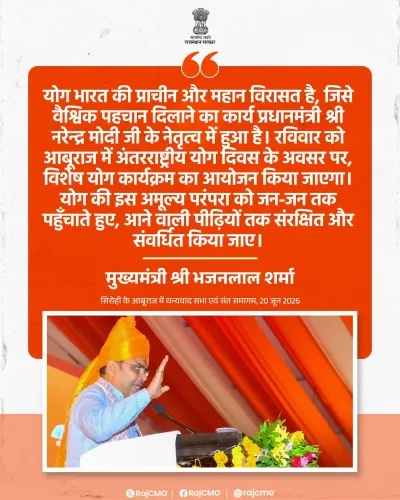
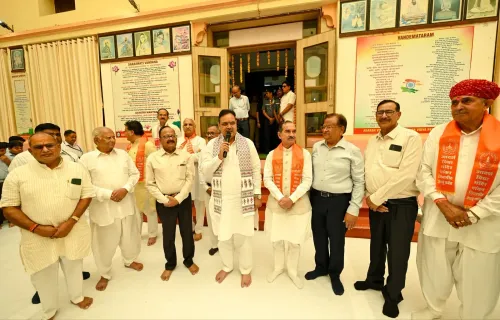
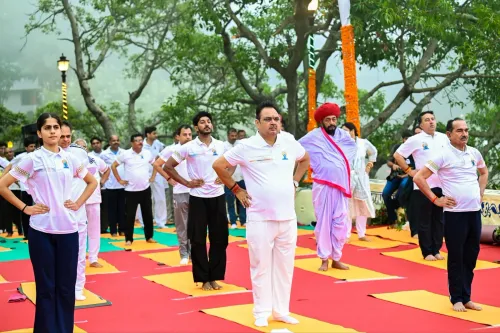
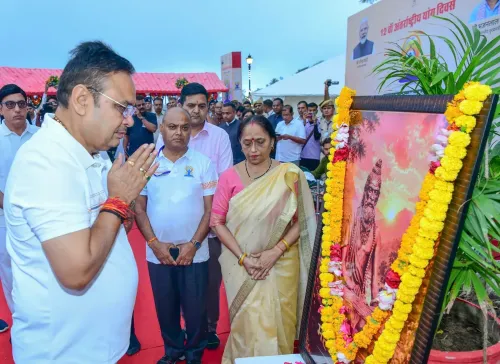
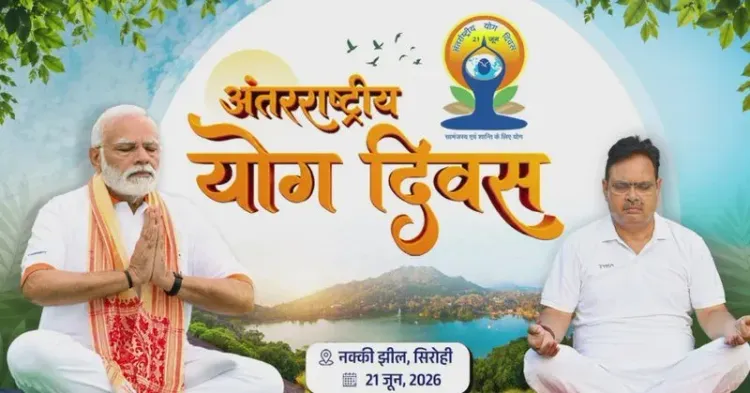
CM Bhajan Lal joins International Yoga Day event in Sirohi
Synopsis
Rajasthan Chief Minister Bhajan Lal Sharma joined International Yoga Day celebrations at Sirohi on 21 June 2026, live-streaming the district event. The observance reflects India's annual tradition under UN Resolution 69/131 and the state government's push to extend wellness outreach beyond urban centres.
Key Takeaways
Rajasthan Chief Minister Bhajan Lal Sharma participated in International Yoga Day celebrations at Sirohi on 21 June 2026 .
The event was broadcast live on the Chief Minister's official social media account.
International Yoga Day on 21 June was established by a UN General Assembly resolution in December 2014 , proposed by India.
India has held nationwide International Yoga Day events every year since 2015 , coordinated by the Ministry of AYUSH .
Sirohi is a southern Rajasthan district known for its tribal population, Mount Abu , and historical temples.
Follow-up policy announcements on yoga in schools or AYUSH wellness centres in the district are being watched.
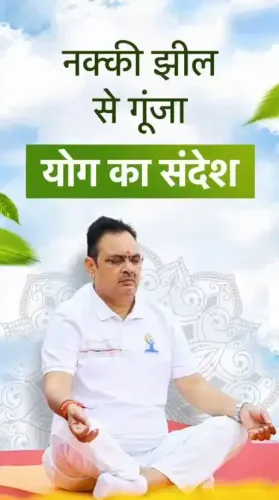
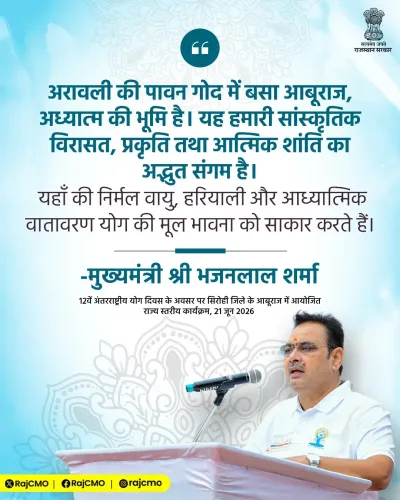
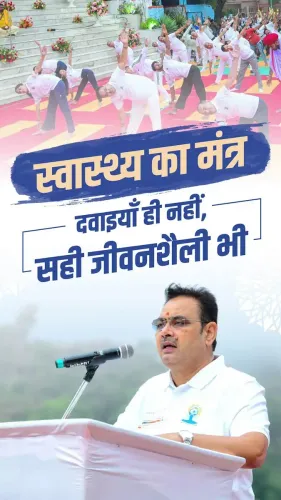
Rajasthan Chief Minister Bhajan Lal Sharma participated in the International Yoga Day celebrations at Sirohi on 21 June 2026, joining residents of the southern Rajasthan district for a live event broadcast on social media. The Chief Minister shared a live stream of the programme on his official account, drawing public attention to the district-level observance of the global wellness day.
Context
International Yoga Day is observed every year on 21 June following a United Nations General Assembly resolution adopted in December 2014 — Resolution 69/131 — which declared the date an international day of recognition for yoga. The resolution was proposed by India and has since anchored annual mass participation events across the country. India has observed the day nationally every year since 2015, with events coordinated through the Ministry of AYUSH.
Sirohi, the chosen venue for this year's Rajasthan event, is a district in the state's southern belt, known for its tribal communities, the Mount Abu hill station, and a cluster of historical temples. Holding the state-level yoga observance in Sirohi signals an intent to extend wellness outreach to regions beyond the state's urban centres.
Policy Backdrop
Successive Indian governments have used International Yoga Day to reinforce traditional wellness practices as a public-health tool and to project yoga as a pillar of India's soft-power diplomacy internationally. At the state level, governments including Rajasthan's have organised district-level events to encourage mass participation and weave yoga messaging into broader health campaigns.
Under Bhajan Lal Sharma, who assumed office in December 2023, Rajasthan has aligned its governance with the Bharatiya Janata Party's emphasis on AYUSH-based wellness. District-level events on occasions such as this one serve as both public-health outreach and demonstrations of administrative reach into smaller towns and rural areas.
Stakeholders and Impact
The primary beneficiaries of such events are Rajasthan's residents, particularly in districts like Sirohi where access to organised wellness infrastructure is limited compared with cities like Jaipur or Jodhpur. Yoga practitioners, local schools, and AYUSH health workers typically form the core of district-level participation, with community leaders and elected representatives joining the sessions.
The live broadcast format chosen by the Chief Minister extended the event's reach beyond physical attendees, allowing residents across the state — and beyond — to participate or watch in real time. This approach reflects a broader pattern of state governments using digital platforms to amplify the visibility of flagship observances.
What's Next
Attention will now turn to whether the Rajasthan government follows the Sirohi event with concrete announcements — such as expanding yoga programmes in government schools or strengthening AYUSH wellness centres at the district level. Such follow-through has been a marker used to assess the policy seriousness behind ceremonial participation in International Yoga Day events across Indian states.
As the 21 June observance becomes an annual fixture on the political calendar, state governments face growing expectations to translate the visibility of these events into measurable public-health outcomes for communities in districts like Sirohi.
Point of View
Tribal-majority district in southern Rajasthan — as the venue for the state's International Yoga Day observance is a deliberate signal of administrative outreach beyond the state's urban heartland. It fits a pattern seen across BJP-governed states where Yoga Day is used simultaneously as a public-health initiative and a soft demonstration of governance presence in underserved regions. The live-stream format amplifies the event's reach without requiring large infrastructure investment. The real test, as with previous years, will be whether the ceremonial participation translates into sustained policy action on AYUSH infrastructure at the district level.
NationPress
20 Sept 2026
Frequently Asked Questions
Where did Rajasthan CM Bhajan Lal Sharma celebrate International Yoga Day 2026?
Chief Minister Bhajan Lal Sharma celebrated International Yoga Day 2026 at Sirohi, a district in southern Rajasthan, on 21 June 2026.
When is International Yoga Day and why is it celebrated on 21 June?
International Yoga Day is observed on 21 June every year. The date was declared by the United Nations General Assembly through Resolution 69/131 in December 2014, following a proposal by India, and celebrations began globally on 21 June 2015.
Who is Bhajan Lal Sharma?
Bhajan Lal Sharma is the Chief Minister of Rajasthan and a Bharatiya Janata Party leader who took office in December 2023.
What is Sirohi district known for?
Sirohi is a district in southern Rajasthan known for its tribal population, the Mount Abu hill station, and a number of historical temples.
How does India observe International Yoga Day?
India organises mass participation events across the country every 21 June, coordinated by the Ministry of AYUSH, with state governments holding district-level programmes to encourage public involvement in yoga and traditional wellness practices.