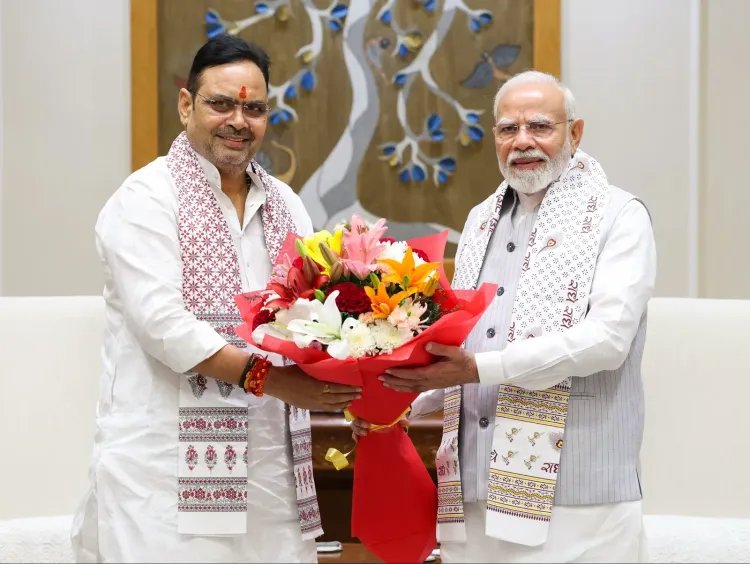
CM Bhajan Lal meets PM Modi, flags Rajasthan's 2047 goals
Synopsis
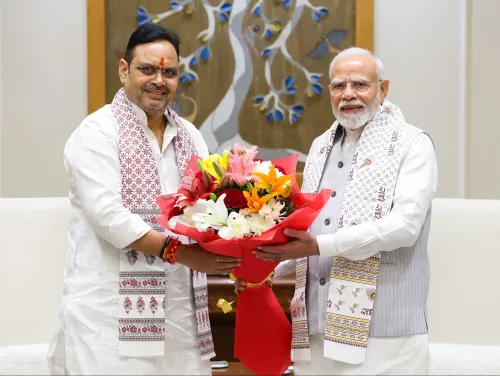
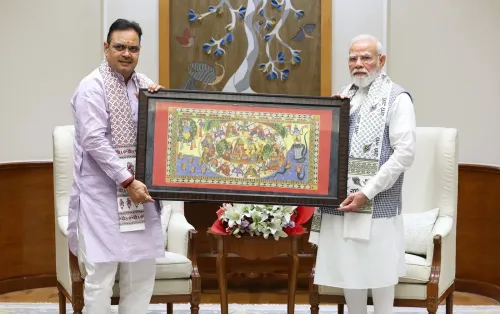
Rajasthan Chief Minister Bhajan Lal Sharma met Prime Minister Narendra Modi in New Delhi on October 15, congratulating him on 25 years in public office and discussing central support for Rajasthan's infrastructure, investment and water management agenda ahead of its 2047 development target.
Key Takeaways
Rajasthan CM Bhajan Lal Sharma met PM Narendra Modi in New Delhi on October 15, 2026 .
Sharma congratulated Modi on completing 25 years in prominent public office, tracing back to his Gujarat Chief Ministership in October 2001 .
The CM described central support in infrastructure, investment and water management as accelerating Rajasthan's development.
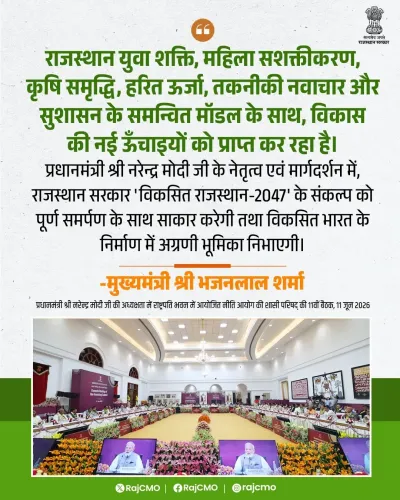
Rajasthan has aligned its long-term goals with the national Viksit Bharat 2047 vision, targeting developed-state status by independence's centenary.
Sharma has served as Rajasthan Chief Minister since December 2023 after the BJP's return to power in the state.
Rajasthan Chief Minister Bhajan Lal Sharma called on Prime Minister Narendra Modi in New Delhi on Thursday, October 15, seeking his guidance on the state's development roadmap — and used the occasion to mark a milestone that few leaders in Indian public life can claim: 25 years of Modi's continuous service in prominent public office.
Sharma posted on X that he 'received inspiring guidance' from the Prime Minister, offering his 'heartfelt congratulations' on the completion of 25 glorious years in public life. Modi's tenure in high office began with his appointment as Chief Minister of Gujarat in October 2001 — a journey that has since reshaped Indian politics at every level.
Modi's 25-year arc and what it means for states like Rajasthan
The milestone is not ceremonial arithmetic. A quarter-century of continuous governance — first in Gujarat, then as Prime Minister since 2014 — gives Modi an institutional depth that state governments draw on constantly. Sharma's visit signals exactly that: Rajasthan does not govern in isolation. Central support in infrastructure, investment, and water management is the scaffolding around the state's own ambitions.
Sharma described the Prime Minister's 'affectionate bond with Rajasthan and his consistent support' as a force accelerating the state's development journey. The language is diplomatic, but the substance is real: a large, arid, infrastructure-hungry state like Rajasthan depends heavily on central allocations and scheme frameworks to move its needle.
Rajasthan's race to 'Viksit Pradesh' by 2047
The meeting sits within a wider strategic frame. The central government's Viksit Bharat 2047 vision — a developed India by the centenary of independence — has given every BJP-governed state a concrete north star to align with. Rajasthan has adopted that timeline explicitly, targeting developed-state status by 2047.
Sharma stated that under Modi's guidance, 'our government, with its resolve for public welfare and good governance, is continuously working towards building a prosperous, self-reliant and developed Rajasthan.' The three pillars he named — infrastructure, investment, and water management — are precisely the pressure points for a desert state that covers 10.4 percent of India's land area but remains water-scarce and logistically challenged.
Water management, in particular, is a defining political and developmental challenge for Rajasthan. Progress on central-state projects in that sector will be the real test of whether the coordination signalled in meetings like this one translates into outcomes on the ground.
Sharma has been Chief Minister since December 2023, when the BJP returned to power in Rajasthan. His regular engagement with the Prime Minister follows a pattern common across BJP states — using the party's command structure to fast-track central approvals and resources. Whether the rhythm of those interactions accelerates delivery for Rajasthan's citizens is the story worth watching.
Point of View
Not merely a political ritual. Sharma's explicit invocation of infrastructure, investment and water management signals that Rajasthan's 2047 agenda needs central fiscal and policy firepower to become real. Modi's 25-year milestone also gives the BJP a powerful internal narrative: continuity of leadership as proof of delivery capacity. For Rajasthan, a state with vast land, scarce water and lagging industrial investment, how central-state coordination converts into on-ground outcomes — rather than press-conference intent — will define whether the 2047 target is a plan or a slogan.
NationPress
15 Oct 2026
Frequently Asked Questions
Why did Rajasthan CM Bhajan Lal Sharma meet PM Modi on October 15, 2026?
Sharma met Modi in New Delhi to seek guidance on Rajasthan's development priorities — including infrastructure, investment and water management — and to congratulate the Prime Minister on completing 25 years in public office.
What is Rajasthan's Viksit Pradesh 2047 goal?
Rajasthan has set a target to become a developed state by 2047, aligning with the national Viksit Bharat 2047 vision of a fully developed India by the centenary of independence.
When did Narendra Modi complete 25 years in public life?
Modi's 25-year milestone in prominent public office is reckoned from his appointment as Chief Minister of Gujarat in October 2001, making 2026 the year of that anniversary.
When did Bhajan Lal Sharma become Chief Minister of Rajasthan?
Bhajan Lal Sharma became Chief Minister of Rajasthan in December 2023, after the BJP won the state assembly elections.
What are Rajasthan's key development challenges that require central support?
Rajasthan's primary development challenges include building infrastructure, attracting industrial investment and managing water resources — the state is one of India's most arid and water-scarce, making central support in these areas critical to its 2047 target.