CM Bhajan Lal pays tribute to JP Narayan on death anniversary
Synopsis
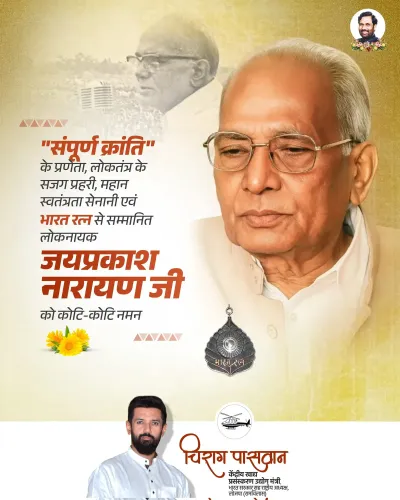
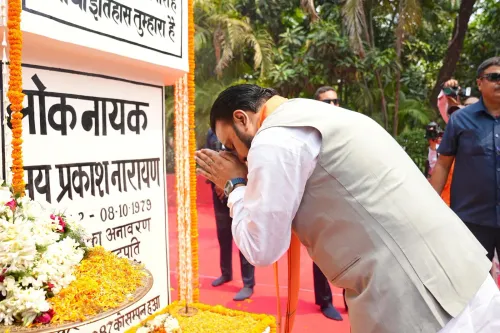
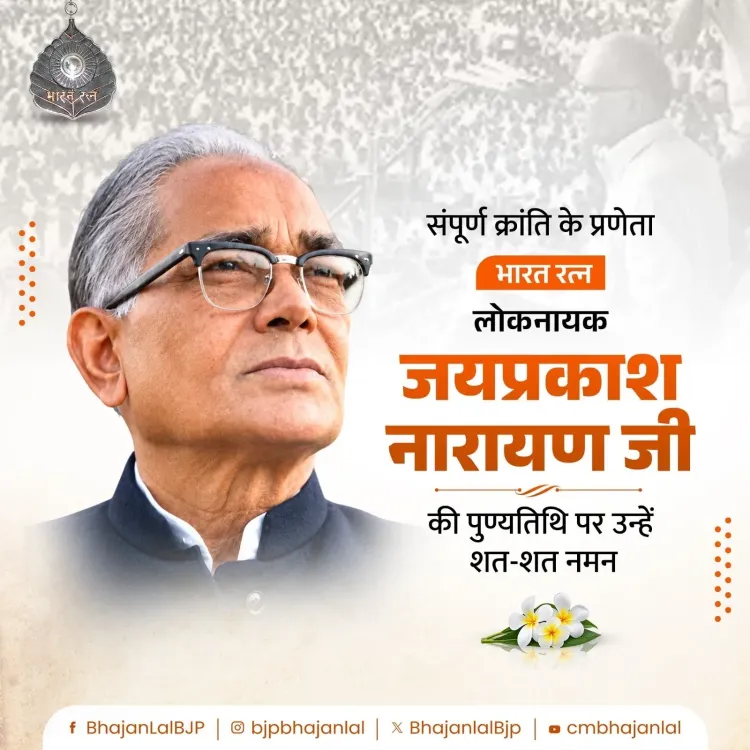
Rajasthan Chief Minister Bhajan Lal Sharma paid tribute to Bharat Ratna Loknayak Jayaprakash Narayan on his 47th death anniversary, honouring the architect of India's 'Total Revolution' whose struggle for democracy and public welfare continues to inspire the nation.
Key Takeaways
Rajasthan CM Bhajan Lal Sharma paid tribute to Jayaprakash Narayan on his 47th death anniversary, October 8, 2026 .
JP Narayan, known as Loknayak , was the pioneer of the 'Sampurna Kranti' (Total Revolution) movement of 1974 .
He was awarded the Bharat Ratna posthumously in 1999 , India's highest civilian honour.
JP's mass movement preceded and is credited with ultimately ending the Emergency period (1975–1977) .
CM Sharma highlighted JP's lifelong contributions to nation-building, public welfare, and the protection of Indian democracy .
On the death anniversary of one of independent India's most consequential democratic voices, Rajasthan Chief Minister Bhajan Lal Sharma offered tribute to Bharat Ratna Loknayak Jayaprakash Narayan on Thursday, October 8, 2026, honouring the man whose call for 'Sampurna Kranti' — Total Revolution — shook the foundations of Emergency-era India.
Sharing his homage on X, CM Sharma wrote: 'On the death anniversary of Bharat Ratna Loknayak Jayaprakash Narayan, the pioneer of Total Revolution, I bow to him a hundredfold. His lifelong struggle and ideas for nation-building, public welfare, and the protection of Indian democracy will always inspire us all.'
The man behind 'Sampurna Kranti'
Jayaprakash Narayan, popularly known as JP, was born on October 11, 1902, and passed away on October 8, 1979 — making today the 47th death anniversary of the socialist leader and freedom fighter. Awarded the Bharat Ratna posthumously in 1999, JP remains a towering figure in India's post-independence political memory, revered across party lines for his moral authority and unwavering commitment to civil liberties.
His 1974 call for 'Sampurna Kranti' galvanised a mass movement against what he termed corruption and authoritarianism in government — a movement that directly preceded the declaration of the Emergency in 1975 by then Prime Minister Indira Gandhi. JP's mobilisation of students and citizens is widely credited with reshaping India's democratic consciousness and ultimately leading to the Emergency's end in 1977.
A legacy that transcends party lines
JP's relevance endures not as a partisan icon but as a symbol of democratic resistance — invoked by leaders of varied political persuasions whenever questions of people's rights, institutional integrity, or civil freedoms arise. His insistence that true democracy demands active, vigilant citizenship, not passive electoral participation, continues to resonate in India's political discourse.
CM Sharma's tribute places the Rajasthan government's remembrance squarely within this broader national conversation about JP's enduring ideals of jan-kalyan (public welfare) and rashtra nirman (nation-building) — values that political leaders across the spectrum invoke, even as they interpret them differently.
Forty-seven years on, Jayaprakash Narayan's greatest legacy may be this: a nation that still argues about what democracy owes its citizens — and a citizenry that knows it has the right to ask.
Point of View
CM Sharma aligns Rajasthan's BJP government with a moral and civic tradition that transcends party identity. The gesture also signals the continued relevance of JP's memory as a unifying national symbol, deployed particularly to reinforce democratic credentials at a time when governance accountability remains a live political debate across India.
NationPress
8 Oct 2026
Frequently Asked Questions
When did Jayaprakash Narayan die?
Jayaprakash Narayan died on October 8, 1979 , making 2026 his 47th death anniversary .
What is 'Sampurna Kranti' or Total Revolution?
' Sampurna Kranti ' or Total Revolution was a mass movement launched by Jayaprakash Narayan in 1974 , calling for fundamental social, economic, and political transformation to combat corruption and authoritarianism in government.
Was Jayaprakash Narayan awarded the Bharat Ratna?
Yes. Jayaprakash Narayan was awarded the Bharat Ratna posthumously in 1999 , India's highest civilian honour, recognising his extraordinary contribution to democracy and public life.
Why did Bhajan Lal Sharma pay tribute to JP Narayan?
Rajasthan CM Bhajan Lal Sharma posted a tribute on October 8, 2026 — JP Narayan's death anniversary — honouring his legacy of nation-building, public welfare, and the protection of Indian democracy.
What was Jayaprakash Narayan's role in the Emergency period?
JP Narayan's 1974 mass movement directly preceded the declaration of Emergency in 1975 by Prime Minister Indira Gandhi. His mobilisation of citizens is widely credited with restoring democratic governance after the Emergency ended in 1977 .