CM Bhajan Lal Puts Villages, Youth, Women and Farmers at Core
Synopsis
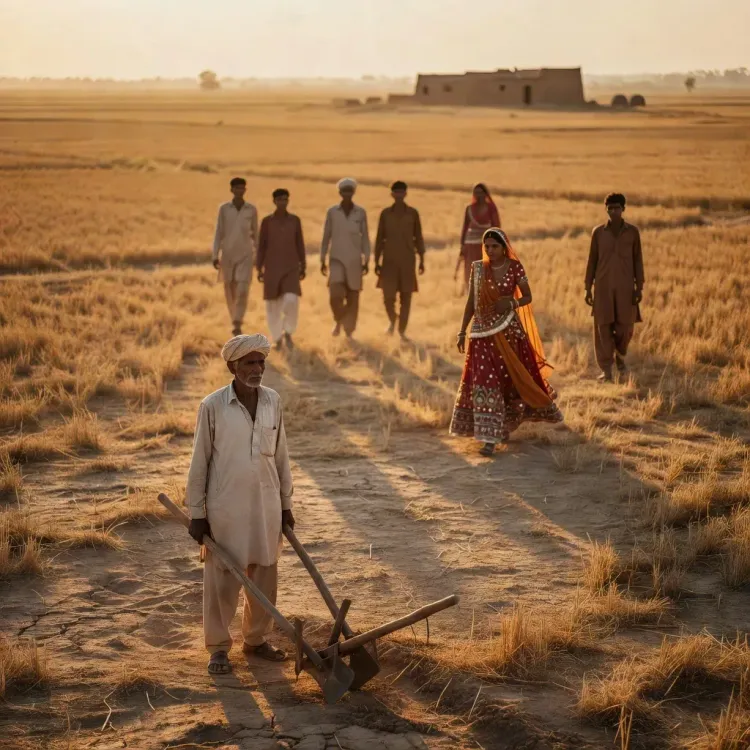
The Chief Minister's Office of Rajasthan, quoting CM Bhajan Lal Sharma, declared on 25 September 2026 that villages, the poor, youth, women, and farmers form the central focus of all state development projects — reinforcing the BJP government's inclusive governance narrative under the 'Aapno Agrani Rajasthan' banner.
Key Takeaways
CM Bhajan Lal Sharma has publicly reaffirmed five priority groups — villages, the poor, youth, women, and farmers — as the core of Rajasthan's state development agenda.
The statement was shared by the Chief Minister's Office of Rajasthan on 25 September 2026 .
The hashtag #AapnoAgrani_Rajasthan ('Our Leading Rajasthan') frames the communication as part of a broader aspirational governance brand.
Bhajan Lal Sharma has served as Chief Minister since December 2023 after the BJP's victory in the state assembly elections.
The messaging aligns with BJP-led state governments' standard public communication framework, centred on rural and demographic welfare groups.
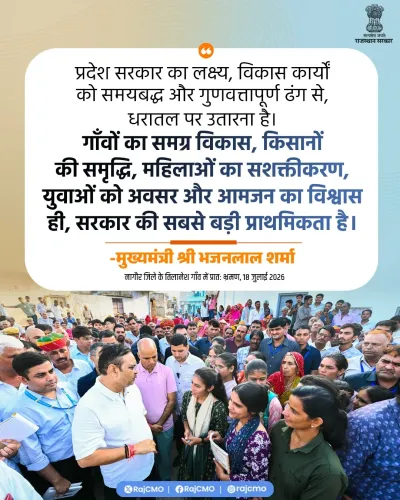
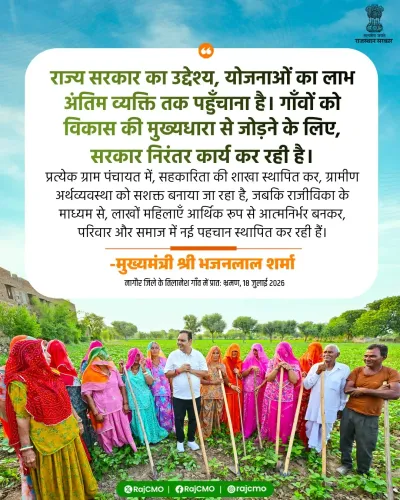
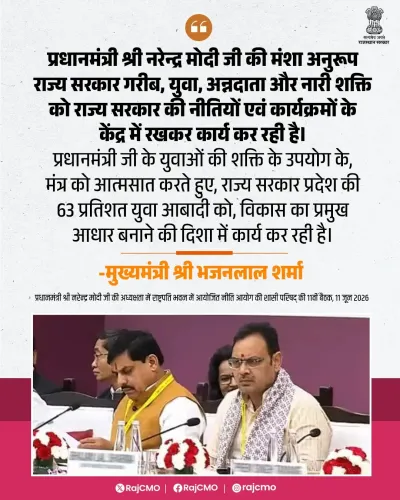
Villages, the poor, youth, women, and farmers — Chief Minister Bhajan Lal Sharma of Rajasthan has reaffirmed these five groups as the central focus of his government's development agenda, in a statement posted on Friday, 25 September 2026. The message, shared from the Chief Minister's Office of Rajasthan, frames the state's entire project pipeline around welfare for its most vulnerable citizens.
The post, in Hindi, reads: 'Gaon, gareeb, yuva, naari shakti aur kisaan rajya sarkar ki vikas pariyojnaon ka kendr bindu hai' — meaning 'Villages, the poor, youth, women's power, and farmers are the central point of the state government's development projects.' The hashtag #AapnoAgrani_Rajasthan — roughly translating to 'Our Leading Rajasthan' — signals an ongoing brand of aspirational governance messaging from the state administration.
Bhajan Lal Sharma's Inclusive Development Framework
Bhajan Lal Sharma has led Rajasthan since December 2023, when the Bharatiya Janata Party returned to power following the state assembly elections. His government has consistently positioned its policy priorities around rural upliftment and demographic welfare groups — a template that has been central to BJP-led state administrations across the country.
The five pillars named — villages, the poor, youth, women, and farmers — track closely with the broader BJP governance vocabulary that has shaped state-level public communication since 2014. What makes this statement notable is its explicit compression of the entire development portfolio into a single, citizen-forward framing, tying every infrastructure and welfare project back to these communities.
What It Means for Rajasthan's Policy Pipeline
Rajasthan is one of India's largest states by area, with a predominantly rural population and a significant agricultural workforce. Schemes targeting farmers' income, rural connectivity, women's self-help groups, and youth employment have been recurring budget priorities for successive state governments. The CMO's messaging suggests these themes will continue to anchor upcoming budget sessions and scheme implementation reviews.
Signals like this from the Chief Minister's Office often precede formal policy announcements or budget allocations. Stakeholders in rural development — from panchayat bodies to women's collectives and agricultural cooperatives — will be watching for concrete programme rollouts that back the stated priorities with spending and timelines.
Point of View
Which has become a durable political language at state level since 2014. By publicly anchoring the entire development portfolio around five identifiable communities, CM Bhajan Lal Sharma signals both a policy intent and an electoral positioning — building a narrative of inclusive governance ahead of potential budget or scheme announcements. The 'Aapno Agrani Rajasthan' branding also indicates a deliberate effort to create a state-specific identity around progress, distinct from the national messaging but aligned with it. Whether the rhetoric translates into measurable programme outcomes will determine its credibility with Rajasthan's largely rural electorate.
NationPress
25 Sept 2026
Frequently Asked Questions
What did Rajasthan CM Bhajan Lal Sharma say about development priorities?
CM Bhajan Lal Sharma stated that villages, the poor, youth, women's power, and farmers are the central focus of the Rajasthan state government's development projects, as posted by the Chief Minister's Office on 25 September 2026.
Who is the Chief Minister of Rajasthan in 2026?
Bhajan Lal Sharma of the Bharatiya Janata Party has been the Chief Minister of Rajasthan since December 2023, following the BJP's victory in the state assembly elections.
What does 'Aapno Agrani Rajasthan' mean?
'Aapno Agrani Rajasthan' is a Hindi phrase meaning 'Our Leading Rajasthan,' used as a hashtag by the Rajasthan government to brand its aspirational governance and development messaging.
What are the Rajasthan government's five development focus groups?
According to the Chief Minister's Office, the five central focus groups for Rajasthan's development projects are: villages (gaon), the poor (gareeb), youth (yuva), women (naari shakti), and farmers (kisaan).
When did the BJP come to power in Rajasthan?
The BJP formed the government in Rajasthan in December 2023, following its victory in the state assembly elections, with Bhajan Lal Sharma sworn in as Chief Minister.