CM Bhajan Lal Reviews Yamuna Water Deal Implementation
Synopsis
Chief Minister Bhajan Lal Sharma on 15 July 2026 reviewed the Yamuna Water Agreement implementation with senior officials and Water Resources Minister Suresh Rawat, directing phased, time-bound execution to deliver drinking water to lakhs in Rajasthan's Shekhawati region and reduce groundwater dependence.
Key Takeaways
CM Bhajan Lal Sharma held a review meeting on 15 July 2026 on the Yamuna Water Agreement's implementation.
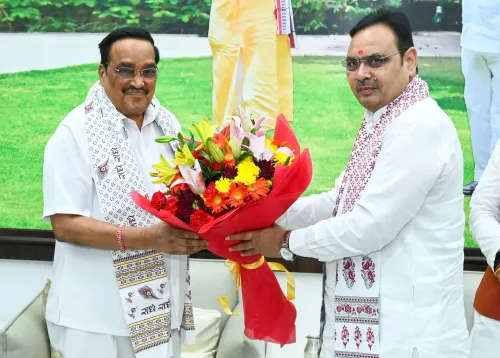
Water Resources Minister Suresh Rawat was present at the meeting.
Officials were directed to maintain timelines, improve inter-departmental coordination, and complete preparations for phased execution.
The project aims to provide drinking water to lakhs of residents in the semi-arid Shekhawati region covering Sikar , Jhunjhunu , and parts of Churu .
A core objective is reducing the region's heavy dependence on depleting groundwater reserves.
The state government's stated resolve is to deliver benefits to ordinary citizens at the earliest possible stage.
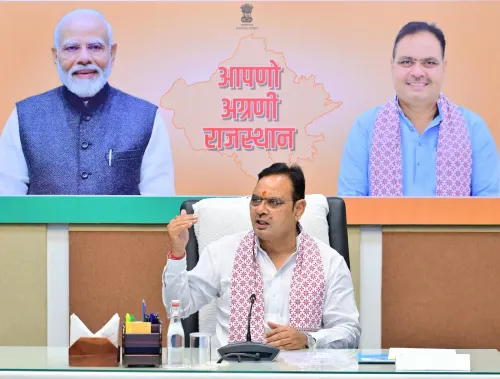
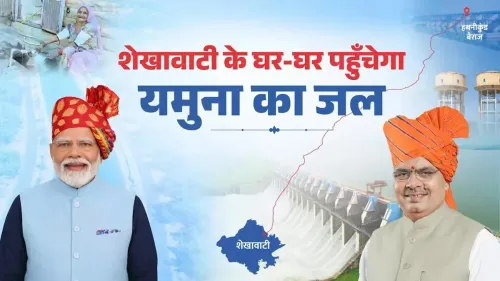
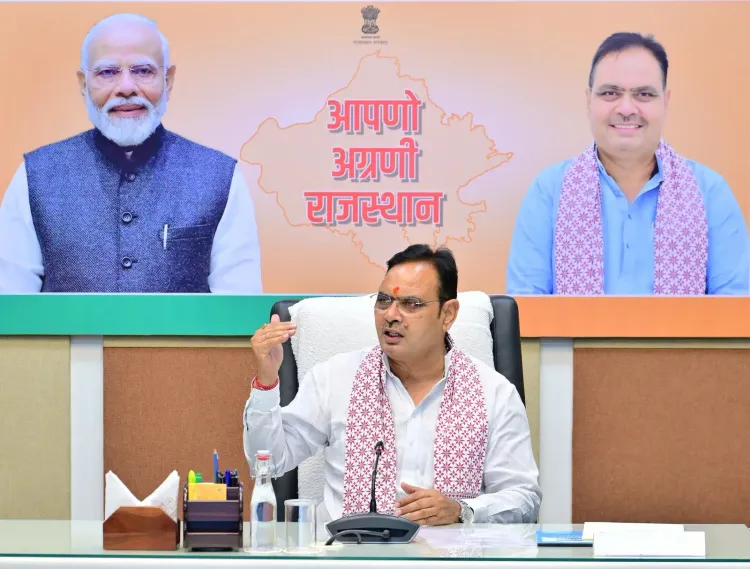
Rajasthan Chief Minister Bhajan Lal Sharma chaired a high-level review meeting on Wednesday, 15 July 2026, directing officials to accelerate the time-bound implementation of the Yamuna Water Agreement — a project he described as historic and critical to the long-term water security of the state's northern districts.
Context
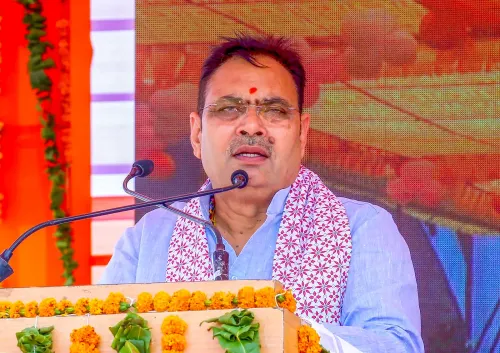
Posting on X, CM Sharma said he held the meeting with concerned officials to ensure effective and time-bound execution of the Yamuna water agreement. In his words, 'यमुना जल समझौते के प्रभावी एवं समयबद्ध क्रियान्वयन को लेकर आज संबंधित अधिकारियों के साथ बैठक की' ('Today I held a meeting with concerned officials regarding the effective and time-bound implementation of the Yamuna water agreement'). Water Resources Minister Suresh Rawat was present at the meeting.
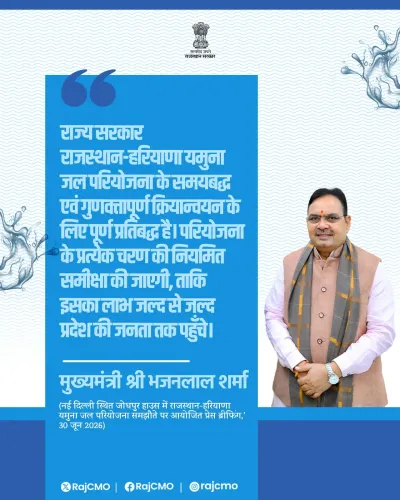
The Chief Minister directed officials to maintain momentum in line with set timelines, ensure better coordination between departments, and complete necessary preparations for the phased implementation of the project.
Policy Backdrop
Rajasthan's claim to Yamuna river waters flows from an inter-state framework rooted in the 1994 Memorandum of Understanding among Yamuna basin states, which created the basis for regulated water sharing and later enabled Rajasthan's allocation claims. The state has long pursued inter-basin transfer projects to supplement local sources in its water-deficit northern and western districts.
The emphasis on inter-departmental coordination at Wednesday's review mirrors the project-management approach used for earlier large-scale water infrastructure such as the Indira Gandhi Canal extensions and various lift irrigation schemes. Successive governments in Jaipur have treated time-bound execution of inter-state water agreements as central to reducing tanker dependency and stabilising rural water supply.
Stakeholders and Impact
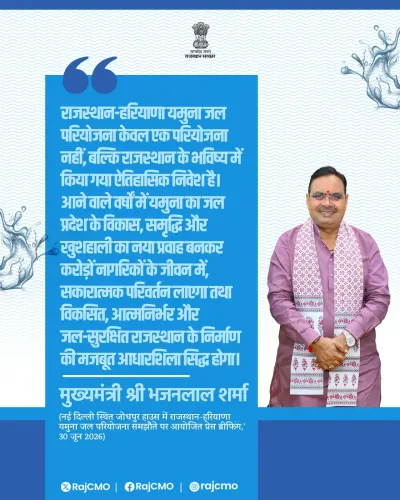
The project's primary beneficiaries are the lakhs of residents of the Shekhawati region — a semi-arid belt spanning Sikar, Jhunjhunu, and parts of Churu — who currently depend heavily on rapidly depleting groundwater. CM Sharma stated that the project will 'provide drinking water to millions of citizens of the Shekhawati region, reduce dependence on groundwater, and give long-term relief to areas affected by water crisis.'
Groundwater-dependent farmers and rural households stand to gain the most if the project delivers on its stated objective of providing a sustainable alternative to borewells and tankers. The phased implementation structure is intended to ensure that benefits reach ordinary citizens at the earliest, as the Chief Minister underlined: 'हमारा संकल्प है कि इसका लाभ शीघ्र आमजन तक पहुँचे' ('Our resolve is that its benefits reach the common people quickly').
What's Next
The review signals that the state government will push for visible on-ground progress on the Yamuna link infrastructure in the near term. Watchers will look for the release of detailed project phases, a funding and disbursement schedule, and tender announcements for pipelines and storage reservoirs.
Any follow-up interstate coordination meetings — particularly with upstream states — and formal notifications of implementation deadlines will be key indicators of whether the project moves from review to execution at the pace CM Sharma has signalled.
Point of View
The Chief Minister is signalling administrative seriousness around a project that has historically stalled at the planning stage. The focus on Shekhawati — a region with significant political weight in Rajasthan's northern constituencies — also carries clear electoral logic. If the project moves into visible construction phases, it could become a flagship deliverable for the BJP government in a state where water scarcity is a perennial voter concern.
NationPress
16 Jul 2026
Frequently Asked Questions
What is the Yamuna Water Agreement for Rajasthan?
The Yamuna Water Agreement is an inter-state arrangement that allocates a share of Yamuna river waters to Rajasthan, primarily for drinking water supply in northern districts. Its framework draws from a 1994 MOU among Yamuna basin states.
Which areas in Rajasthan will benefit from the Yamuna water project?
The primary beneficiaries are residents of the Shekhawati region, covering Sikar, Jhunjhunu, and parts of Churu — a semi-arid belt facing severe groundwater depletion and drinking water shortages.
What did CM Bhajan Lal Sharma announce about the Yamuna water project?
On 15 July 2026, CM Sharma chaired a review meeting and directed officials to accelerate time-bound, phased implementation of the Yamuna Water Agreement, improve inter-departmental coordination, and ensure benefits reach citizens quickly.
Who is Suresh Rawat in the context of Rajasthan's water projects?
Suresh Rawat is Rajasthan's Water Resources Minister, responsible for canal and drinking water projects in the state. He was present at CM Sharma's 15 July 2026 review meeting on the Yamuna water agreement.
Why is Shekhawati facing a water crisis?
Shekhawati is a semi-arid region in northern Rajasthan where groundwater levels have declined sharply due to over-extraction and low rainfall recharge, making communities heavily dependent on tankers and borewells for drinking water.