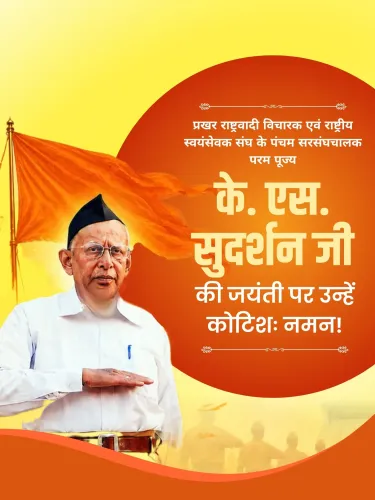
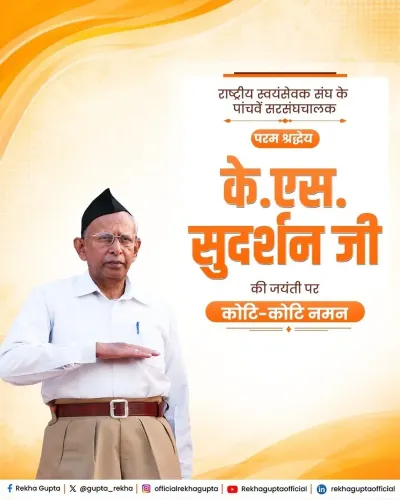
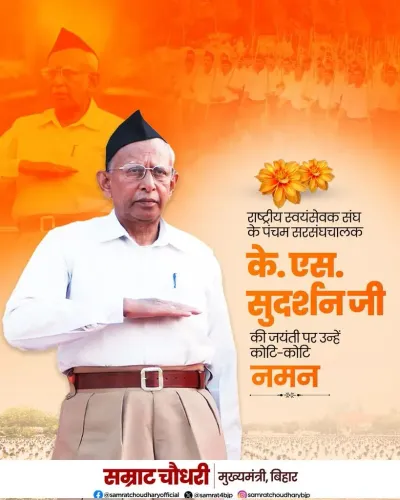
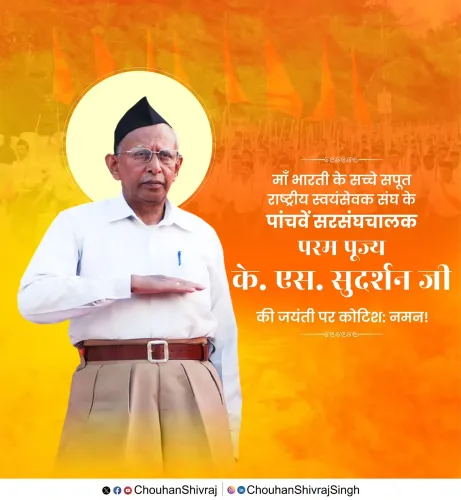
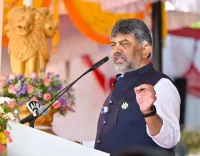
CM Bhajan Lal Pays Tribute to RSS Chief K. S. Sudarshan on Birth Anniversary
Synopsis
Rajasthan Chief Minister Bhajan Lal Sharma paid tribute to K. S. Sudarshan, the fifth RSS Sarsanghchalak, on his birth anniversary, praising his devotion to Swadeshi thought, national self-reliance, and social harmony as an enduring inspiration for nation-building.
Key Takeaways
Rajasthan CM Bhajan Lal Sharma posted a tribute to K.
Sudarshan on his birth anniversary on 18 June .
Sudarshan was the fifth Sarsanghchalak of the RSS , serving from 2000 to 2009 .
Sharma described Sudarshan as a devoted champion of Swadeshi thinking , national interest, and social harmony.
Sudarshan's ideological emphasis on self-reliance is seen as a precursor to the Atmanirbhar Bharat policy framework.
BJP leaders routinely mark RSS Sarsanghchalak anniversaries, reflecting the party's deep organisational ties with the RSS .
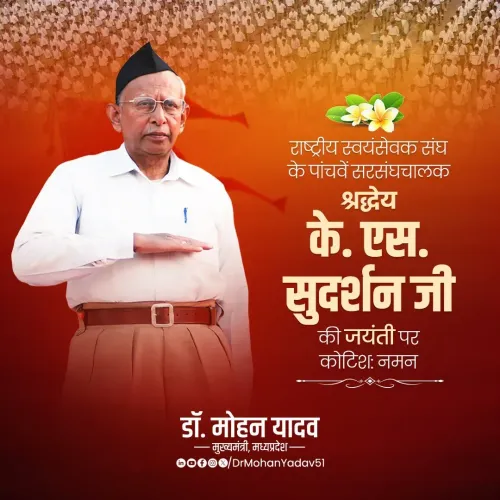
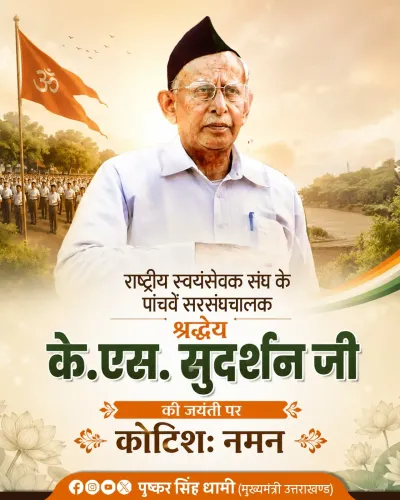
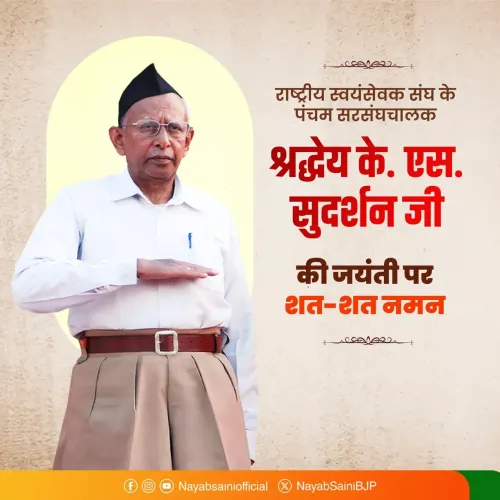
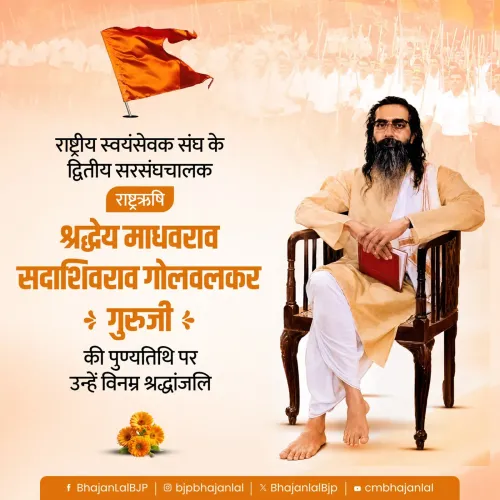
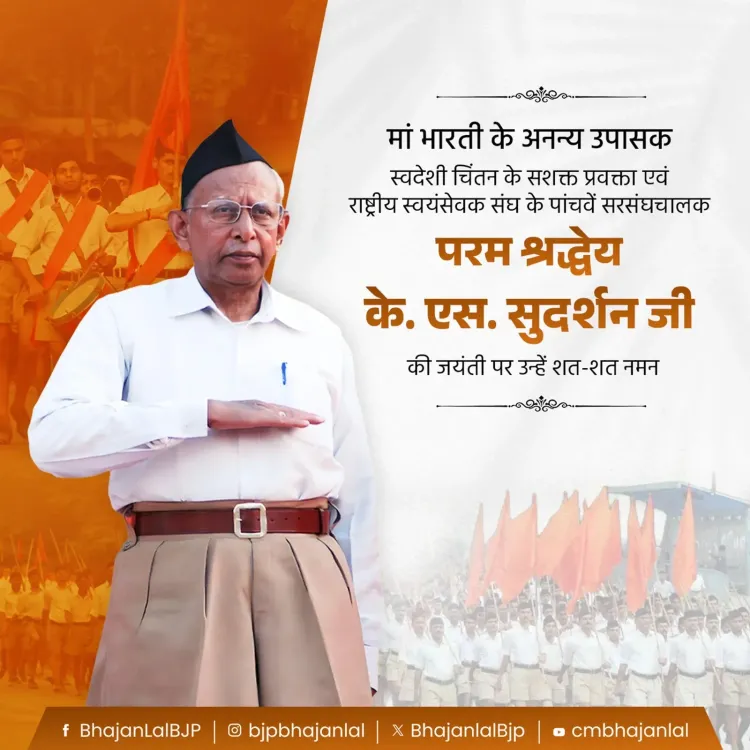
Rajasthan Chief Minister Bhajan Lal Sharma on Thursday, 18 June paid tribute to K. S. Sudarshan, the fifth Sarsanghchalak of the Rashtriya Swayamsevak Sangh (RSS), on the occasion of Sudarshan's birth anniversary, hailing him as a devoted champion of Swadeshi thought and national self-reliance.
In his post, Sharma described Sudarshan as 'मां भारती के अनन्य उपासक' ('an unparalleled devotee of Mother India') and 'स्वदेशी चिंतन के सशक्त प्रवक्ता' ('a powerful voice for indigenous thinking'). He offered 'शत-शत नमन' — a hundredfold salute — to the late RSS chief, and said Sudarshan's life of dedication to national interest, self-reliance, and social harmony would continue to guide the nation on the path of nation-building.
Context
K. S. Sudarshan served as the fifth Sarsanghchalak of the RSS from March 2000 to 2009, succeeding Rajendra Singh. He was widely regarded within the Sangh Parivar for his emphasis on Swadeshi economics — the promotion of domestically produced goods and services — and for articulating a vision of social cohesion rooted in Hindu cultural values. His tenure saw the RSS expand its footprint across educational, tribal welfare, and self-reliance programmes.
The RSS, founded in 1925, is the ideological parent organisation of the BJP. Annual birth anniversaries of its Sarsanghchalaks, including founding figures such as K. B. Hedgewar and M. S. Golwalkar, are observed as part of the Sangh calendar, with tributes from both RSS volunteers and BJP leaders across the country.
Policy Backdrop
Sudarshan's advocacy for Swadeshi and national self-reliance predated — and is often cited as an ideological precursor to — policy frameworks such as Atmanirbhar Bharat (Self-Reliant India), the economic vision promoted by the central government in recent years. His insistence on reducing dependence on foreign goods and strengthening indigenous industry resonated with a strand of economic nationalism that has since found expression in formal government policy.
His emphasis on samajik samarasata (social harmony) also informed RSS outreach programmes aimed at bridging caste divides within Hindu society, a theme that remains central to the organisation's social agenda.
Stakeholders and Impact
BJP office-bearers across the country routinely mark the birth and death anniversaries of senior RSS leaders on social media, a practice that reinforces the party's organisational and ideological linkage with the Sangh. Sharma's post is consistent with this pattern, signalling alignment with core RSS values at a time when the Rajasthan government is positioning itself as a vehicle for both development and cultural nationalism.
For RSS volunteers and Swayamsevaks in Rajasthan, such commemorations carry symbolic weight, affirming that the state's political leadership shares the Sangh's foundational commitments. Shakha-level events marking Sudarshan's birth anniversary are typically held across RSS units on this date.
What's Next
Similar tributes from other BJP chief ministers and central leaders are expected to follow through the day, as the party's social media machinery observes the anniversary in coordinated fashion. Within Rajasthan, the tribute may be accompanied by RSS-affiliated events focused on Sudarshan's legacy of Swadeshi thought and social service — themes the Sharma government has sought to weave into its own governance narrative. The anniversary also serves as a reminder of the continuing ideological influence the RSS exercises over the broader Sangh Parivar and its elected representatives.
Point of View
Allowing BJP leaders to frame government programmes such as Atmanirbhar Bharat as rooted in Sangh thought rather than mere electoral strategy. The coordinated nature of such commemorations across BJP chief ministers and central leaders also underscores the party's disciplined use of social media as an instrument of ideological messaging. In a state where the RSS organisational network is a critical electoral asset, such symbolic gestures carry real political currency beyond their ceremonial appearance.
NationPress
17 Sept 2026
Frequently Asked Questions
Who was K. S. Sudarshan of the RSS?
K. S. Sudarshan was the fifth Sarsanghchalak (chief) of the Rashtriya Swayamsevak Sangh (RSS), serving from March 2000 to 2009. He was known for championing Swadeshi economics, national self-reliance, and social cohesion within Hindu society.
Why did Bhajan Lal Sharma pay tribute to K. S. Sudarshan?
Rajasthan Chief Minister Bhajan Lal Sharma paid tribute to K. S. Sudarshan on his birth anniversary, 18 June, praising him as an inspiration for nation-building through his commitment to Swadeshi thought and social harmony. Such commemorations are a regular practice among BJP leaders given the party's ideological ties with the RSS.
What is the RSS Sarsanghchalak?
The Sarsanghchalak is the supreme head of the Rashtriya Swayamsevak Sangh (RSS), the Hindu nationalist volunteer organisation founded in 1925. K. S. Sudarshan was the fifth person to hold this position.
What did K. S. Sudarshan believe in?
K. S. Sudarshan was a strong advocate of Swadeshi (indigenous) economics, national self-reliance, and social harmony. His ideas emphasised reducing dependence on foreign goods and bridging social divides, themes that have since influenced broader policy discourse in India.
How is the BJP connected to the RSS?
The BJP traces its ideological roots to the RSS, which was founded in 1925. BJP leaders regularly participate in RSS commemorations and anniversaries, reflecting a longstanding organisational and philosophical linkage between the two bodies.