CM Bhajan Lal Sharma outlines Rajasthan's investment vision
Synopsis
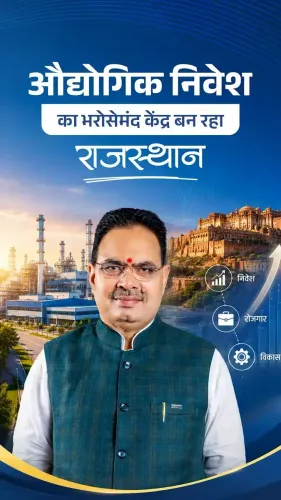
Rajasthan Chief Minister Bhajan Lal Sharma on 10 July 2026 outlined his government's vision to make Rajasthan a leading investment, renewable energy and tourism destination, emphasising policy stability and execution as the pillars of the state's growth strategy.
Key Takeaways
CM Bhajan Lal Sharma articulated Rajasthan's growth strategy on 10 July 2026 , centred on investment, infrastructure, renewables, tourism and sustainable development.
The Chief Minister identified 'decisive governance, policy stability and commitment to execution' as the three drivers of the state's growth journey.
Rajasthan , India's largest state by area, has emerging strengths in solar energy alongside established sectors such as minerals and heritage tourism.
The BJP government has positioned investor-friendly policy continuity as a core identity since taking office in December 2023 .
Concrete delivery metrics — including budget allocations and investment summit outcomes — will be the key test of the administration's stated ambitions.
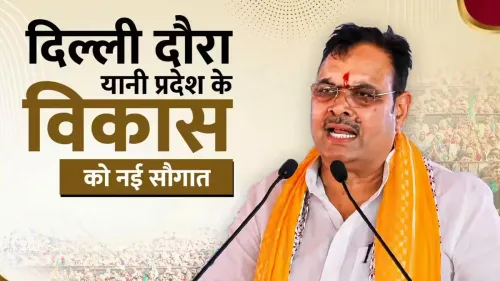
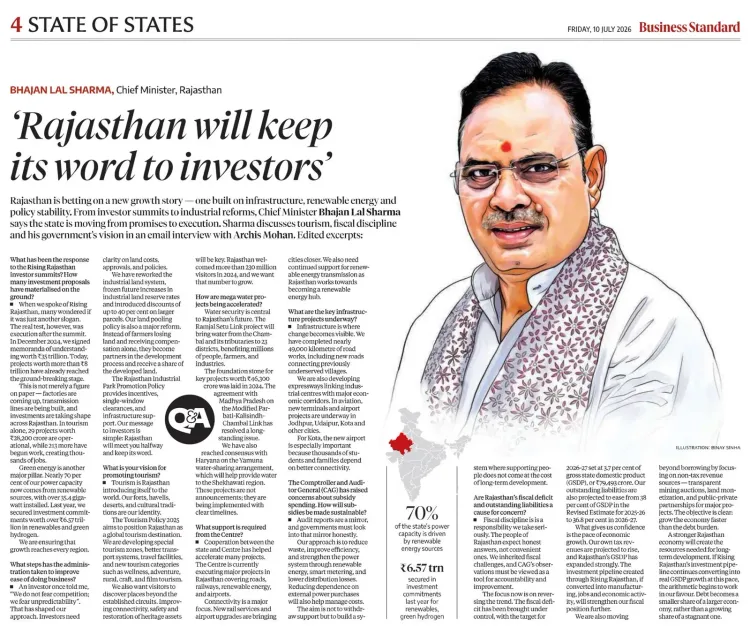
Rajasthan Chief Minister Bhajan Lal Sharma on Friday, 10 July 2026 shared his government's economic roadmap, stating that the state's growth is anchored in 'decisive governance, policy stability and a steadfast commitment to execution.' The Chief Minister was speaking in the context of a published interview in which he laid out Rajasthan's ambitions across investment attraction, infrastructure, renewable energy, tourism and sustainable development.
Context
Bhajan Lal Sharma took office as Chief Minister of Rajasthan in December 2023 after the BJP won the state assembly elections, ending the previous Congress government's tenure. His administration has since positioned itself around policy continuity and investor-friendly governance as its defining identity. The interview, in which he articulated this vision, represents one of the more detailed public statements he has made on the state's economic direction.
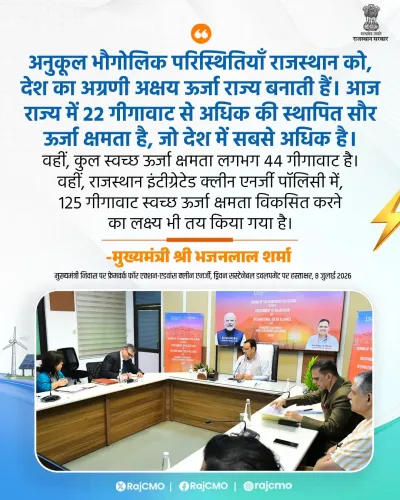
In the post, the Chief Minister summarised his core message: making Rajasthan 'a leading destination for investment, infrastructure, renewable energy, tourism and sustainable development — while ensuring that every promise translates into meaningful progress for our people.'
Policy Backdrop
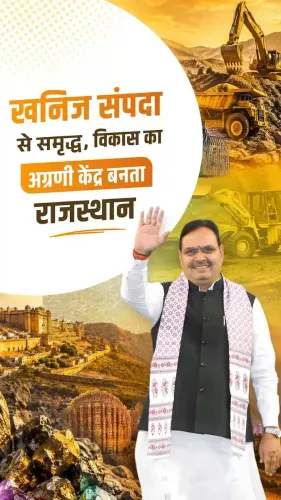
Rajasthan is India's largest state by area and carries established strengths in minerals and tourism, while more recently emerging as a significant player in renewable energy, particularly solar power, owing to its vast arid terrain. The BJP government's emphasis on investment facilitation aligns with a broader national pattern in which state governments compete for capital by offering policy stability and single-window clearance mechanisms.
Since 2014, central government infrastructure outlays have created an opening for states to attract complementary private investment. Rajasthan's stated priorities — renewables, infrastructure, tourism — mirror the playbook adopted by peer states seeking to convert federal spending into local economic momentum. The Chief Minister's framing of 'vision into action' signals an intent to demonstrate execution, not merely announce targets.
Stakeholders and Impact
The primary audiences for CM Sharma's message are domestic and foreign investors, renewable energy developers, and the tourism sector — all of whom weigh policy predictability heavily before committing capital. For ordinary residents of Rajasthan, the stated promise is that governance improvements will translate into tangible improvements in livelihoods and public services.
Infrastructure development and renewable energy projects, if realised at scale, could generate significant employment in a state where agriculture remains dominant and industrial diversification is a long-standing policy goal. Tourism, already a pillar of the state's economy anchored by heritage sites across Jaipur, Jodhpur and Udaipur, stands to benefit from sustained government attention and investment in connectivity.
What's Next
Analysts and investors will watch the next state budget and any forthcoming investment summit for concrete project announcements, funding commitments and measurable targets. Follow-up legislation on land acquisition, power-sector reforms or single-window clearance upgrades would be the clearest signal that the vision articulated by CM Sharma is being operationalised. The gap between stated ambition and verifiable on-ground delivery will define how the administration's governance record is assessed ahead of the next electoral cycle.
Point of View
Reflecting awareness that investor confidence in Indian states has historically been eroded by the gap between policy promises and on-ground delivery. Rajasthan's combination of solar potential, heritage tourism and mineral wealth gives it genuine competitive assets, but translating those into sustained growth will depend on administrative reform and infrastructure investment that goes beyond communication strategy. The interview, and the social media amplification around it, is as much a signal to New Delhi and the investor community as it is a message to the state's own electorate.
NationPress
10 Jul 2026
Frequently Asked Questions
What is Rajasthan CM Bhajan Lal Sharma's vision for the state's economy?
Chief Minister Bhajan Lal Sharma has outlined a vision to make Rajasthan a leading destination for investment, infrastructure, renewable energy, tourism and sustainable development, with an emphasis on policy stability and converting promises into measurable progress for residents.
When did Bhajan Lal Sharma become Chief Minister of Rajasthan?
Bhajan Lal Sharma became Chief Minister of Rajasthan in December 2023 after the BJP won the state assembly elections.
Why is Rajasthan considered a potential renewable energy hub?
Rajasthan is India's largest state by area and has vast arid and semi-arid terrain that is well-suited for large-scale solar energy projects, making it one of the country's most significant states for renewable energy development.
What sectors is the Rajasthan government focusing on for growth?
The Rajasthan government under CM Bhajan Lal Sharma is focusing on investment attraction, infrastructure development, renewable energy, tourism and sustainable development as its primary growth sectors.
How does Rajasthan plan to attract investors?
The state government is emphasising policy stability, single-window clearance mechanisms and decisive governance as tools to attract domestic and foreign investors, aligning with a broader national trend among Indian states competing for capital.