CM Bhajan Lal Sharma Chairs Cabinet Meet on Land, Farm Rules
Synopsis
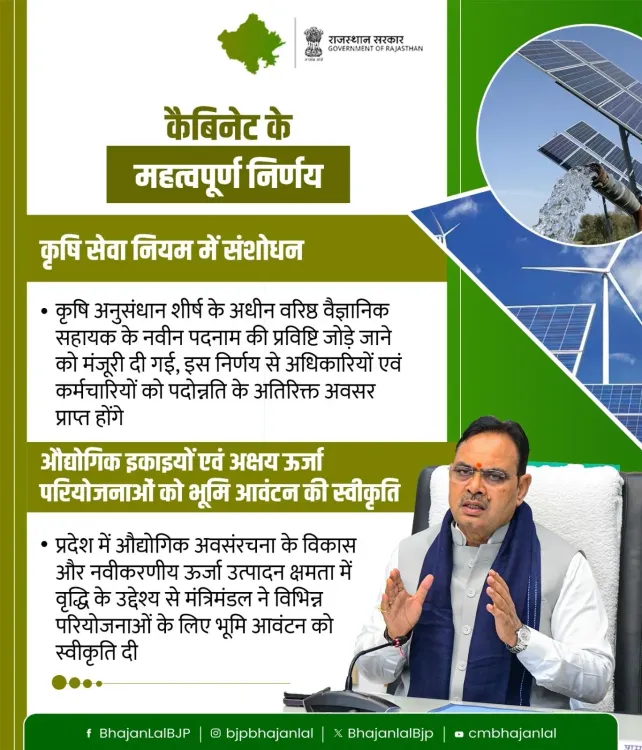
Rajasthan Chief Minister Bhajan Lal Sharma announced on 22 May 2026 that the state cabinet approved amendments to agricultural service rules and cleared land allotments for industrial units and renewable energy projects, advancing the BJP government's dual agenda of economic liberalisation and clean energy expansion.
Key Takeaways
The Rajasthan cabinet met on 22 May 2026 under CM Bhajan Lal Sharma and passed multiple policy decisions in a single session.
The cabinet approved an amendment to agricultural service rules , affecting the state's agriculture cadre.
Land allotments were cleared for industrial units and renewable energy projects , signalling continued investor-friendly policy.
Rajasthan has been a major renewable energy hub, with significant solar capacity already installed in its western districts.
Formal government notifications detailing the specific rule changes and land parcels are yet to be issued.
The decisions align with the BJP government's post-2023 agenda of simplifying land allotment to attract private capital.
Rajasthan Chief Minister Bhajan Lal Sharma on Friday, 22 May 2026 announced that the state cabinet had approved amendments to agricultural service rules and cleared land allotments for industrial units and renewable energy projects, signalling a broad push to accelerate the state's economic agenda.
Context
Posting on X in Hindi, CM Sharma wrote that the cabinet meeting advanced policy reforms, approving an amendment to the krishi seva niyam (agricultural service rules) alongside land allotment approvals for industrial units and renewable energy projects. The hashtag #आपणो_अग्रणी_राजस्थान ('Our Leading Rajasthan') reflects the government's branding for its development agenda. The decisions were taken in a single sitting, underscoring the cabinet's intent to bundle structural and sectoral reforms together.
Policy Backdrop
Since taking office in December 2023, the BJP government under Sharma has repeatedly stated its aim to simplify land allotment procedures to attract private investment and expand manufacturing in Rajasthan. The state has also built significant renewable energy infrastructure over the past decade, with large-scale solar installations in its western arid tracts forming a key part of that strategy. Amending agricultural service rules in the same session as approving industrial and renewable land allotments reflects the government's stated goal of balancing farm-sector governance with economic liberalisation.
Indian states have frequently used cabinet-level approvals to signal policy predictability to private capital, and Rajasthan's dual focus on industry and clean energy mirrors national targets for manufacturing growth and non-fossil power capacity addition.
Stakeholders and Impact
The decisions directly affect three groups: agricultural service personnel covered under the amended rules, industrial investors seeking land in the state, and renewable energy developers looking to commission solar or wind projects on allocated parcels. For the agriculture cadre, the rule amendment could alter service conditions, though the precise provisions have not yet been detailed in official notifications. For the private sector, cabinet-level land clearances reduce procedural uncertainty and can accelerate project timelines.
Rajasthan's large land bank and high solar irradiance have long made it attractive to renewable developers, and a streamlined allotment process is likely to reinforce that appeal. Industrial investors, particularly those eyeing manufacturing zones, stand to benefit from the same procedural clarity.
What's Next
Formal government notifications detailing the amended agricultural service rules and specifying the land parcels or project identities cleared for allotment are expected in the weeks ahead. Stakeholders and opposition parties will scrutinise those notifications for the scale of land involved, the beneficiary entities, and whether agricultural safeguards have been adequately preserved. The cabinet decisions also set a benchmark for how the Sharma government intends to use executive instruments to advance its investment and energy transition goals through the remainder of its term.
Point of View
A metric the BJP government has leaned on since taking office in December 2023. By tying farm-sector governance reform to pro-industry and clean-energy clearances, CM Sharma is attempting to project a balanced development narrative ahead of potential investor summits and central government reviews. The move fits a well-established pattern among BJP-governed states of using cabinet approvals as public-facing policy announcements, amplified through social media, to build investor confidence before formal notifications are issued. The real test will come when the detailed notifications are published and stakeholders can assess whether agricultural safeguards have been maintained alongside the liberalisation measures.
NationPress
19 Sept 2026
Frequently Asked Questions
What did the Rajasthan cabinet decide on 22 May 2026?
The Rajasthan cabinet on 22 May 2026 approved an amendment to agricultural service rules and cleared land allotments for industrial units and renewable energy projects, as announced by Chief Minister Bhajan Lal Sharma.
What is the agricultural service rule amendment in Rajasthan?
The cabinet approved a change to Rajasthan's agricultural service rules during the 22 May 2026 meeting. The precise provisions of the amendment are yet to be detailed in official government notifications.
Which renewable energy projects got land allotment in Rajasthan?
The cabinet cleared land allotments for renewable energy projects as part of the 22 May 2026 decisions, but the specific projects, developers, and parcel sizes have not yet been officially notified.
Who is Bhajan Lal Sharma?
Bhajan Lal Sharma is the Chief Minister of Rajasthan and a BJP leader who took office in December 2023 following the state assembly elections.
How does Rajasthan's land allotment policy support industrial growth?
Since 2023, the Rajasthan government has worked to simplify land allotment procedures to attract private investment in manufacturing and clean energy, using cabinet approvals to signal policy predictability to investors.