Rajasthan CMO: Speed Up Power Grid Strengthening Works
Synopsis
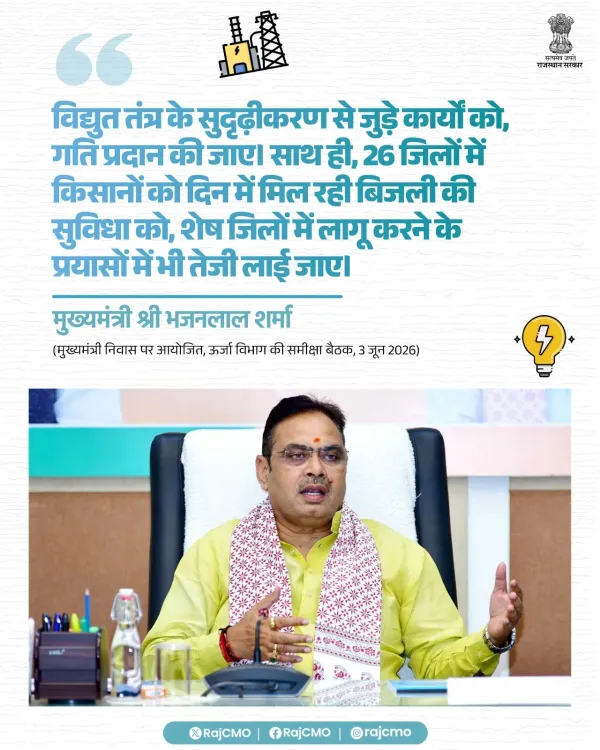
The Chief Minister's Office of Rajasthan has directed that works to strengthen the state's electricity system be accelerated. The 4 June 2026 post on X, tagging CM Bhajan Lal Sharma, frames the push within the government's Aapno Agrani Rajasthan branding and aligns with the state's 75 GW renewable target and central RDSS funding.
Key Takeaways
The CMO directed officials on 4 June 2026 to speed up electricity system strengthening works.
The post tagged CM Bhajan Lal Sharma and used the hashtag #आपणो_अग्रणी_राजस्थान .
The directive aligns with the Rajasthan Renewable Energy Policy 2023 target of 75 GW by 2030 .
Rajasthan draws central funding under the Revamped Distribution Sector Scheme launched in 2021 .
Rajasthan Rajya Vidyut Prasaran Nigam leads transmission and grid evacuation works.
Industrial clusters, three state DISCOMs and agricultural pump users are key stakeholders.
The Chief Minister's Office of Rajasthan on 4 June 2026 directed that works connected with the strengthening of the state's electricity transmission and distribution system be accelerated. In a post on X tagging Chief Minister Bhajan Lal Sharma, the office invoked the government's signature tagline Aapno Agrani Rajasthan (Our Leading Rajasthan), signalling a renewed push on grid modernisation.
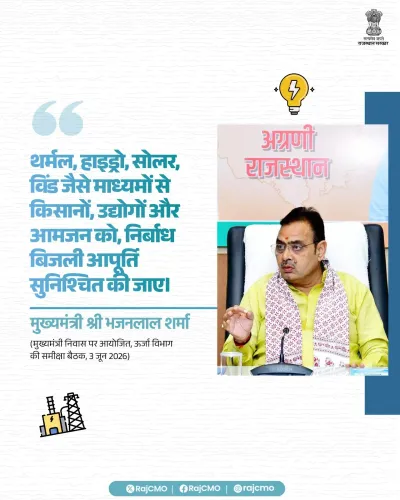
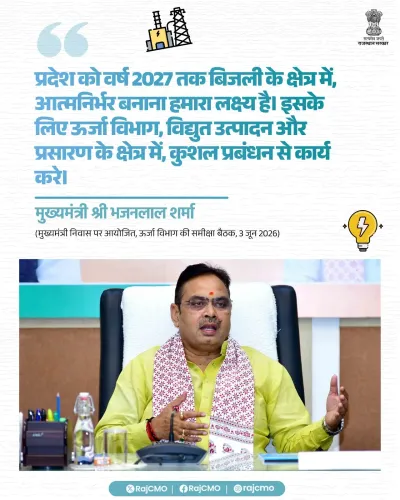
The Hindi-language post stated, in translation, 'Works related to the strengthening of the electricity system should be given speed.' The accompanying image and the hashtag #आपणो_अग्रणी_राजस्थान place the directive within the Sharma government's broader development branding.
Context
Rajasthan, India's largest state by area, faces a dual challenge of meeting rapidly rising peak demand and evacuating large volumes of renewable power from its solar and wind belts in Jodhpur, Jaisalmer and Bikaner. Transmission bottlenecks have been flagged in successive state energy reviews as a constraint on both industrial supply reliability and the absorption of new generation capacity.
Chief Minister Bhajan Lal Sharma, who assumed office in December 2023 after the BJP's assembly election victory, has repeatedly framed power-sector reform as central to attracting manufacturing investment. The latest directive from his office indicates a continued focus on execution timelines for ongoing grid works.
Policy backdrop
The directive sits atop a layered policy stack. The Rajasthan Renewable Energy Policy 2023 targets 75 GW of capacity by 2030, an ambition that hinges on parallel transmission upgrades to move power from desert generation hubs to load centres in eastern Rajasthan and beyond.
At the central level, the Revamped Distribution Sector Scheme (RDSS), launched in 2021, provides funds to states for smart metering, feeder separation and loss reduction. Rajasthan is a participant and has drawn on the scheme for distribution-side modernisation. The state had earlier joined the Ujwal DISCOM Assurance Yojana (UDAY) in 2015, aimed at restoring the financial health of state power utilities.
Execution on the transmission side is led by Rajasthan Rajya Vidyut Prasaran Nigam, the state transmission utility responsible for evacuation infrastructure and grid strengthening, including high-voltage lines feeding industrial corridors.
Stakeholders and impact
The immediate beneficiaries of faster execution are three constituencies the state government has consistently flagged. Industrial consumers in clusters around Jaipur, Alwar, Bhiwadi and Kota require stable high-tension supply for capacity expansion. The state's three DISCOMs — covering Jaipur, Ajmer and Jodhpur zones — stand to see lower technical and commercial losses if distribution upgrades land on schedule.
Agricultural pump users, a politically sensitive segment in Rajasthan, are tied into the feeder separation programme that distinguishes farm supply from domestic and commercial loads, allowing more predictable daytime solar-backed power for irrigation.
Renewable developers, too, are watching evacuation readiness closely. Delays in high-capacity lines have historically stranded generation capacity in the western districts, eroding project economics.
What's next
Attention now turns to the state's next budget outlay for power-sector capital expenditure and to tendering progress on planned 400 kV and 765 kV transmission lines listed under RDSS and state plans. Departmental review meetings are typically the vehicle through which such directives translate into revised milestones.
For the Sharma government, the political stakes are concrete: visible improvement in supply reliability and the unlocking of stranded renewable capacity feed directly into the Aapno Agrani Rajasthan narrative the CMO is building ahead of the second half of its term.
Point of View
And the Sharma administration is consolidating that arc under its Aapno Agrani Rajasthan branding. The political value lies less in announcing fresh schemes than in being seen to compress execution timelines on works already in the pipeline. The metric that will matter is tendering and commissioning progress on high-voltage lines, not the directive itself.
NationPress
18 Oct 2026
Frequently Asked Questions
Who is the Chief Minister of Rajasthan in 2026?
Bhajan Lal Sharma is the Chief Minister of Rajasthan. He assumed office in December 2023 after the BJP won the state assembly elections.
What did the Rajasthan CMO say about the power sector?
The Chief Minister's Office of Rajasthan posted on 4 June 2026 directing that works related to strengthening the electricity system be accelerated. The post tagged CM Bhajan Lal Sharma and used the hashtag Aapno Agrani Rajasthan.
What is the Revamped Distribution Sector Scheme?
The Revamped Distribution Sector Scheme (RDSS) is a central government programme launched in 2021. It provides financial assistance to states for modernising electricity distribution infrastructure, installing smart meters and reducing technical and commercial losses.
What is Rajasthan's renewable energy target?
Rajasthan's Renewable Energy Policy 2023 targets 75 GW of renewable capacity by 2030. The plan emphasises associated transmission upgrades to evacuate solar and wind power from western districts.
What does Aapno Agrani Rajasthan mean?
Aapno Agrani Rajasthan translates from Rajasthani as 'Our Leading Rajasthan'. It is a tagline used by the current state government to frame its development and governance agenda.