Rajasthan CMO: Ensure uninterrupted power via thermal, hydro, solar, wind
Synopsis
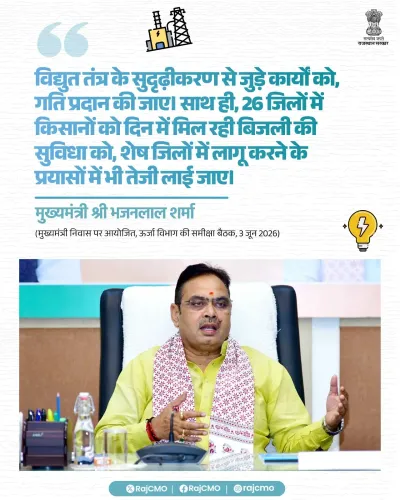
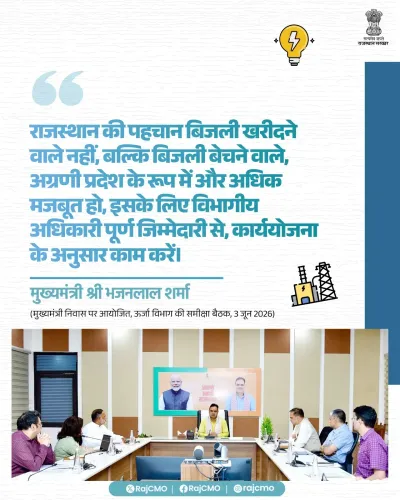
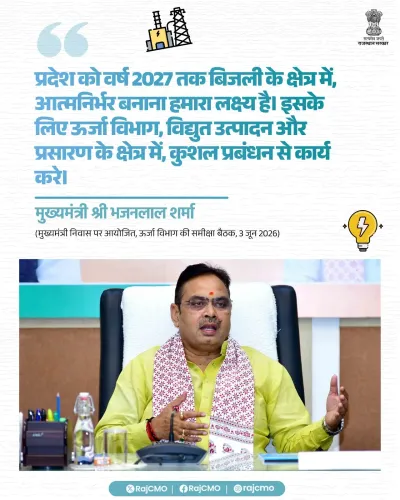
The Chief Minister's Office of Rajasthan has directed that uninterrupted electricity be supplied to farmers, industries and common citizens through a mix of thermal, hydro, solar and wind sources, reinforcing CM Bhajan Lal Sharma's reliability mandate under the 'Apno Agrani Rajasthan' campaign.
Key Takeaways
The Chief Minister's Office of Rajasthan issued the directive on June 4, 2026 , addressed to CM Bhajan Lal Sharma .
The message names four generation sources: thermal , hydro , solar and wind .
Three stakeholder groups are flagged: farmers , industries and the common public .
Rajasthan's Renewable Energy Policy 2023 targets 50 GW of renewables by 2030 .
The state hosts Bhadla Solar Park in Jodhpur , among the world's largest solar installations.
The post uses the campaign hashtag #आपणो_अग्रणी_राजस्थान ('Our Leading Rajasthan').
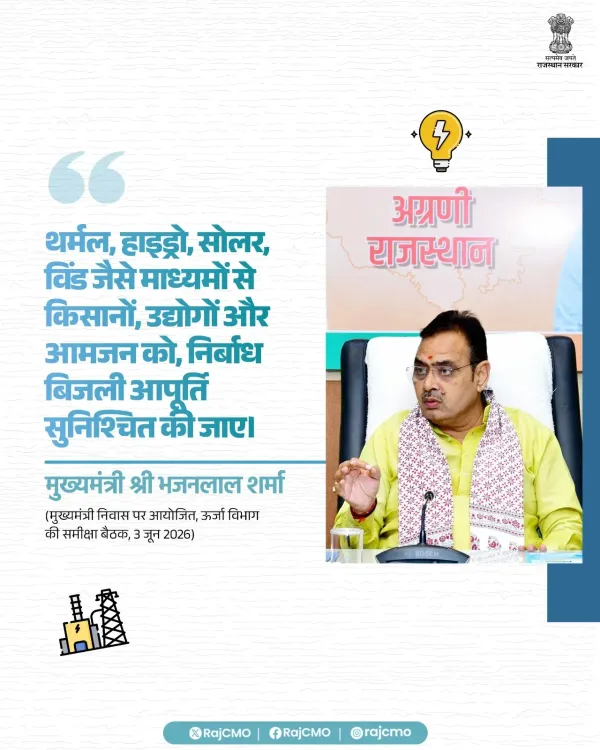
The Chief Minister's Office of Rajasthan on June 4, 2026 directed that uninterrupted electricity supply be ensured for farmers, industries and common citizens through a balanced energy mix spanning thermal, hydro, solar and wind sources. The instruction, addressed to Chief Minister Bhajan Lal Sharma, was issued via the official handle of the state government and tagged with the campaign hashtag #आपणो_अग्रणी_राजस्थान ('Our Leading Rajasthan').
In translation, the post states: 'Uninterrupted power supply should be ensured to farmers, industries and the common public through means such as thermal, hydro, solar and wind.' The message frames reliability of supply as a cross-cutting priority binding agriculture, manufacturing and household consumers under a single delivery mandate.
Context
Bhajan Lal Sharma, who has served as Chief Minister of Rajasthan since December 2023, has consistently linked governance outcomes to dependable electricity in a state where summer demand peaks coincide with intensive irrigation cycles. The campaign tagline used in the post, 'आपणो अग्रणी राजस्थान' ('Our Leading Rajasthan'), has been deployed by the administration to package its development messaging across sectors from water to roads to power.
Rajasthan's geography lends itself to a diversified generation portfolio. The western districts host some of India's highest solar irradiance zones, while the Aravalli belt and border districts offer wind corridors. Thermal stations continue to supply baseload, and hydro draws on inter-state allocations.
Policy backdrop
The directive sits within a policy arc anchored by the Rajasthan Solar Energy Policy 2019, which set capacity targets and opened the state to large private investment in parks and rooftop projects. It was followed by the Rajasthan Renewable Energy Policy 2023, which envisages adding 50 GW of renewable capacity by 2030 while addressing transmission and storage gaps.
The state is home to Bhadla Solar Park in Jodhpur district, one of the largest solar installations in the world, developed in phases since 2015. Together with wind clusters in Jaisalmer and Barmer, these assets feed both the state grid and inter-state corridors, supporting India's national goal of 500 GW non-fossil capacity by 2030.
Stakeholders and impact
The three stakeholder groups named in the post — farmers, industries and the common public — represent distinct load profiles. Agricultural pumpsets dominate rural feeders and have historically driven peak demand during sowing seasons. Industrial clusters around Jaipur, Bhiwadi, Alwar, Kota and Udaipur require steady three-phase supply for continuous-process units.
Domestic consumers, particularly in desert districts, face high cooling loads in summer months when outages can be most acute. A directive that bundles all three groups under one reliability standard signals that the administration intends to treat supply quality as a uniform service obligation rather than a tiered one.
What's next
Implementation will be visible in upcoming tariff orders from the Rajasthan Electricity Regulatory Commission, fresh capacity tenders, and budgetary allocations for grid modernisation and feeder separation. Distribution companies will be expected to translate the directive into measurable outage-reduction targets and procurement plans that draw proportionately from each generation source named in the post.
For Rajasthan, the deeper test is whether the mix-based reliability framing can convert the state's renewable headline numbers into lived consumer experience across its 33 districts — a translation that will shape the political dividends of the energy transition in the years ahead.
Point of View
Where reliability — not just capacity addition — is becoming the measurable outcome on which governments are judged. By naming thermal alongside renewables, the messaging acknowledges that the transition is additive rather than substitutive in the near term, a pragmatic signal to industrial investors wary of intermittency. It also folds farmers into the same supply standard as factories and households, narrowing the historical reliability gap between rural feeders and urban grids. The political payoff will depend on whether distribution companies can convert this top-down mandate into outage data that holds up in a heat-wave summer.
NationPress
14 Sept 2026
Frequently Asked Questions
What did the Rajasthan CMO say about power supply?
The Chief Minister's Office of Rajasthan directed that uninterrupted electricity supply be ensured to farmers, industries and common citizens through thermal, hydro, solar and wind sources. The post was addressed to Chief Minister Bhajan Lal Sharma.
Who is the current Chief Minister of Rajasthan?
Bhajan Lal Sharma has been the Chief Minister of Rajasthan since December 2023. He represents the Bharatiya Janata Party and has prioritised power sector reliability among his governance focus areas.
What is Rajasthan's renewable energy target?
Rajasthan's Renewable Energy Policy 2023 sets a target of adding 50 GW of renewable capacity by 2030. The policy also seeks to address transmission and storage gaps in the state grid.
Where is the Bhadla Solar Park located?
Bhadla Solar Park is located in Jodhpur district of Rajasthan. It is one of the largest solar installations in the world and has been developed in phases since 2015.
What does 'Apno Agrani Rajasthan' mean?
'Apno Agrani Rajasthan' translates to 'Our Leading Rajasthan'. It is a campaign tagline used by the state government to brand its development messaging across sectors including power, water and infrastructure.