CM Bhajan Lal Sharma pays tribute to Dr. Muthulakshmi Reddy on her birth anniversary
Synopsis
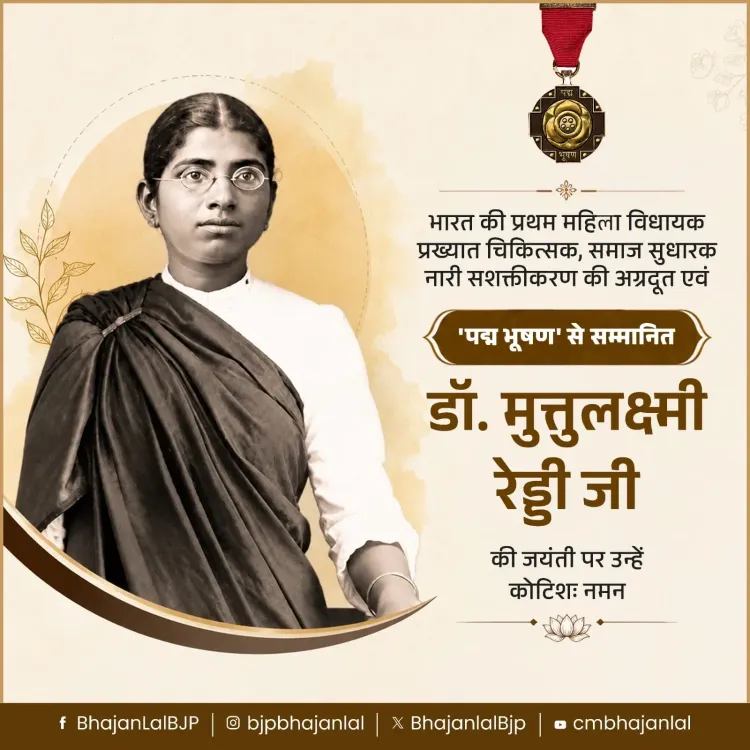
Rajasthan Chief Minister Bhajan Lal Sharma on 30 July 2026 paid tribute to Dr. Muthulakshmi Reddy — India's first woman legislator, pioneering physician, and Padma Bhushan recipient — on her birth anniversary, honouring her legacy in women's rights, education, and health.
Key Takeaways
Rajasthan CM Bhajan Lal Sharma posted a tribute to Dr.
Muthulakshmi Reddy on her birth anniversary on 30 July 2026 .
Reddy was elected to the Madras Legislative Council in 1926 , becoming India's first woman legislator.
She was a trained physician who campaigned against the devadasi system and child marriage.
She was honoured with the Padma Bhushan , one of India's highest civilian awards.
Sharma described her as a pioneer of women's empowerment whose legacy 'will continue to inspire everyone, always.'
A century after she walked into the Madras Legislative Council as India's first woman legislator, Dr. Muthulakshmi Reddy continues to draw salutes from across the country. On Thursday, 30 July 2026, Rajasthan Chief Minister Bhajan Lal Sharma marked her birth anniversary with a heartfelt tribute, calling her a pioneer of women's empowerment and a lifelong servant of health, education, and social reform.
Sharma wrote, 'Kotishaḥ naman' — 'a million salutations' — to Dr. Reddy, describing her as India's first woman legislator, a distinguished physician, a social reformer, and a trailblazer for women's rights who was honoured with the Padma Bhushan. He added that her lifelong dedication to women's rights, education, health, and social upliftment 'will continue to inspire everyone, always.'
The woman who rewrote what was possible in 1926
Dr. Muthulakshmi Reddy was elected to the Madras Legislative Council in 1926, becoming the first woman to enter any legislature in India — a milestone that arrived decades before independence. A trained physician by profession, she used her platform to wage relentless campaigns against the devadasi system and child marriage, while pushing hard for women's access to education and healthcare at a time when both were largely denied to them.
Her contributions to public life earned her the Padma Bhushan, one of India's highest civilian honours. She remains a foundational figure in the history of Indian feminism and social reform, her legacy cutting across regional and party lines.
A national reformer remembered by Rajasthan's chief minister
The tribute from a BJP chief minister in Rajasthan for a Tamil social reformer from the early 20th century reflects a well-established pattern in Indian political culture: leaders across states and parties invoke the anniversaries of national reformers to anchor contemporary governance messaging in historical moral authority. Women's empowerment, health, and education — the themes Sharma highlighted — remain active policy priorities for the Rajasthan government.
Dr. Reddy's story is a reminder that the battles she fought — for women in legislatures, in hospitals, in schools — were not won in a single generation. The fact that her birth anniversary still prompts tributes from state capitals across India says something about how far her reach extended, and how much of her unfinished work still echoes in the present.
Point of View
Sharma frames Rajasthan's contemporary governance priorities — health, education, women's empowerment — within a longer national arc. Such cross-regional commemorations also reflect the BJP's effort to build a pan-India reform narrative that transcends state and linguistic identity. The choice of Dr. Reddy, a figure associated with dismantling entrenched patriarchal institutions, gives the tribute particular resonance in the current political climate around gender equity.
NationPress
30 Jul 2026
Frequently Asked Questions
Who was Dr. Muthulakshmi Reddy?
Dr. Muthulakshmi Reddy was India's first woman legislator, elected to the Madras Legislative Council in 1926. She was also a pioneering physician, a social reformer who fought against the devadasi system and child marriage, and a recipient of the Padma Bhushan.
Why is Dr. Muthulakshmi Reddy significant in Indian history?
She made history in 1926 by becoming the first woman to enter any legislature in India, decades before independence. Her campaigns for women's rights, education, and healthcare laid important groundwork for modern gender reform in the country.
What did Rajasthan CM Bhajan Lal Sharma say about Dr. Muthulakshmi Reddy?
CM Sharma called her India's first woman legislator, a distinguished physician, a social reformer, and a pioneer of women's empowerment. He offered 'a million salutations' and said her lifelong dedication to women's rights, education, and health will continue to inspire everyone.
What award did Dr. Muthulakshmi Reddy receive?
Dr. Muthulakshmi Reddy was honoured with the Padma Bhushan, one of India's highest civilian awards, in recognition of her distinguished service to the nation.
When is Dr. Muthulakshmi Reddy's birth anniversary?
Dr. Muthulakshmi Reddy's birth anniversary falls on 30 July. In 2026, Rajasthan Chief Minister Bhajan Lal Sharma and other leaders marked the occasion with public tributes.