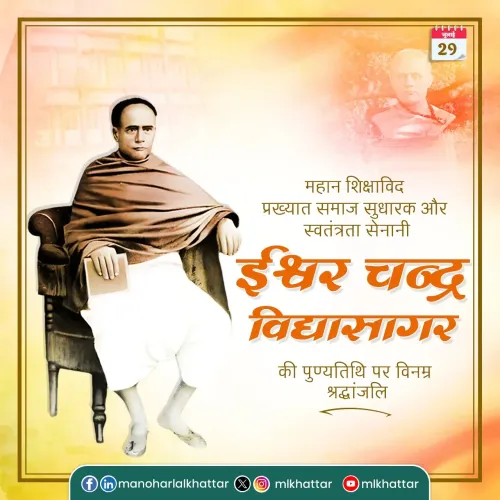
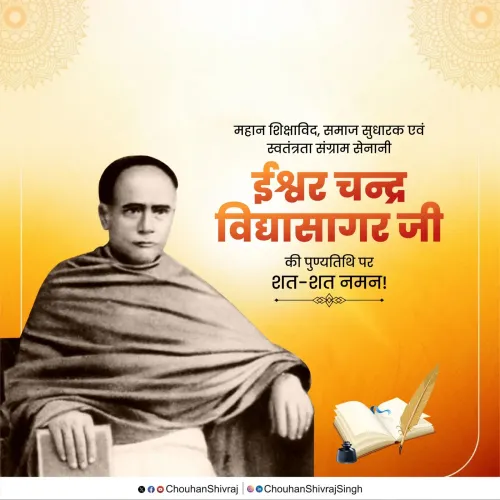
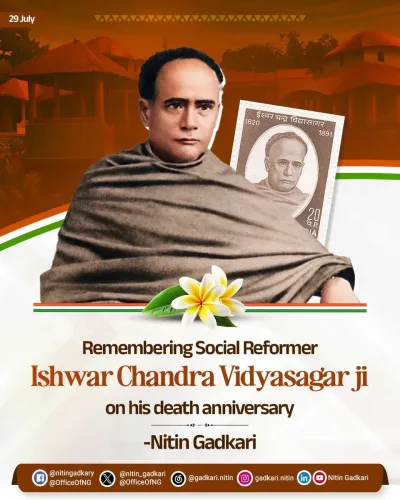
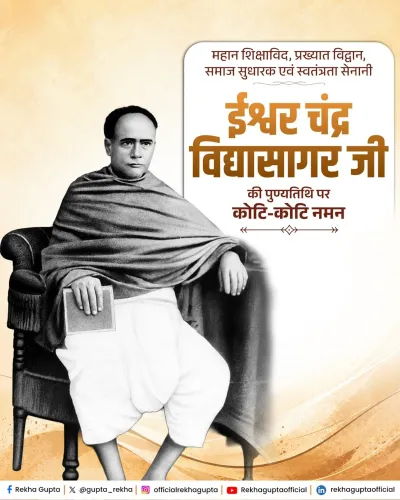
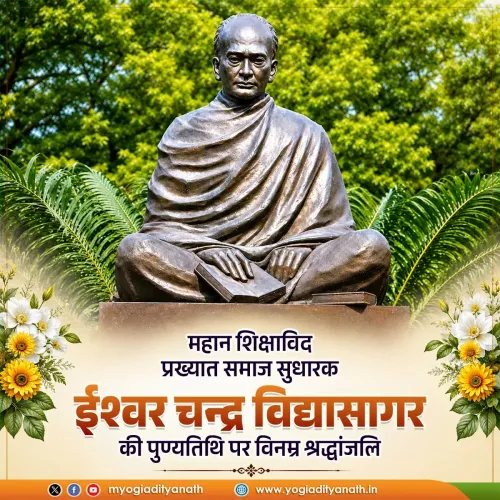
CM Bhajan Lal Sharma pays tribute to Ishwar Chandra Vidyasagar
Synopsis
Rajasthan Chief Minister Bhajan Lal Sharma paid tribute to Ishwar Chandra Vidyasagar on his death anniversary, honouring the 19th-century reformer's campaigns for widow remarriage, girls' education, and social harmony.
Key Takeaways
Rajasthan CM Bhajan Lal Sharma paid tribute to Ishwar Chandra Vidyasagar on his death anniversary on 29 July .
Sharma praised Vidyasagar as a 'great educationist, passionate social reformer and true devotee of humanity.' Vidyasagar (1820–1891) led the campaign for the Hindu Widows' Remarriage Act of 1856 , a landmark in women's rights in colonial India.
He established dozens of schools for women across Bengal and is credited as the father of modern Bengali prose.
Sharma invoked Vidyasagar's ideals as an inspiration for 'nation-building and public welfare' in contemporary India.
On the death anniversary of one of India's most consequential 19th-century reformers, Rajasthan Chief Minister Bhajan Lal Sharma offered his respects to Ishwar Chandra Vidyasagar, calling him a 'great educationist, passionate social reformer and true devotee of humanity.'
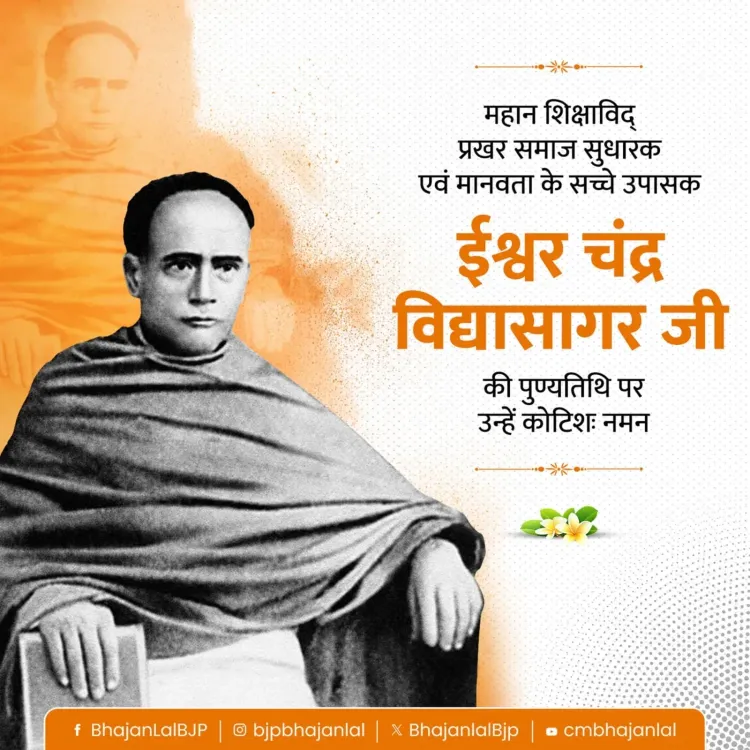
In his post, CM Sharma wrote: 'महान शिक्षाविद्, प्रखर समाज सुधारक एवं मानवता के सच्चे उपासक ईश्वर चंद्र विद्यासागर जी की पुण्यतिथि पर उन्हें कोटिशः नमन!' — translated: 'A million salutes to the great educationist, passionate social reformer and true devotee of humanity, Ishwar Chandra Vidyasagar, on his death anniversary!' He added that Vidyasagar's 'unparalleled contributions to the spread of education, respect for women, social harmony and public welfare will always be remembered,' and that his ideals and resolve for social reform will 'continue to inspire us all on the path of nation-building and public welfare.'
Who was Ishwar Chandra Vidyasagar?
Ishwar Chandra Vidyasagar (1820–1891) was a Bengali polymath whose influence reshaped 19th-century Indian society. A Sanskrit scholar turned radical reformer, he led the campaign that resulted in the Hindu Widows' Remarriage Act of 1856 — one of the first legislative victories for women's rights in colonial India. He championed girls' education at a time when it was socially taboo, establishing dozens of schools for women across Bengal. His simplification of the Bengali script and prose style made literacy accessible to millions, earning him the title 'father of modern Bengali prose.'
A reformer whose legacy cuts across party lines
Vidyasagar's death anniversary draws tributes from leaders across the political spectrum — a recognition that his work on widow remarriage, female literacy, and caste-based social barriers predates and transcends modern political divides. For a BJP leader like CM Sharma to invoke Vidyasagar underscores how 19th-century reformers have become shared national touchstones, their legacies claimed as moral authority by governments of every stripe. The emphasis on 'social harmony' and 'public welfare' in Sharma's tribute maps Vidyasagar's mission onto the language of contemporary governance.
Nearly 135 years after his death, Vidyasagar's core causes — access to education, dignity for women, an equitable society — remain live policy conversations in India. The tribute is a reminder that the arguments he won in the 1850s still echo in debates today.
Point of View
But its symbolism is pointed.
NationPress
29 Jul 2026
Frequently Asked Questions
Who was Ishwar Chandra Vidyasagar?
Ishwar Chandra Vidyasagar (1820–1891) was a Bengali polymath, educator and social reformer who championed widow remarriage, girls' education and simplification of the Bengali script. He is widely regarded as one of the most important figures of the 19th-century Bengal Renaissance.
Why is Ishwar Chandra Vidyasagar's death anniversary observed?
Vidyasagar's death anniversary is observed to honour his transformative contributions to women's rights — particularly the Hindu Widows' Remarriage Act of 1856 — and to girls' education and Bengali prose literature. Leaders across the political spectrum use the occasion to reaffirm commitment to social reform.
What did the Hindu Widows' Remarriage Act of 1856 do?
The Hindu Widows' Remarriage Act of 1856, secured largely through Vidyasagar's campaigning, legally permitted Hindu widows in British India to remarry — a practice that had been socially forbidden and left countless women destitute.
Why did Rajasthan CM Bhajan Lal Sharma pay tribute to Vidyasagar?
CM Sharma paid tribute on Vidyasagar's death anniversary, citing his unparalleled contributions to education, women's dignity, social harmony and public welfare, and calling his ideals an inspiration for nation-building.
When did Ishwar Chandra Vidyasagar die?
Ishwar Chandra Vidyasagar died on 29 July 1891 in Calcutta (now Kolkata), Bengal.