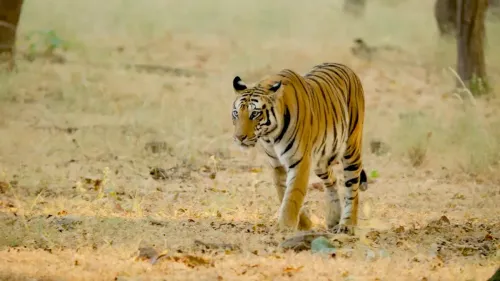
Puri hails India's tiger conservation on International Tiger Day
Synopsis
On International Tiger Day 2026, Union Petroleum Minister Hardeep Singh Puri praised India's forest staff, conservationists and local communities for building the world's largest, most viable wild tiger population through decades of sustained effort under Project Tiger and allied programmes.
Key Takeaways
International Tiger Day falls on 29 July each year; Union Petroleum Minister Hardeep Singh Puri marked it with a tribute to conservation workers.
India is home to the world's largest, most viable and stable wild tiger population , a status built through Project Tiger , launched in 1973 .
The National Tiger Conservation Authority (NTCA) conducts an All India Tiger Estimation census every four years to track population trends.
Key tiger landscapes include the Western Ghats , Central India and the Terai arc along the Nepal border.
At the 2010 Global Tiger Summit in St.
Petersburg , range nations pledged to double wild tiger numbers by 2022 ; India's results have been among the strongest.
Community participation — through revenue sharing and buffer-zone management — is a structural pillar of India's conservation model, not a footnote.
On International Tiger Day, 29 July 2026, Union Petroleum Minister Hardeep Singh Puri saluted the forest staff, conservationists, researchers and local communities whose collective effort has made India home to the world's largest, most viable and stable wild tiger population — a status the country has held through decades of sustained, structured conservation work.
From near-collapse in 1973 to a global conservation benchmark
The story begins with a crisis. By the early 1970s, tiger numbers across India had fallen sharply, prompting the government to launch Project Tiger in 1973 — one of the world's earliest dedicated large-carnivore recovery programmes. The scheme established a network of protected reserves, restricted human activity in core zones, and created a cadre of dedicated forest protection staff. What followed was one of wildlife conservation's more remarkable reversals.
The National Tiger Conservation Authority (NTCA), the statutory body under the Ministry of Environment, Forest and Climate Change, has since overseen the programme's expansion and conducts a comprehensive All India Tiger Estimation census every four years. The results have tracked a broadly upward trajectory across key landscapes — the Western Ghats, Central India and the Terai arc along the Nepal border.
The 2010 St. Petersburg pledge and India's delivery
At the 2010 Global Tiger Summit in St. Petersburg, tiger-range nations committed to doubling wild tiger populations by 2022 — the Tx2 goal. India's census results in subsequent years placed it among the few countries to have meaningfully advanced that target, a point successive governments have cited as evidence that community-linked, enforcement-backed conservation can work at scale.
Minister Puri's post underlines that the achievement is not the state's alone. 'This remarkable achievement reflects the power of their collective effort and enduring commitment to wildlife conservation,' he wrote, explicitly naming forest staff, conservationists, researchers and local communities as co-authors of the outcome. That framing matters: community participation in buffer zones — through eco-tourism revenue sharing and voluntary relocation schemes — has been a structural pillar of the model.
What the next tiger census will reveal
The conservation community is now watching for the next All India Tiger Estimation report, which will provide updated population figures and assess whether protected-area management plans are keeping pace with habitat pressures. Encroachment, linear infrastructure through forest corridors and human-wildlife conflict remain live challenges in several landscapes, even as headline numbers have improved.
International Tiger Day, established to drive global awareness of the species' vulnerability, gives India an annual platform to signal its conservation credentials — and to press for stronger international cooperation in range states where tiger recovery has stalled.
Point of View
The framing deflects any partisan reading while reinforcing the BJP government's broader 'whole-of-society' conservation narrative. The timing ahead of the next NTCA census is also deliberate: a positive public mood around tigers strengthens the government's hand in defending protected-area boundaries against infrastructure and development lobbies. Watch whether the next estimation report sustains the upward trend — that number will determine how long this narrative holds.
NationPress
27 Oct 2026
Frequently Asked Questions
Why is International Tiger Day celebrated on 29 July?
International Tiger Day is observed every year on 29 July to raise global awareness about tiger conservation. It was established at the 2010 Global Tiger Summit in St. Petersburg , where tiger-range nations pledged to double wild tiger populations by 2022.
Which country has the largest tiger population in the world?
India has the world's largest, most viable and stable wild tiger population, a status built through Project Tiger (launched 1973 ) and sustained conservation efforts across key landscapes including the Western Ghats , Central India and the Terai arc .
What is Project Tiger and when was it launched?
Project Tiger is India's flagship tiger conservation programme, launched in 1973 by the Government of India. It established a network of protected reserves, restricted activity in core zones, and created dedicated forest protection staff to reverse a sharp decline in tiger numbers.
What is the National Tiger Conservation Authority?
The National Tiger Conservation Authority (NTCA) is a statutory body under India's Ministry of Environment, Forest and Climate Change. It oversees tiger protection, manages reserve networks, and conducts the All India Tiger Estimation census every four years.
What did Hardeep Singh Puri say on International Tiger Day 2026?
On 29 July 2026 , Union Petroleum Minister Hardeep Singh Puri commended forest staff, conservationists, researchers and local communities for enabling India to nurture the world's largest, most viable and stable tiger population, calling it 'the power of their collective effort and enduring commitment to wildlife conservation.'