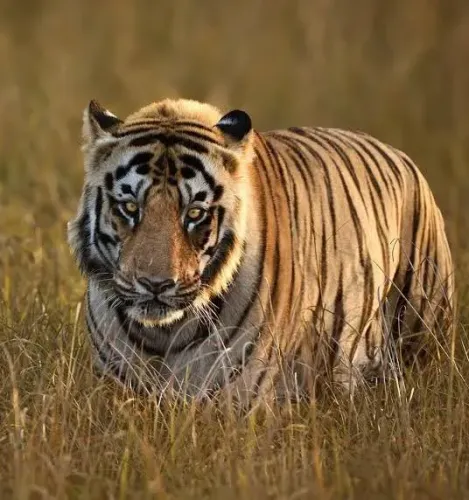
Khattar marks International Tiger Day, urges conservation push

Synopsis
On International Tiger Day (29 July), Union Minister Manohar Lal Khattar urged Indians to build awareness around tiger conservation and environmental balance, calling the tiger an unparalleled symbol of national strength. India's Project Tiger, launched in 1973, anchors the country's decades-long conservation commitment.
Key Takeaways
Union Power Minister Manohar Lal Khattar posted a greeting on International Tiger Day, 29 July , calling for tiger conservation awareness.
He described the tiger as an 'unparalleled symbol of strength, courage, and capability' and India's national animal.
International Tiger Day originated at the 2010 St.
Petersburg Tiger Summit , where 13 tiger range countries pledged to double wild tiger numbers.
Project Tiger , launched in 1973 , remains India's primary institutional framework for protecting tigers and their habitats.
The next All India Tiger Estimation report by the National Tiger Conservation Authority (NTCA) is awaited by conservationists globally.
On International Tiger Day, 29 July, Union Power Minister Manohar Lal Khattar called on every nature and animal lover in India to make the day meaningful — not just by marking it on a calendar, but by actively building awareness around tiger conservation and environmental balance.
Posting in Hindi on X (formerly Twitter), Khattar described the tiger — India's national animal — as an 'unparalleled symbol of strength, courage, and capability' (शक्ति, साहस व सामर्थ्य का अद्वितीय प्रतीक). His message extended greetings to all nature and wildlife enthusiasts while urging society to channel the occasion toward conservation and ecological awareness.
Why 29 July matters for the world's tigers
International Tiger Day is observed every year on 29 July, a date that traces its origins to the 2010 St. Petersburg Tiger Summit — a landmark gathering where the 13 tiger range countries, India among them, committed to doubling wild tiger populations by 2022. The day has since become a global focal point for governments, conservationists, and wildlife organisations to renew that pledge. India's own institutional commitment to the big cat stretches back more than five decades. Project Tiger, launched in 1973, remains the backbone of the country's conservation architecture — establishing dedicated tiger reserves, protecting core habitats, and funding anti-poaching operations across states. India is home to the largest share of the world's wild tiger population, a fact that places it at the centre of any credible global recovery story.The next count that conservationists are watching
The conservation community's attention is now fixed on the next All India Tiger Estimation report by the National Tiger Conservation Authority (NTCA). Each cycle of this census — conducted through camera traps, pug-mark surveys, and remote-sensing data — provides the most authoritative snapshot of how India's tiger population is faring. The results carry weight far beyond borders, shaping international conservation policy and funding priorities. Khattar's message, while ceremonial in register, lands against this backdrop of ongoing institutional effort. Senior political voices lending public weight to tiger conservation on a day like this reinforces the social-awareness dimension that wildlife experts consistently identify as essential — because reserves and laws alone cannot protect an animal that shares landscapes with millions of people. The tiger's survival is ultimately a test of whether a nation can hold space for wildness inside a rapidly developing economy. India is still sitting that exam.Point of View
But it sits within a broader pattern of the ruling establishment keeping wildlife conservation visible as a soft-power and environmental governance signal. India's tiger story — anchored by Project Tiger since 1973 — is one of the few conservation successes the government can point to with hard population data, making political reinforcement of the cause low-risk and high-optic. The real policy watch remains the NTCA's next census cycle, which will determine whether India's tiger numbers have continued their upward trend or plateaued. Until that data lands, ministerial messaging on the subject is largely symbolic but not without value in sustaining public and institutional attention.
NationPress
28 Oct 2026
Frequently Asked Questions
What is International Tiger Day and when is it celebrated?
International Tiger Day is observed every year on 29 July to raise global awareness about tiger conservation. It was established at the 2010 St. Petersburg Tiger Summit , where 13 tiger range countries committed to doubling wild tiger populations.
What did Manohar Lal Khattar say on International Tiger Day 2026?
Manohar Lal Khattar extended greetings to all nature and animal lovers and called on society to raise awareness about tiger conservation and environmental balance, describing the tiger as an 'unparalleled symbol of strength, courage, and capability.'
What is Project Tiger in India?
Project Tiger is India's central government conservation programme launched in 1973 . It established dedicated tiger reserves across the country to protect tigers, their prey, and their natural habitats, and remains the cornerstone of India's tiger conservation policy.
Which authority conducts the tiger census in India?
The National Tiger Conservation Authority (NTCA) conducts the All India Tiger Estimation, using camera traps, pug-mark surveys, and remote-sensing data to count wild tigers across the country's reserves.
How many tiger range countries are there in the world?
There are 13 tiger range countries globally, including India. They collectively pledged at the 2010 St. Petersburg Summit to double wild tiger numbers, with India holding the largest share of the world's wild tiger population.