CM Bhajan Lal Sharma Pays Tribute to Maj Somnath Sharma
Synopsis
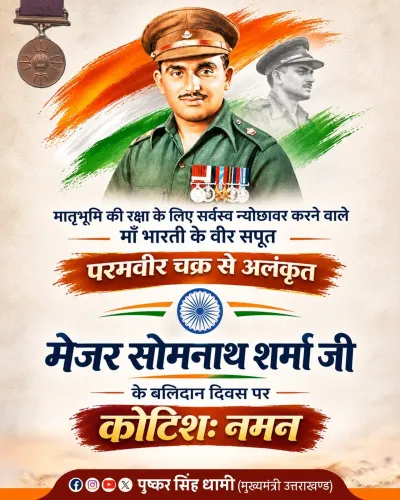
Rajasthan Chief Minister Bhajan Lal Sharma on Tuesday honoured Major Somnath Sharma — the first-ever Param Vir Chakra recipient — on his martyrdom anniversary, recalling the major's last stand at the Battle of Badgam in November 1947 that helped secure the Srinagar airfield for India.
Key Takeaways
Major Somnath Sharma was martyred on 3 November 1947 during the Battle of Badgam in Jammu and Kashmir.
He was posthumously awarded India's first-ever Param Vir Chakra , instituted on 26 January 1950 with retrospective effect.
His company held the flank protecting the Srinagar airfield , preventing a Pakistani advance that could have altered the outcome of the 1947-48 war .
Rajasthan CM Bhajan Lal Sharma paid tribute on the 79th martyrdom anniversary , calling the sacrifice 'sacred and worthy of emulation.' Annual tributes to Param Vir Chakra recipients on their death anniversaries are observed across party lines by elected leaders and the Indian Army.
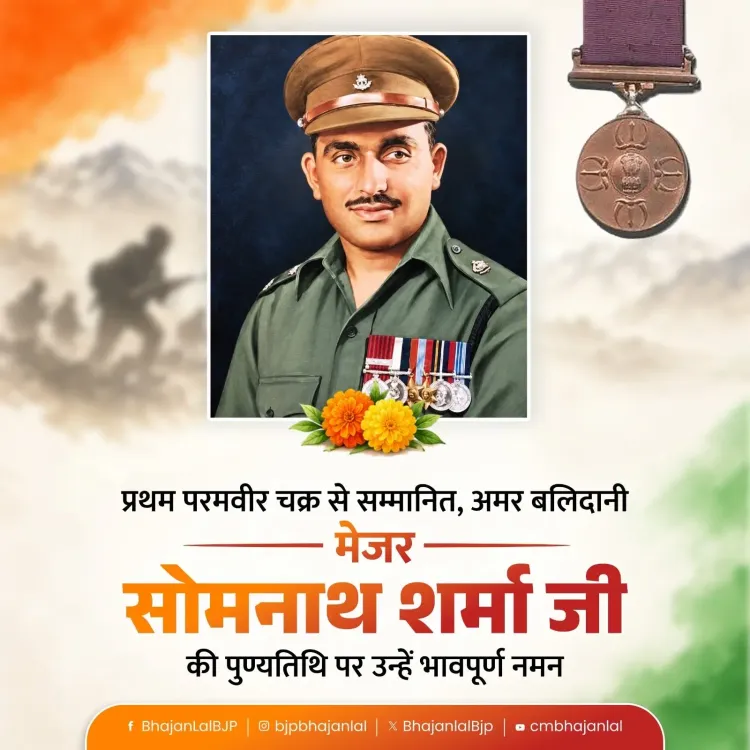
Seventy-nine years after Major Somnath Sharma fell at Badgam holding a crumbling perimeter with his last bullet, India's leaders still mark 3 November as a day to stop and remember. Rajasthan Chief Minister Bhajan Lal Sharma was among the first to do so on Tuesday, posting a tribute that invoked the major's indomitable courage and supreme patriotism on the anniversary of his martyrdom.
Writing in Hindi, CM Sharma saluted the soldier as the 'प्रथम परमवीर चक्र से सम्मानित अमर बलिदानी' — the immortal martyr honoured with the first-ever Param Vir Chakra — and declared that the story of his valour at the Battle of Badgam in 1947 would 'kindle the flame of national service in the heart of every Indian for ages to come.'
The 1947 battle that stopped Pakistan's advance on Srinagar
The context matters as much as the tribute. On 3 November 1947, barely weeks after Jammu and Kashmir acceded to India, Pakistani tribal militias backed by regular forces swept toward the Srinagar airfield — the single lifeline for Indian reinforcements. Major Somnath Sharma, commanding a company of the 4th Battalion, Kumaon Regiment, was deployed at Badgam to hold the flank.
Outgunned and outnumbered, Sharma's men absorbed assault after assault. According to army records, he continued to direct his troops and report the enemy's advance to headquarters even as the situation grew untenable. He was killed when a mortar shell detonated an ammunition box nearby. His last radio message — that the enemy was only fifty yards away but he would not withdraw — has passed into military legend. The airfield held. Srinagar did not fall.
India's first Param Vir Chakra — awarded posthumously
When the Government of India instituted the Param Vir Chakra on 26 January 1950 — the republic's first day — it made the award retrospective to the 1947 operations. Major Somnath Sharma became its first recipient, posthumously. The honour remains India's highest military decoration for battlefield gallantry in the face of the enemy, and Sharma's name leads every roll-call of its recipients.
CM Sharma's tribute describes the major's sacrifice as 'पावन बलिदान' — a sacred sacrifice — and calls it 'forever worthy of reverence and emulation' for all citizens. The language is ceremonial but the underlying reference point is consequential: a thirty-six-hour defensive action in Kashmir that shaped the territorial outcome of a war.
Across party lines, 3 November draws annual tributes from chief ministers, defence ministers, and army chiefs alike — a cross-partisan consensus that the 1947-48 Jammu and Kashmir operations belong not to any political legacy but to the national memory. That tradition continued this morning from Jaipur.
Point of View
Invoking Major Somnath Sharma's sacrifice on the 3 November anniversary reinforces a BJP-governed state's alignment with defence-and-patriotism narratives that resonate strongly in Rajasthan, a state that has historically sent a disproportionate share of personnel to the Indian Army. The framing — individual sacrifice securing national territory — also carries an implicit resonance with ongoing debates around Jammu and Kashmir's integration, connecting 1947 to contemporary political priorities without stating so explicitly. Such tributes rarely generate policy news, but they perform an important symbolic function: anchoring present-day governance in a lineage of sacrificial nationalism that is broadly uncontested.
NationPress
3 Nov 2026
Frequently Asked Questions
Who was Major Somnath Sharma?
Major Somnath Sharma was an Indian Army officer who was martyred on 3 November 1947 at the Battle of Badgam in Jammu and Kashmir. He is best known as the first-ever recipient of the Param Vir Chakra , India's highest military gallantry award, which was awarded to him posthumously.
What happened at the Battle of Badgam in 1947?
The Battle of Badgam took place on 3 November 1947 , shortly after Jammu and Kashmir's accession to India. Major Somnath Sharma and his outnumbered company held off a much larger Pakistani tribal militia force, protecting the critical Srinagar airfield . Sharma was killed in action but his stand prevented the airfield — and Srinagar — from falling to the enemy.
When was the Param Vir Chakra instituted and who was its first recipient?
The Param Vir Chakra was instituted by the Government of India on 26 January 1950 , India's first Republic Day. It was made retrospective to 1947 , and Major Somnath Sharma became its first-ever recipient, posthumously, for his actions at Badgam.
Why did Rajasthan CM Bhajan Lal Sharma post a tribute today?
3 November is the martyrdom anniversary of Major Somnath Sharma . Rajasthan Chief Minister Bhajan Lal Sharma posted the tribute as part of the longstanding practice of elected leaders honouring Param Vir Chakra recipients on their death anniversaries.
What is the significance of Major Somnath Sharma for the Indian Army?
Major Somnath Sharma holds a foundational place in Indian military history as the first Param Vir Chakra recipient . His name leads every official roll-call of the award's recipients, and his last stand at Badgam — holding position until his final bullet — is taught as an exemplar of duty and sacrifice in Indian military tradition.