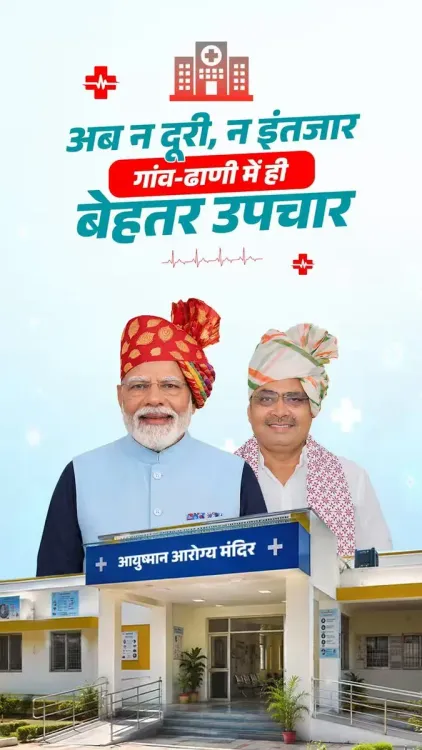
CM Bhajan Lal Sharma Pushes Healthcare to Rajasthan's Doorstep
Synopsis
Rajasthan CM Bhajan Lal Sharma declares that Ayushman Arogya Mandirs, e-Sanjeevani telemedicine, and free medicines are ending rural residents' dependence on city hospitals, framing the push as the fruit of 'double engine' governance with PM Modi.
Key Takeaways
CM Bhajan Lal Sharma on 27 October 2026 reaffirmed Rajasthan's commitment to village-level healthcare delivery.
Ayushman Arogya Mandirs — rebranded Health and Wellness Centres under the 2018 Ayushman Bharat framework — are the primary rural care infrastructure cited. e-Sanjeevani , the national telemedicine platform launched in 2019, enables remote consultations and reduces the need for city travel.
Free medicines and free diagnostics are the third pillar of the state's stated rural health strategy.
Sharma explicitly credits PM Narendra Modi's guidance, invoking the 'double engine government' framing to link state delivery to central policy.
The operative test is ground-level utilisation data — staffing, drug availability, and consultation volumes at the last mile.
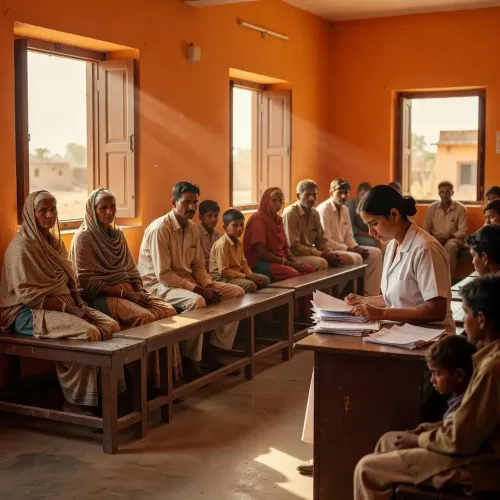
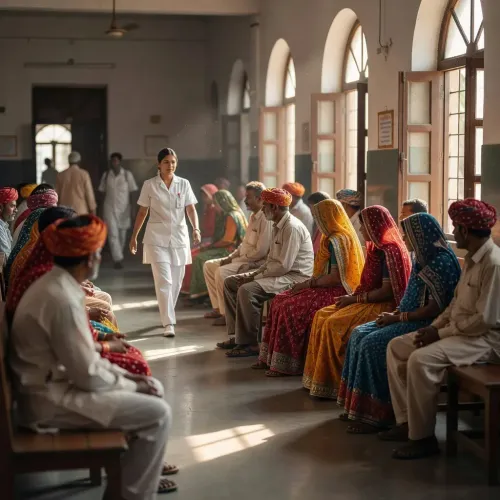
Rural Rajasthan's long, exhausting trek to the nearest city hospital may finally be coming to an end. Rajasthan Chief Minister Bhajan Lal Sharma on Tuesday, 27 October 2026, reaffirmed his government's commitment to bringing quality healthcare directly to villages and dhanis (hamlets) — declaring that no citizen of the state should be denied treatment simply because of where they live.
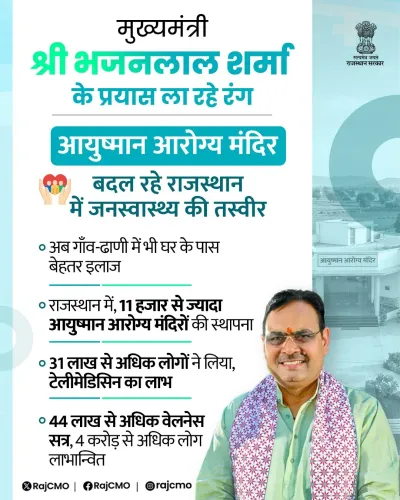
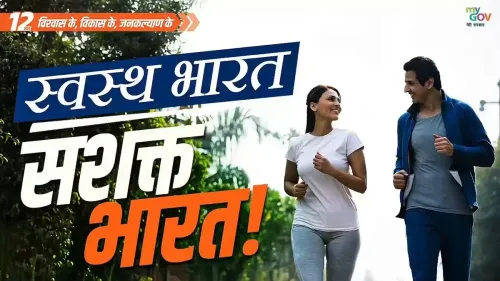
Posting in Hindi, CM Sharma invoked the vision of a 'Swasth Rajasthan, Sashakt Rajasthan' — 'Healthy Rajasthan, Empowered Rajasthan' — and named three specific delivery pillars: Ayushman Arogya Mandirs, the e-Sanjeevani telemedicine platform, and free medicines and diagnostics. Together, he argued, these tools eliminate the compulsion for rural residents to travel to cities for basic care.
What Ayushman Arogya Mandirs Actually Do
Ayushman Arogya Mandirs are the rebranded Health and Wellness Centres operating under the Ayushman Bharat framework launched nationally in 2018 by Prime Minister Narendra Modi. Designed for primary and preventive care, they bring diagnostics, consultations, and essential medicines to the grassroots — the first line of defence before a patient ever needs a hospital. CM Sharma explicitly cited Modi's 'visionary guidance' as the backbone of Rajasthan's health push, leaning on the 'double engine government' argument — the idea that a BJP state and a BJP Centre accelerate delivery faster in tandem.
The scheme's ambition is structural: instead of building more urban super-hospitals, the model bets on a dense, decentralised network of local care points. For Rajasthan — a geographically vast state where dhanis can sit hours from the nearest town — that bet carries real consequence.
e-Sanjeevani: A Phone Call Instead of a Bus Ride
The second pillar CM Sharma highlighted is e-Sanjeevani, the national telemedicine service first rolled out in 2019 by the Union Ministry of Health and Family Welfare and scaled aggressively during the COVID-19 pandemic. The platform allows patients in remote areas to consult doctors remotely — replacing a half-day journey with a video or voice call. For Rajasthan's sparsely populated desert and tribal regions, it is arguably the most immediate equaliser in the state's healthcare toolkit.
Paired with the free medicines and free diagnostics guarantee, the three-pronged approach is designed to attack the three classic barriers to rural healthcare: distance, cost, and availability.
The 'Double Engine' Frame and What Comes Next
Sharma's post is the latest articulation of a messaging strategy BJP-governed states have employed consistently since 2014 — presenting state delivery as the natural downstream of central policy, with the 'double engine' metaphor underscoring political alignment as a governance advantage. By naming PM Modi directly, the CM is not just crediting a policy architect; he is stitching Rajasthan's health record to the national BJP narrative ahead of any future accountability moment.
The harder test will be in the numbers: how many Ayushman Arogya Mandirs are functional and fully staffed across Rajasthan's 200-plus blocks, what the actual e-Sanjeevani consultation volumes look like, and whether free-drug availability holds at the last mile. Those utilisation figures are the difference between a slogan and a system.
Point of View
Ongoing state commitment, which is politically significant ahead of any performance audit. The emphasis on three named, specific schemes rather than vague promises signals a deliberate shift toward accountability-by-specificity — but that same specificity will invite scrutiny of delivery gaps in a state as vast as Rajasthan. How the government responds to data on functional Mandirs and e-Sanjeevani uptake will reveal whether this is a governance story or a communications exercise.
NationPress
27 Oct 2026
Frequently Asked Questions
What are Ayushman Arogya Mandirs in Rajasthan?
Ayushman Arogya Mandirs are rebranded Health and Wellness Centres under the national Ayushman Bharat programme, launched in 2018, that provide primary care, diagnostics, and free medicines at the village level — reducing the need for patients to travel to city hospitals.
How does e-Sanjeevani telemedicine work for rural patients?
e-Sanjeevani is a national telemedicine platform launched in 2019 that allows rural patients to consult doctors remotely via video or voice call, eliminating travel to distant facilities for basic medical advice.
What free health services is the Rajasthan government offering in villages?
The Rajasthan government under CM Bhajan Lal Sharma is providing free medicines and free diagnostic tests through Ayushman Arogya Mandirs, alongside telemedicine consultations via e-Sanjeevani.
What is the 'double engine government' in the context of Rajasthan health schemes?
The 'double engine government' refers to the political alignment between BJP's state government in Rajasthan and the BJP-led central government, which CM Sharma argues accelerates the implementation of central health schemes like Ayushman Bharat at the grassroots.
Who launched Ayushman Bharat and what is its connection to Rajasthan's health push?
Prime Minister Narendra Modi launched the Ayushman Bharat programme in 2018. Rajasthan's Ayushman Arogya Mandirs and e-Sanjeevani rollout are state-level implementations of that national framework, which CM Sharma is now highlighting as a core delivery vehicle.