CM Bhajanlal Sharma: 11,500 Ayushman Arogya Mandirs active in Rajasthan
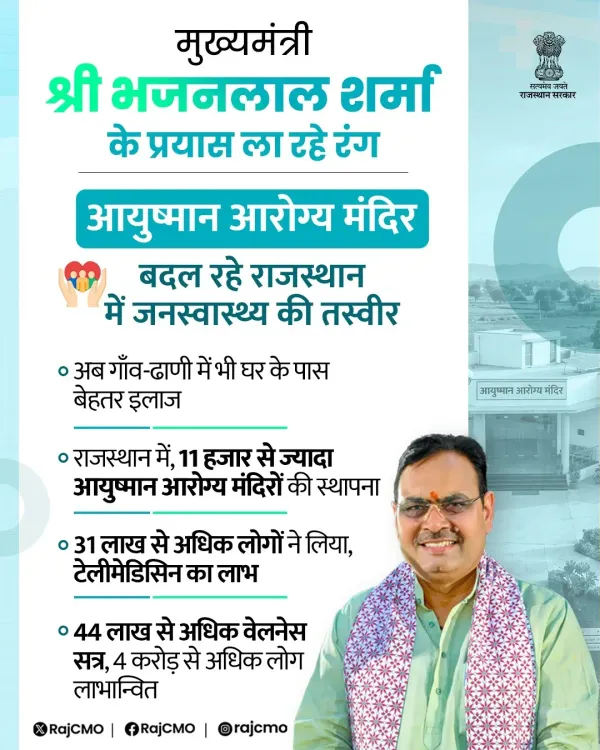
Synopsis
The Chief Minister's Office of Rajasthan announced that nearly 11,500 Ayushman Arogya Mandirs are now fully operational under CM Bhajanlal Sharma, out of a state target of 18,436 upgraded health institutions, with remaining facilities being activated in phases.
Key Takeaways
Rajasthan has set a target of upgrading 18,436 health institutions as Ayushman Arogya Mandirs under the Ayushman Bharat framework.
Nearly 11,500 Ayushman Arogya Mandirs are already fully operational as of July 2026.
The operational network includes 8,370 sub-health centres, 2,107 primary health centres, 286 urban primary health centres, and 728 urban public clinics.
Remaining institutions are being activated in a phased manner under CM Bhajanlal Sharma 's leadership.
The initiative extends primary healthcare access to rural villages, hamlets, and urban communities across Rajasthan .
The Chief Minister's Office of Rajasthan announced on Tuesday, 28 July 2026 that under Chief Minister Bhajanlal Sharma's leadership, nearly 11,500 Ayushman Arogya Mandirs have been made fully operational across the state, out of a total target of 18,436 health institutions to be upgraded under the scheme.
Context
The CMO's post states that the healthcare landscape in Rajasthan is transforming 'गाँव-ढाणी तक' (right up to villages and hamlets). The remaining institutions are being activated in a phased manner. The announcement highlights the scale of the state's primary healthcare push under the Ayushman Arogya Mandir brand.
According to the post, the current operational network comprises 8,370 sub-health centres, 2,107 primary health centres, 286 urban primary health centres, and 728 urban public clinics — all now functioning as Ayushman Arogya Mandirs providing regular health services to residents.
Policy Backdrop
Ayushman Arogya Mandir is Rajasthan's state-level branding for the upgraded Health and Wellness Centres envisioned under the national Ayushman Bharat programme, which was launched in 2018. The national framework sought to convert sub-centres and primary health centres into comprehensive care hubs that shift emphasis from curative treatment to preventive and promotive healthcare at the grassroots.
Rajasthan, a large western Indian state with vast rural and semi-urban populations, has historically depended heavily on government primary health infrastructure. The state's target of upgrading 18,436 facilities is among the more ambitious state-level commitments under the Ayushman Bharat umbrella.
Stakeholders and Impact
The primary beneficiaries are rural residents and semi-urban communities who previously had limited access to structured primary care. By embedding regular health services within familiar sub-centre and PHC structures, the programme aims to reduce dependence on district and tertiary hospitals for basic medical needs.
Urban residents are also covered through the 286 urban primary health centres and 728 urban public clinics included in the network, reflecting an effort to extend the model beyond rural areas into towns and smaller cities across Rajasthan.
What's Next
The remaining facilities — roughly 6,936 institutions out of the original target — are being brought online in a phased rollout. State health budget allocations and central government review meetings on Ayushman Bharat implementation progress will be key markers to watch in the coming months.
The pace of completing the remaining upgrades and ensuring consistent service delivery at all 18,436 facilities will be a measure of the programme's long-term success in reshaping primary healthcare access across Rajasthan.
Point of View
Positioning the Bhajanlal Sharma government as a strong executor of national health policy at the state level. With roughly 62 percent of the target already operational, the figures signal momentum, but the pace of completing the remaining 6,936 facilities will determine whether this becomes a genuine healthcare transformation or a headline-driven milestone. The emphasis on village-level reach — gaon-dhani tak — also signals a deliberate political narrative around grassroots governance. Rajasthan's approach mirrors a broader national pattern where states compete to show Ayushman Bharat implementation progress, making health infrastructure a key metric of administrative credibility.
NationPress
27 Oct 2026
Frequently Asked Questions
What is Ayushman Arogya Mandir in Rajasthan?
Ayushman Arogya Mandir is Rajasthan's state-level branding for Health and Wellness Centres upgraded under the national Ayushman Bharat programme, offering expanded primary and preventive healthcare services at sub-centres, PHCs, and urban clinics.
How many Ayushman Arogya Mandirs are operational in Rajasthan in 2026?
As of July 2026, nearly 11,500 Ayushman Arogya Mandirs have been made fully operational in Rajasthan, out of a total target of 18,436 health institutions.
What is Rajasthan's total target for Ayushman Arogya Mandirs?
Rajasthan has set a target of converting 18,436 health institutions into Ayushman Arogya Mandirs, including sub-health centres, primary health centres, urban PHCs, and urban public clinics.
What types of health facilities are included in Rajasthan's Ayushman Arogya Mandir network?
The network includes 8,370 sub-health centres, 2,107 primary health centres, 286 urban primary health centres, and 728 urban public clinics across Rajasthan.
What is the Ayushman Bharat programme and when was it launched?
Ayushman Bharat is a national health initiative launched in 2018 to upgrade sub-centres and primary health centres into comprehensive Health and Wellness Centres, shifting focus from curative to preventive and promotive care across India.