Nvidia-Powered AI Tool Helps Predict Breast Cancer Return
Synopsis
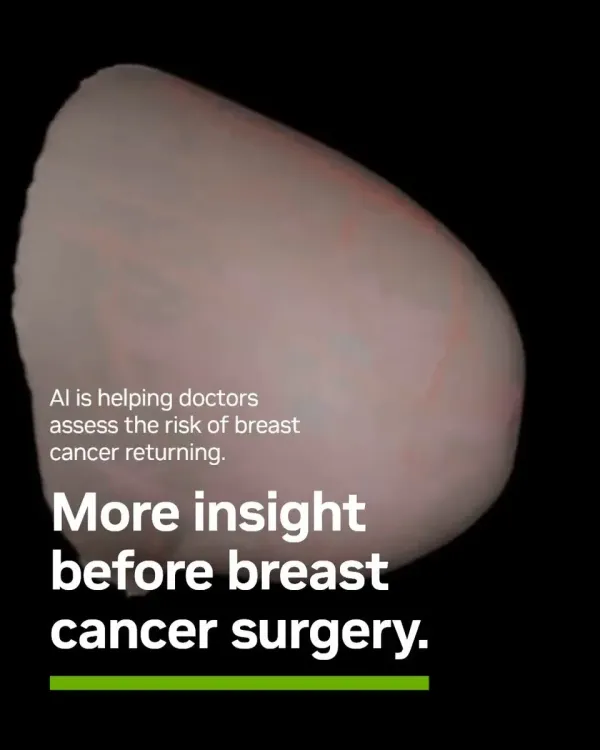
Nvidia has highlighted SimBioSys and its FDA-cleared TumorSight Risk platform, an AI tool that analyzes breast MRI and pathology data to predict cancer recurrence probability, giving oncologists a sharper clinical decision-support resource powered by Nvidia GPU infrastructure.
Key Takeaways
TumorSight Risk , developed by SimBioSys , is an FDA-cleared AI tool designed to estimate breast cancer recurrence probability after diagnosis.
The platform works by combining an existing breast MRI with pathology findings — no new tests required — to generate a risk signal for oncologists.
Nvidia GPU technology underpins the computational infrastructure that powers the SimBioSys platform.
The FDA clearance means TumorSight Risk has passed the regulatory review required for clinical use in oncology settings in the United States.
Nvidia has a multi-year strategy of embedding its AI infrastructure in precision-medicine and medical-imaging applications, with SimBioSys a key example.
Real-world clinical adoption will hinge on outcome validation studies and integration into hospital oncology workflows.
A breast cancer diagnosis is devastating enough — but the haunting question of whether it will return can be just as crushing. Now, an FDA-cleared AI platform built on Nvidia technology is giving oncologists and patients a sharper, data-driven answer to that question. Nvidia on Monday, October 26, 2026 spotlighted SimBioSys and its TumorSight Risk tool, which analyzes an existing breast MRI alongside pathology data to estimate the probability of cancer recurrence.
What TumorSight Risk actually does in the clinic
TumorSight Risk, developed by computational oncology firm SimBioSys, works by combining two data sources a patient has almost certainly already produced: a breast MRI scan and pathology findings from a biopsy or surgery. Rather than ordering new tests, the tool extracts deeper predictive signal from existing clinical data. The output helps clinicians assess how likely it is that a patient's cancer returns — a calculation that directly shapes treatment planning, follow-up schedules, and conversations about aggressive versus watchful management.
The platform carries FDA clearance, meaning it has passed the U.S. Food and Drug Administration's review process for AI-based software used in a clinical oncology setting. That regulatory stamp matters: it is the bar that separates an experimental research model from a tool a physician can actually use with a real patient in a real hospital.
Nvidia's role in computational oncology
Nvidia has spent several years positioning its GPU infrastructure at the centre of medical imaging and biological workloads, backing precision-medicine startups that need serious compute to run AI models at clinical scale. SimBioSys is a textbook example of this strategy: a focused oncology software company that needs GPU horsepower to turn complex imaging and molecular data into a usable clinical signal, fast.
The broader industry pattern is unmistakable. AI-assisted clinical decision support in oncology — tools that sit beside the radiologist or oncologist and surface risk information that human review alone might miss — is one of the fastest-growing segments in health technology. Breast cancer recurrence prediction is a particularly high-stakes application: globally, breast cancer is the most commonly diagnosed cancer, and recurrence risk drives some of the most consequential treatment choices a patient will face.
What adoption and scrutiny look like from here
FDA clearance opens the door to clinical use, but real-world adoption depends on how the tool performs across diverse patient populations and imaging equipment. Health systems, insurers, and hospital oncology departments will watch outcome studies and validation data closely before integrating TumorSight Risk into standard-of-care workflows.
For SimBioSys, the logical next steps are expanding the tool's reach — whether to additional cancer types, other imaging modalities, or new geographies — each requiring its own regulatory pathway. For Nvidia, every validated clinical AI product that runs on its infrastructure is proof that the GPU's role in medicine is not a future promise. It is a present fact.
Point of View
High-margin vertical for its GPU ecosystem, not a one-off showcase. For India's growing oncology-AI sector, the SimBioSys model — deep imaging plus molecular pathology, regulated and vendor-partnered — offers a replicable blueprint for domestic startups eyeing similar precision-medicine applications. The harder test ahead is whether real-world performance data, especially across demographically diverse populations, validates the tool's recurrence predictions at the scale regulators and payers will demand.
NationPress
27 Oct 2026
Frequently Asked Questions
What is TumorSight Risk and what does it do?
TumorSight Risk is an FDA-cleared AI platform made by SimBioSys that analyzes a patient's existing breast MRI and pathology data to estimate the probability that their breast cancer will return after diagnosis.
Is TumorSight Risk approved for use by doctors?
Yes. TumorSight Risk has received clearance from the U.S. Food and Drug Administration (FDA), which means it has passed regulatory review as an AI-based software tool intended for clinical oncology use.
What role does Nvidia play in SimBioSys and TumorSight Risk?
Nvidia provides the GPU and AI infrastructure that powers the SimBioSys platform. The company has been expanding its presence in medical imaging and precision-medicine AI through partnerships with health technology startups like SimBioSys.
Why is predicting breast cancer recurrence important?
Recurrence risk directly influences major clinical decisions — including how aggressively to treat, how frequently to schedule follow-ups, and whether to pursue additional therapies — making accurate prediction critical for both patient outcomes and quality of life.
Does TumorSight Risk require patients to do new scans or tests?
No. TumorSight Risk works by extracting deeper predictive information from MRI scans and pathology data the patient has already produced, avoiding the need for additional tests.