Nvidia AI Cuts Medical Query Time to 2 Seconds for Frontline Workers
Synopsis
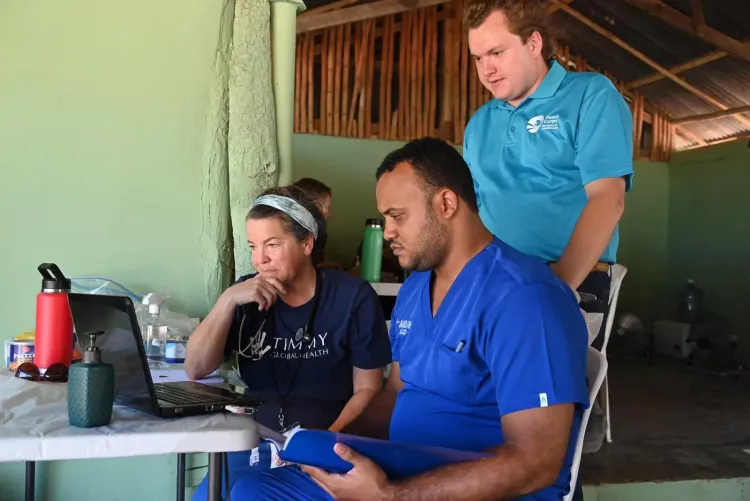
Nvidia has highlighted how its accelerated computing technology enables Techies Without Borders' offline AI platform to deliver evidence-based medical answers in 2 seconds, in local languages, to frontline workers in under-resourced clinics — with no internet connection required.
Key Takeaways
Nvidia's AI and accelerated computing powers an experimental 'doctor's assistant' platform built by Techies Without Borders for low and middle-income countries.
The platform reduces medical query response time from 5 minutes to 2 seconds , according to Nvidia's announcement.
It runs locally on edge devices , removing dependence on internet connectivity — a critical barrier in under-resourced clinics.
Frontline workers can query the system in their own language , addressing language gaps that delay critical care.
Nvidia states the broader initiative impacts 20 million lives every year.
The deployment reflects a wider industry shift toward offline, edge-optimized AI for bandwidth-scarce healthcare environments.
Chip giant Nvidia announced on Tuesday, 7 July 2026 that its AI and accelerated computing technology now powers an experimental 'doctor's assistant' platform built by Techies Without Borders, designed to deliver instant, evidence-based medical guidance to frontline healthcare workers in low and middle-income countries — even without an internet connection.
Context
The platform, described by Nvidia as a localized AI-powered assistant, allows frontline workers to type a medical query and receive an answer in their own language within seconds. According to Nvidia's post, medical insights that previously took 5 minutes to load are now delivered in just 2 seconds, thanks to accelerated computing infrastructure. The system runs locally on edge devices, eliminating dependence on reliable internet connectivity.
Techies Without Borders engineered the platform specifically to address three structural barriers common across under-resourced health systems: unreliable internet, a shortage of localized content, and language gaps that delay critical care decisions. Nvidia's post states the broader initiative reaches 20 million lives every year.
Policy Backdrop
The deployment sits within a wider industry shift toward edge AI — inference that runs directly on local hardware rather than cloud servers — particularly for environments where bandwidth is scarce or intermittent. Major chipmakers, including Nvidia, have directed significant engineering resources toward optimizing AI workloads for exactly these conditions, mirroring multilateral commitments under the Sustainable Development Goals framework to expand digital public goods for primary care.
Offline clinical decision-support tools have attracted growing interest from global health bodies, which are beginning to examine validation and safety standards for AI systems operating outside traditional hospital infrastructure. Any forthcoming guidance from bodies such as the WHO or national health ministries on locally-run tools of this kind will be closely watched by developers and policymakers alike.
Stakeholders and Impact
The primary beneficiaries are frontline healthcare workers — community health workers, nurses, and paramedics — stationed at clinics in low and middle-income countries that face acute physician shortages. For these workers, the ability to receive an evidence-based response in their own language, without waiting for a network connection, can be the difference between timely intervention and delayed care.
The platform's multilingual, offline design also addresses a longstanding equity gap: most AI health tools are built for high-bandwidth, English-language environments, leaving the populations with the greatest need least served by technological advances. By running on edge devices, the system extends the reach of AI-assisted medicine to settings that cloud-dependent tools cannot reliably serve.
What's Next
Nvidia's announcement does not detail a specific rollout timeline or the number of pilot sites currently active. The next indicators to watch include expansion metrics from additional deployments, independent clinical validation of the platform's outputs, and whether global health authorities move to issue formal guidance on AI-assisted decision support tools operating at the edge. The convergence of accelerated computing, localized language models, and offline inference suggests this model of health AI could be replicated across other resource-constrained domains beyond primary care.
Point of View
Not merely enterprise technology — a narrative that carries weight as regulatory and public scrutiny of big tech intensifies globally. The choice to highlight an NGO partner rather than a government or hospital system signals an intent to occupy the 'digital public good' space ahead of potential WHO or national-ministry frameworks for AI-assisted clinical tools. For India, where community health worker networks operate at enormous scale in connectivity-challenged districts, the offline-inference model described here has direct policy relevance. The announcement also underscores a competitive dynamic: chipmakers that establish early credibility in edge health AI stand to shape procurement and standards conversations for years to come.
NationPress
6 Oct 2026
Frequently Asked Questions
What is the Techies Without Borders AI doctor's assistant?
It is an experimental AI-powered platform built by Techies Without Borders that allows frontline healthcare workers to type a medical query and receive an instant, evidence-based answer in their own language, running locally on edge devices without requiring an internet connection.
How does Nvidia's technology help healthcare in low-income countries?
Nvidia's AI and accelerated computing infrastructure powers the platform's ability to process medical queries in approximately 2 seconds on local edge devices, eliminating the need for cloud connectivity and making clinical decision support viable in areas with unreliable internet.
What is edge AI and why does it matter for healthcare?
Edge AI refers to running artificial intelligence models directly on local devices rather than sending data to remote cloud servers. In healthcare, this matters because it allows AI tools to function in clinics with poor or no internet connectivity, which is common across rural and low-income settings.
How many people does this Nvidia-backed health initiative impact?
Nvidia's post states the initiative impacts 20 million lives every year, though this figure has not been independently verified from publicly available records.
What are the barriers to healthcare AI in developing countries?
The main barriers highlighted by Nvidia and Techies Without Borders include unreliable internet connectivity, a lack of localized content in regional languages, and language gaps between available medical resources and frontline workers — all of which the platform is designed to address.