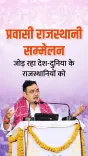
CM Bhajanlal calls Swachh Bharat a mass movement at Shekhawati Summit
Synopsis
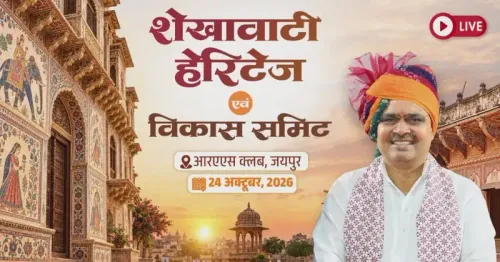
Chief Minister Bhajanlal Sharma addressed the Shekhawati Heritage and Development Summit in Jaipur on 25 October 2026, crediting PM Modi with turning the Swachh Bharat Mission into a nationwide mass movement and linking cleanliness goals to Rajasthan's heritage tourism agenda.
Key Takeaways
CM Bhajanlal Sharma addressed the Shekhawati Heritage and Development Summit in Jaipur on 25 October 2026 .
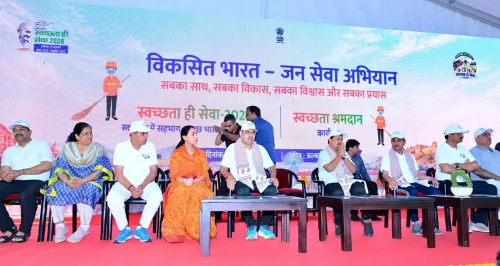
He credited PM Narendra Modi with transforming the Swachh Bharat Mission into a people's movement since its 2014 launch.
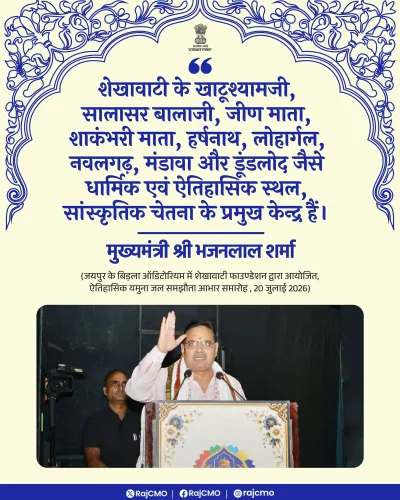
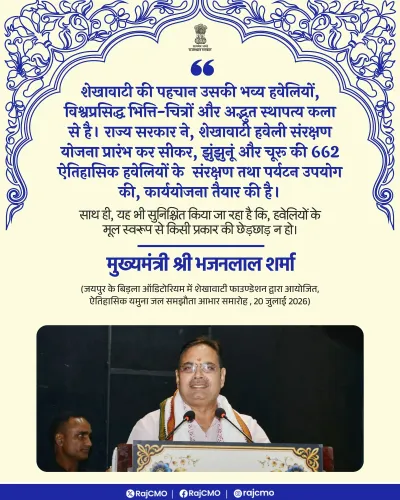
The summit focused on heritage preservation and regional development in Shekhawati , northern Rajasthan's celebrated haveli belt.
The event falls under the state campaign #AapnoAgraniRajasthan , positioning Rajasthan as a national frontrunner.
Rajasthan's BJP government has consistently aligned state-level summits with central government schemes since CM Sharma took office in December 2023 .
At a summit bringing together heritage and development ambitions for one of Rajasthan's most storied regions, Chief Minister Bhajanlal Sharma used the stage in Jaipur to credit Prime Minister Narendra Modi with transforming a government cleanliness programme into something far larger — a genuine people's movement.
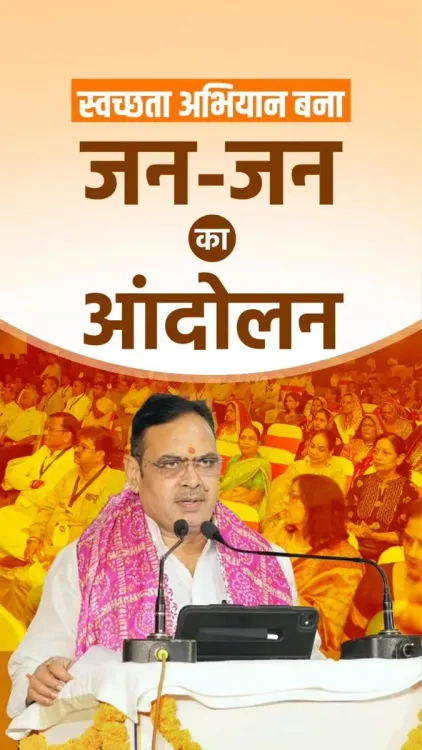
Addressing the Shekhawati Heritage and Development Summit on Sunday, 25 October 2026, CM Sharma said that 'Mananiya Pradhanmantri Shri Narendra Modi ji ne Swachhata Abhiyan ko jan-jan ka andolan bana diya' — 'Honourable Prime Minister Narendra Modi has turned the Swachhata Abhiyan into a movement of every single person.' The remark came under the campaign banner #AapnoAgraniRajasthan — 'Our Rajasthan, the Frontrunner' — signalling the state government's intent to align regional identity with national benchmarks.
Shekhawati's heritage moment on the policy map
The Shekhawati region — a belt of northern Rajasthan famed for its intricately painted havelis, step-wells, and merchant-era architecture — has long drawn heritage tourists but has struggled to convert cultural capital into sustained economic development. Hosting a dedicated summit in Jaipur signals that the state's BJP government is treating the region not just as a tourism curiosity but as a development priority.
The framing matters: by invoking Swachh Bharat Mission — launched nationally in 2014 — at a heritage summit, Sharma is stitching together two policy threads. Clean, well-maintained heritage sites attract more visitors; more visitors justify infrastructure investment. It is a compact political argument dressed in the language of a national mission.
Swachh Bharat as political shorthand in Rajasthan
Since taking office in December 2023, CM Sharma's administration has made a visible habit of anchoring state-level events to central government schemes. The Swachh Bharat Mission provides an especially useful frame: it carries Prime Ministerial authority, a decade of implementation history, and strong public recognition. Invoking it at a regional heritage summit allows the state to claim continuity with New Delhi's agenda while spotlighting a constituency — Shekhawati — that has historically felt peripheral to Jaipur's political gravity.
For the heritage tourism sector and residents of towns like Mandawa, Nawalgarh, and Fatehpur, the real question is whether the summit rhetoric translates into on-the-ground investment: cleaner access roads to painted havelis, improved sanitation at tourist nodes, and infrastructure that can absorb a growing visitor footprint without eroding the very character that draws travellers in the first place.
Rajasthan's BJP government has shown a pattern of regional summits as political-mobilisation tools. Whether this one produces concrete project announcements for Shekhawati will be the measure that moves beyond the headline.
Frequently Asked Questions
What is the Shekhawati Heritage and Development Summit?
It is a summit held in Jaipur focused on heritage conservation and regional development for the Shekhawati region of northern Rajasthan, known for its painted havelis and historic architecture.
What did CM Bhajanlal Sharma say about Swachh Bharat at the summit?
CM Sharma said that PM Narendra Modi has transformed the Swachh Bharat Mission into a movement of every single person, underlining the scheme's reach as a mass public campaign.
When was the Swachh Bharat Mission launched?
The Swachh Bharat Mission was launched nationally in 2014 by Prime Minister Narendra Modi as a sanitation and cleanliness drive aimed at becoming a broad public movement.
Where is the Shekhawati region in Rajasthan?
Shekhawati is a heritage belt in northern Rajasthan, encompassing towns such as Mandawa, Nawalgarh, and Fatehpur, renowned for elaborately painted merchant havelis and step-wells.
When did Bhajanlal Sharma become Chief Minister of Rajasthan?
Bhajanlal Sharma took office as Chief Minister of Rajasthan in December 2023 after the BJP's victory in the state assembly elections.