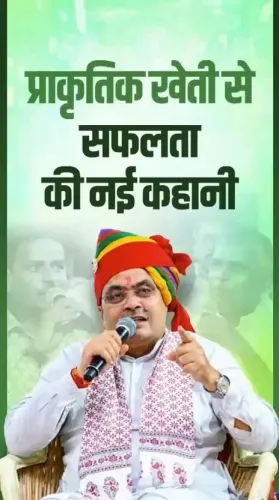
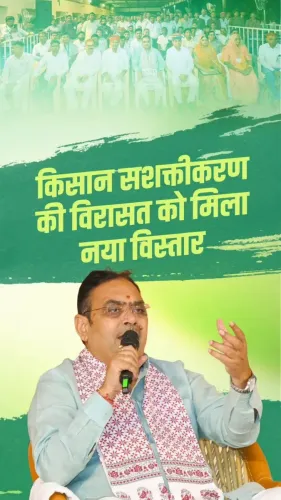
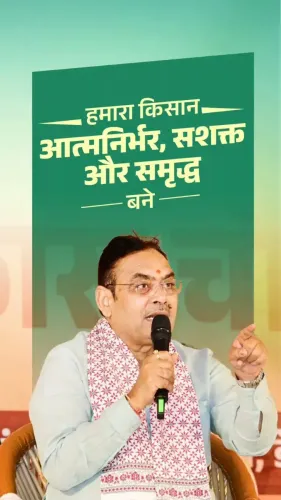
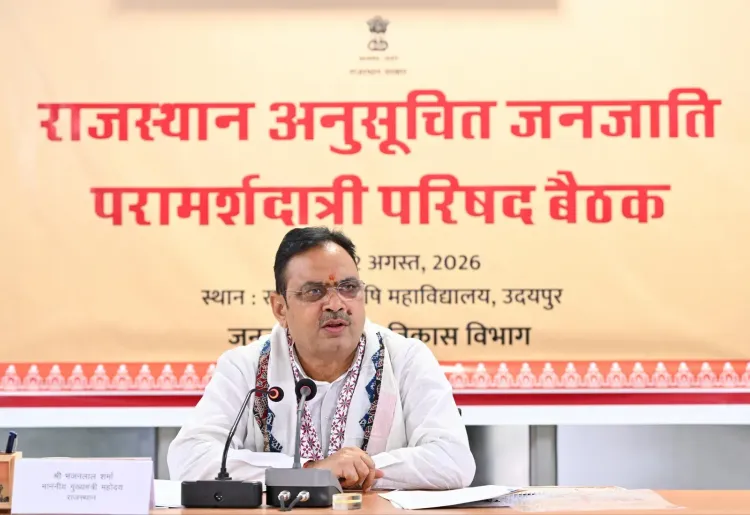
CM Bhajanlal chairs ST Advisory Council meet in Udaipur
Synopsis
Chief Minister Bhajanlal Sharma chaired the Rajasthan Scheduled Tribe Advisory Council meeting in Udaipur on 3 August 2026, reviewed PM JANMAN Yojana implementation, invoked PM Modi's GYAN model for tribal welfare, and appointed organic farmer Premchand Kapaya as 'Kisan Brand Ambassador' and trainer at Kota's Organic Agriculture Research Centre.
Key Takeaways
CM Bhajanlal Sharma chaired the Rajasthan Scheduled Tribe Advisory Council meeting at the Agriculture College, Udaipur on 3 August 2026 .
He linked the state's tribal welfare agenda to PM Modi's GYAN model — Garib, Yuva, Annadata, Nari — signalling Centre-state policy alignment.
The CM reviewed implementation of PM JANMAN Yojana and directed officials to expedite pending infrastructure works in tribal areas.
Premchand Kapaya , a farmer from Jalmapur village, Udaipur , was named 'Kisan Brand Ambassador' for his work in organic and natural farming.
Kapaya has been appointed as a trainer at the Organic Agriculture Research and Training Centre in Kota .
The Advisory Council meeting reflects constitutional obligations under Article 338A and the BJP government's push to make tribal welfare a visible political priority.
A farmer from a village in Udaipur district walked into a government meeting on Monday, 3 August 2026 — and walked out as Rajasthan's newest 'Kisan Brand Ambassador.' That appointment, made by Chief Minister Bhajanlal Sharma at the Rajasthan Scheduled Tribe Advisory Council meeting in Udaipur's Agriculture College, crystallised the state government's pitch: tribal welfare and sustainable farming are now the same conversation.
The GYAN framework driving tribal policy in Rajasthan
Chairing the council session, CM Sharma anchored the government's tribal welfare agenda to Prime Minister Narendra Modi's GYAN model — an acronym for Garib, Yuva, Annadata aur Nari (the poor, the youth, the farmer, and the woman). He stated that the state government is working toward economic empowerment, social security, and holistic upliftment of Scheduled Tribes on the basis of this framework. It is a deliberate alignment: by invoking the GYAN model, Rajasthan's BJP government ties its own tribal programmes directly to the Centre's inclusive-development narrative.
The meeting also served as a ground-level audit of PM JANMAN Yojana, the central scheme launched in November 2023 to saturate Particularly Vulnerable Tribal Groups with housing, drinking water, education, and health facilities. CM Sharma took feedback on the scheme's progress and directed officials to expedite pending works — a signal that implementation gaps remain even as the political messaging stays upbeat.
Premchand Kapaya: a village farmer becomes a state trainer
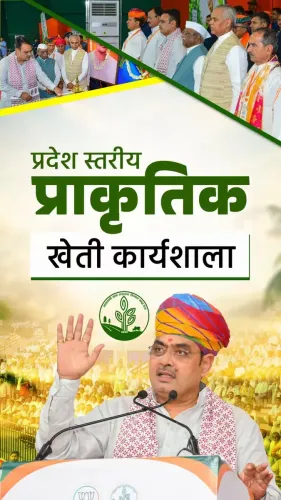
Premchand Kapaya, a progressive farmer from Jalmapur village in the Falasia Panchayat Samiti of Udaipur, was named 'Kisan Brand Ambassador' by the Chief Minister for his 'notable contribution' to organic, traditional, and natural farming. The recognition comes with a concrete role: Kapaya has been appointed as a trainer at the Organic Agriculture Research and Training Centre in Kota. One farmer's field-level practice, in other words, becomes curriculum for others.
The move fits within India's broader push for natural farming under the Paramparagat Krishi Vikas Yojana, running since 2015, which incentivises chemical-free cultivation across tribal and non-tribal belts alike. Elevating a tribal farmer to trainer status is both a welfare gesture and a policy signal — that the state sees indigenous agricultural knowledge as scalable, not just symbolic.
Why the Advisory Council meeting matters
The Scheduled Tribe Advisory Council is not a ceremonial body. Under Article 338A of the Constitution, such councils carry a mandate to monitor welfare measures for tribal communities and advise the government on their implementation. A Chief Minister presiding over the session — rather than delegating it — underscores that the BJP government in Rajasthan is treating ST welfare as a visible political priority ahead of continued implementation of central schemes in the state's tribal belt, which spans districts from Udaipur to Banswara and Dungarpur.
The question the next progress report will have to answer: how many of those PM JANMAN infrastructure projects in Rajasthan's tribal districts have actually crossed the finish line?
Point of View
High-visibility gesture that doubles as organic farming outreach. The directive to expedite pending PM JANMAN works, however, quietly acknowledges that implementation has lagged behind the political calendar. Watch whether the Kisan Brand Ambassador model is replicated in other tribal districts — if it is, it suggests a scalable template; if it stays a one-off, it reads as event management.
NationPress
17 Sept 2026
Frequently Asked Questions
What is the Rajasthan Scheduled Tribe Advisory Council?
It is a constitutional body under Article 338A mandated to monitor welfare measures for Scheduled Tribes and advise the state government on their implementation. Chief Minister Bhajanlal Sharma chaired its meeting in Udaipur on 3 August 2026.
What is PM JANMAN Yojana and how does it relate to Rajasthan's tribal areas?
PM JANMAN Yojana, launched in November 2023, is a central scheme targeting Particularly Vulnerable Tribal Groups with housing, drinking water, education, and health facilities. CM Sharma reviewed its progress at the Udaipur meeting and directed officials to complete pending works quickly.
Who is Premchand Kapaya and why was he made Kisan Brand Ambassador?
Premchand Kapaya is a progressive farmer from Jalmapur village in Udaipur's Falasia Panchayat Samiti, recognised for his contributions to organic, traditional, and natural farming. CM Bhajanlal Sharma named him 'Kisan Brand Ambassador' and appointed him as a trainer at the Organic Agriculture Research and Training Centre in Kota.
What is the GYAN model mentioned by CM Bhajanlal Sharma?
GYAN stands for Garib (poor), Yuva (youth), Annadata (farmer), and Nari (woman) — a framework articulated by Prime Minister Narendra Modi for inclusive development. CM Sharma cited it as the basis for Rajasthan's tribal welfare and empowerment programmes.
Where is the Organic Agriculture Research and Training Centre in Rajasthan?
The centre is located in Kota, Rajasthan. Premchand Kapaya has been appointed as a trainer there following his recognition as Kisan Brand Ambassador at the Udaipur ST Advisory Council meeting.