CM Bhajanlal Salutes Shekhawati's Entrepreneurs and Bhamashahs
Synopsis
The Chief Minister's Office of Rajasthan publicly saluted Shekhawati's entrepreneurs and Bhamashahs for their significant contribution to India's economic progress, tagging CM Bhajan Lal Sharma under the hashtag #AapnoAgraniRajasthan on 25 October 2026.
Key Takeaways
Rajasthan's CMO posted on 25 October 2026 honouring Shekhawati entrepreneurs and Bhamashahs for their role in India's economic growth.
Chief Minister Bhajan Lal Sharma was tagged, underscoring the gesture as an official government position.
Shekhawati — covering Sikar, Jhunjhunu, and Churu districts — is the ancestral home of many prominent Marwari industrial and trading families.
The term 'Bhamashah' carries historical resonance as a symbol of selfless civic philanthropy, tracing back to Maharana Pratap's era.
The hashtag #AapnoAgraniRajasthan ('Our Leading Rajasthan') ties the tribute to the BJP government's broader state-branding campaign.
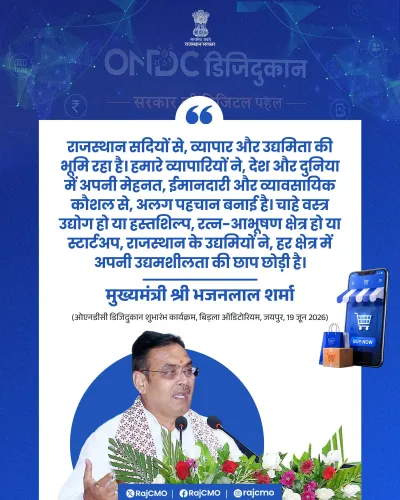
The acknowledgement aligns with CM Bhajanlal's broader effort to position Rajasthan as a business-friendly and investor-welcoming state since December 2023 .
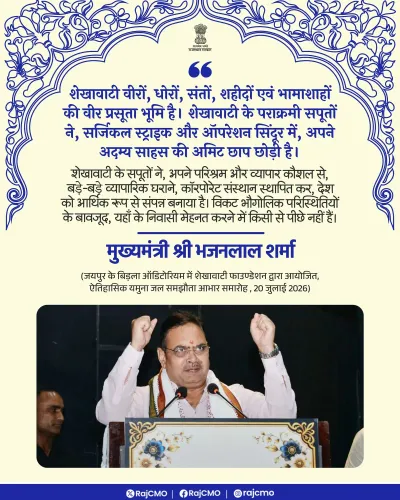
From the painted havelis of Sikar and Jhunjhunu to the trading floors of Mumbai and beyond, Shekhawati has long punched far above its weight in India's economic story — and on Sunday, 25 October 2026, the Chief Minister's Office of Rajasthan made that acknowledgement official. The CMO posted on X, tagging Chief Minister Bhajan Lal Sharma, to affirm the indispensable role of the region's entrepreneurs and philanthropists in the nation's economic progress.
The post read: 'Shekhawati ke udyamiyon aur Bhamashaahon ka desh ki aarthik pragati mein yogdan mahatvapurna hai' — ('The contribution of Shekhawati's entrepreneurs and Bhamashahs to the country's economic progress is significant'), accompanied by the hashtag #AapnoAgraniRajasthan ('Our Leading Rajasthan'), a recurring motif for the BJP-led state government's brand identity.
Who Are Shekhawati's Bhamashahs — and Why Does the Title Matter?
Shekhawati — a semi-arid stretch covering largely the districts of Sikar, Jhunjhunu, and Churu in northern Rajasthan — is the ancestral homeland of many of India's most storied Marwari trading and industrial dynasties. The term 'Bhamashah' evokes Maharana Pratap's legendary treasurer, who donated his entire fortune to fund the Mewar resistance — making it a synonym for extraordinary civic generosity. Invoking it here is deliberate: the CMO is saluting not just wealth creation, but wealth shared with society.
The region's merchant families migrated across India and the world over centuries, building textile empires, financial houses, and industrial conglomerates. That diaspora's link back to Rajasthan — through temples, schools, hospitals, and trusts they funded in their hometowns — remains one of the more quietly powerful forces in the state's social infrastructure.
Bhajanlal's Business-Friendly Signal
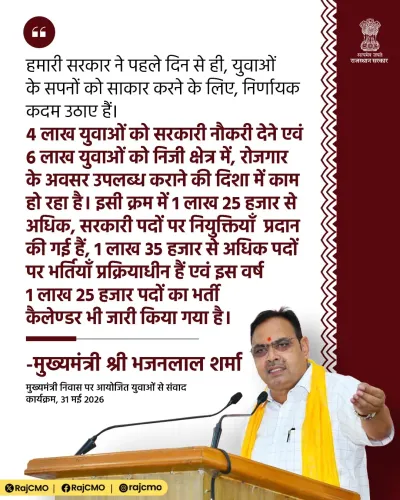
Chief Minister Bhajan Lal Sharma, who took charge in December 2023 as the BJP's choice after the party's return to power in Rajasthan, has positioned his administration around investor outreach and economic revival. Public acknowledgements of communities with deep entrepreneurial traditions — like Shekhawati's — serve a dual purpose: honouring a genuine economic legacy and signalling to diaspora business networks that the state government sees them as partners, not merely as voters.
Rajasthan governments across party lines have periodically made such gestures toward Shekhawati and Marwari networks. What is notable here is the hashtag framing — #AapnoAgraniRajasthan ('Our Leading Rajasthan') — which knits this tribute into a broader state-branding effort, projecting Rajasthan as a frontrunner in national economic ambition rather than a lagging desert state.
Whether a formal event, a conclave, or a policy announcement follows this public salute is the real test. The Shekhawati diaspora's investment interest in its home turf is well-established; channelling it into concrete projects is the harder ask. For now, the CMO has placed community pride and economic partnership on the same page — and that, in Rajasthan's political economy, is always the first move.
Point of View
Keeping diaspora entrepreneurs emotionally invested is sound political economy. The real measure will be whether this public salute translates into structured investment partnerships or remains goodwill branding.
NationPress
25 Oct 2026
Frequently Asked Questions
Who are the Shekhawati entrepreneurs mentioned by Rajasthan CM's office?
Shekhawati's entrepreneurs refer to the trading and industrial families originating from the semi-arid northern Rajasthan region covering Sikar, Jhunjhunu, and Churu districts. Many prominent Marwari business dynasties trace their roots to this area and have built major industries across India and globally.
What does 'Bhamashah' mean in Indian history?
'Bhamashah' is a title evoking the legendary minister of Maharana Pratap of Mewar, who donated his personal wealth to fund the king's resistance campaign. Today it is used to honour exceptional civic philanthropists who contribute generously to public causes.
Who is Bhajan Lal Sharma and when did he become Chief Minister of Rajasthan?
Bhajan Lal Sharma is a Bharatiya Janata Party leader who became Chief Minister of Rajasthan in December 2023 following the BJP's victory in the state assembly elections.
What is the hashtag #AapnoAgraniRajasthan about?
#AapnoAgraniRajasthan translates to 'Our Leading Rajasthan' and is a state government branding hashtag used by the Bhajanlal-led BJP administration to project Rajasthan as a frontrunner in economic development and governance.
Why is Shekhawati important to India's business history?
Shekhawati is considered the cradle of many Marwari mercantile families who migrated across India over centuries to build textile empires, financial institutions, and industrial conglomerates. The region is also famous for its intricately painted havelis, which were funded by these wealthy merchant families.